

Pakbeng Travel Guide
Pakbeng Overview

Pakbeng is a small Mekong river town in Oudomxay Province, best known as the overnight stop on the two-day slow-boat journey between Houay Xai and Luang Prabang. The town sits on a scenic bend where the Nam Beng River joins the Mekong, which explains its name, commonly interpreted as the “mouth of the Beng River”.
Pakbeng is not a large sightseeing destination, and most travelers still spend only one night here. Its value comes from the river journey itself, sunset over the Mekong, the morning market and the fact that it breaks a long boat trip into two manageable days. Travelers who stay an extra night can also visit the Mekong Elephant Park, walk into nearby Khamu communities or continue inland toward Oudomxay and the Laos-China Railway. Travelers planning the wider country can place Pakbeng within a broader Laos travel itinerary connecting the Thai border with Luang Prabang and beyond.
Official tourism information describes Pakbeng as an important southwestern gateway into Oudomxay Province. The wider province covers mountainous northern Laos and is home to Khamu, Hmong, lowland Lao and other communities. Pakbeng should therefore be understood as both a Mekong stop and an entry point into inland northern Laos, not simply a place where boat passengers sleep.
Older descriptions of Pakbeng as a town where electricity is switched off every night are no longer useful for modern trip planning. The town now has substantially more accommodation, restaurants and visitor infrastructure than the Pakbeng described in early backpacker guides.

The Mekong remains Pakbeng’s defining transport route and the main reason most international travelers encounter the town.
How Long Should You Stay in Pakbeng?
| Stay | Best For | Realistic Experience |
|---|---|---|
| 1 night | Standard slow-boat travelers | Sunset, dinner, overnight stay, morning market, onward boat |
| 2 nights | Nature and culture travelers | Add Mekong Elephant Park or a countryside trek |
| 3 nights | Slow travel | Elephant Park, trekking, temples, market and relaxed Mekong time |
| 4+ nights | Travelers exploring Oudomxay | Use Pakbeng as a base before continuing inland by road |
Pakbeng Weather and Best Time to Visit
November to February is the best overall period for Pakbeng. These months combine cooler mornings, lower rainfall, more reliable road conditions and comfortable temperatures for a full day on the Mekong.
| Period | Conditions | What It Means for Pakbeng |
|---|---|---|
| Nov-Feb | Cooler and mostly dry | Best overall slow-boat, walking and road conditions |
| Mar-Apr | Hot, dry and potentially smoky | River travel remains possible, but PM2.5 and heat can reduce comfort |
| May-Jun | Beginning of green season | Lush vegetation, more cloud and increasing rainfall |
| Jul-Sep | Wettest period | High river levels and green scenery, but road and trail disruption is more likely |
| Oct | Transition toward dry season | Good balance if heavy rains have eased |
The dry season in Laos is generally the easiest period for the classic Houay Xai-Pakbeng-Luang Prabang journey. Lower rainfall also suits countryside trekking, including longer Pakbeng routes that are currently offered only during the dry months.
March and April Haze
Late dry season has an important disadvantage: smoke and fine-particle pollution. On April 20, 2026, authorities recorded PM2.5 of 140 micrograms per cubic meter in Xay District, Oudomxay Province, while other northern Lao locations recorded even higher levels.
Travelers with asthma, cardiovascular conditions or other sensitivities should check current air-quality readings before a March or April river journey. The long hours outdoors on an open or semi-open boat can make poor air quality more noticeable than during city sightseeing.
Green Season and Flood Risk
The rainy season in Laos gives the Mekong corridor its greenest appearance. Forests become dense, clouds sit lower over the mountains and water levels rise.
The trade-off is flexibility. Heavy rain in Oudomxay on August 29-30, 2026 caused flash flooding that affected roads, bridges and dozens of villages. Travelers using road connections between Pakbeng, Xay and other northern destinations should check current conditions after prolonged monsoon rain.
Slow Boat to Pakbeng from Houay Xai and Luang Prabang
The Mekong slow boat is the classic way to reach Pakbeng and remains the main reason travelers stay overnight in town. The full route normally takes two days, with Pakbeng dividing the journey approximately midway.
| Route | Day 1 | Overnight | Day 2 |
|---|---|---|---|
| Downstream | Houay Xai to Pakbeng | Pakbeng | Pakbeng to Luang Prabang |
| Upstream | Luang Prabang to Pakbeng | Pakbeng | Pakbeng to Houay Xai |
Current local transport information says public slow boats normally leave in the morning, around 08:30, and reach Pakbeng in the late afternoon, often around 17:00 or 18:00. River level, weather, passenger loading and the individual vessel can all affect travel time, so exact schedules should be reconfirmed before departure.
Tickets for public boats are generally sold locally rather than with reserved seat numbers. Arriving early gives travelers a better choice of seats. Sitting farther from the engine usually provides a quieter journey.
There are no normal restaurant stops during the public boat day. Current Pakbeng transport information says snacks, beer and instant noodles may be available onboard, but travelers should buy water and more substantial food before departure rather than relying entirely on the boat.
Entering Laos from Thailand via Houay Xai
Travelers beginning in Thailand usually travel to Chiang Khong, cross the Mekong using Lao-Thai Friendship Bridge IV and continue to Houay Xai before starting the slow boat. Friendship Bridge IV is currently one of Laos’s official eVisa entry ports.
This route works particularly well for travelers combining northern Thailand and Laos. Allow enough time for immigration rather than planning to cross the international border immediately before a boat departure.
Pakbeng to Luang Prabang
The second downstream day follows the Mekong toward Luang Prabang. Organized cruises commonly add riverside villages and Pak Ou Caves before arriving in Luang Prabang late in the afternoon.
Public boats do not necessarily reproduce the sightseeing program of a guided cruise, so travelers should distinguish between transport boats and tour products when comparing itineraries online.
Public Slow Boat or Premium Mekong Cruise?
The public slow boat and a premium Mekong cruise use the same broad river corridor but provide very different travel experiences.
| Feature | Public Slow Boat | Organized or Premium Cruise |
|---|---|---|
| Best for | Budget travelers, independent travel | Couples, families, older travelers, comfort-focused trips |
| Seating | Usually open seating | More controlled passenger numbers and seating |
| Meals | Basic snacks may be available | Lunch commonly included |
| Guide | Usually no sightseeing guide | Guide commonly included |
| Village stops | Not guaranteed as a structured tour | Often included |
| Pakbeng hotel | Booked separately | May be bundled into the cruise package |
| Luggage handling | More self-managed | Frequently assisted |
| Price | Lowest | Substantially higher |
For example, the current Luang Say Cruise includes guided village stops, onboard meals, a night near Pakbeng and a Pak Ou Cave visit on the journey to Luang Prabang.
Travelers who value comfort and organized logistics can also compare other Mekong cruises. Independent travelers who mainly want the river experience can save considerably by using the public boat and booking their Pakbeng room separately.
Arriving in Pakbeng and Getting Around
Pakbeng is small enough to explore largely on foot, but the town climbs steeply uphill from the Mekong landing. Short map distances can therefore feel harder when carrying a suitcase or backpack after a full day on the boat.
The Mekong River Commission identifies Pakbeng Port as a passenger and cargo landing roughly 140 river kilometers upstream from Luang Prabang Port. The landing uses a sloping concrete ramp, and river depth changes substantially between wet and dry seasons.
Official tourism information places a Pakbeng tourist information office only about 50 meters from the boat landing. Travelers planning onward travel into Oudomxay can ask there about current road conditions and local transport.
- Walking: practical for the market, town center, restaurants and temples if you are comfortable with hills.
- Tuk-tuk: useful with luggage or for reaching the bus station and accommodation farther uphill.
- Hotel pickup: worth requesting in advance, particularly for older travelers or anyone carrying heavy bags.
- Boat: required for Mekong Elephant Park, which sits across the river from Pakbeng.
What to Do in Pakbeng in One Night
If you are staying only between two slow-boat days, do not try to turn Pakbeng into a packed sightseeing itinerary. Most travelers have only late afternoon, evening and a short period the following morning.
| Time | Best Use |
|---|---|
| Late afternoon | Check in, shower and watch sunset over the Mekong |
| Evening | Dinner and a quiet walk through town |
| Early morning | Visit Pakbeng Market and buy food for the boat |
| Before departure | Return to the pier early for boarding |
Sunset is one of Pakbeng’s strongest simple experiences. The river curves below forested hills, while passenger boats and local vessels continue moving between the landing and surrounding communities.
Pakbeng does not have a major nightlife district. Most evenings center on guesthouse restaurants, small bars and an early night before the next boat departure.
Mekong Elephant Park: Is It Worth Staying an Extra Day?
Mekong Elephant Park is the strongest reason to spend a second night in Pakbeng. The sanctuary sits across the Mekong from town and has operated as an elephant conservation and ecotourism project since 2008.
The park describes itself as a non-riding elephant preservation sanctuary. Visitors are not allowed to ride the elephants or enter the water to bathe with them. Instead, activities focus on guided forest observation, walking beside elephants at an appropriate distance and watching natural feeding or bathing behavior.
The distinction matters because not every attraction using the word “sanctuary” follows the same welfare policy. Mekong Elephant Park states that elephants should not be required to perform unnatural behavior for tourists.
| Current Program | Time | Published Adult Price, Sep 2026 | Main Experience |
|---|---|---|---|
| Elephant Wonders | 09:00-13:00 | USD 65 | Forest encounter, guided walk, bath observation and lunch |
| Elephant Herd Day Tour | 09:00-16:00 | USD 85 | Full-day elephant observation, crafts, health activity and lunch |
Tours are reservation-based and operate in small groups. Current visitor arrangements begin with a boat transfer from the Sanctuary Pakbeng Lodge reception. Prices and activity details are highly perishable, so reconfirm them before travel.
The full-day experience also introduces traditional activities such as bamboo weaving, loom weaving and blacksmithing. This creates a useful connection between elephant conservation, mahout livelihoods and the communities surrounding Pakbeng.
The park’s 2026 community program also began bringing Pakbeng school groups to the sanctuary for elephant and forest education, involving nearly 400 children, teachers and parents.
Is Green Season Good for the Elephant Park?
Green season has some advantages here. The park reports cooler conditions, more shade and renewed vegetation after the rains. For travelers whose main priority is elephant and forest observation rather than a long road journey, the wet months can still be rewarding when local weather is stable.
Pakbeng Market, Temples and Local Life
Pakbeng Market is the most useful everyday cultural stop in town, especially early in the morning. Local produce, household goods and food arrive from the surrounding district, while boat passengers shop for snacks and drinks before returning to the Mekong.

Pakbeng’s compact town center climbs the hillside above the Mekong, with everyday local life centered around the market and riverside streets.
There is no need to search for a highly specific “Pakbeng cuisine”. The town’s food is more practical than destination-defining, with northern Lao staples such as sticky rice, grilled dishes, noodle soups and baguette-style sandwiches commonly serving both residents and travelers. Broader specialties worth trying across the country are covered in this guide to Laos food.
Vat Si Chom Cheng
Vat Si Chom Cheng is one of Pakbeng’s most relevant local temples and is described in current Pakbeng activity programs as the town’s oldest temple. Older English material also renders the name as Wat Sin Jong Jeang, reflecting inconsistent Lao-to-Latin transliteration.
The temple lies on an elevated route that works naturally with a walk through the surrounding hills. It is more valuable as part of Pakbeng’s local landscape and community life than as a major architectural monument comparable with the famous temples of Luang Prabang.
Wat Khok Koh
Wat Khok Koh is another hill temple associated with views across the Mekong and Pakbeng. Travelers with only one overnight stay can choose a riverside or hill viewpoint for sunset rather than trying to visit both temples in a rushed evening.
Broader Lao temple etiquette still applies: cover shoulders and knees, keep voices low and remove footwear where requested. Travelers interested in Buddhist architecture elsewhere in the country can also see some of Laos’s most famous and beautiful temples.
Trekking from Pakbeng to Khamu Villages
Pakbeng has a genuine countryside trekking option that many overnight travelers never discover. Current 2026 activity programs connect the town market with nearby hills, Khamu communities and Vat Si Chom Cheng.
Ban Kieng Xang Short Trek
A current three-hour circuit starts in Pakbeng, passes through the market and climbs into the surrounding hills before reaching Ban Kieng Xang, a Khamu village. The route continues beside a river and returns through Vat Si Chom Cheng.
The walk is offered throughout the year and is described as generally easy apart from a steep section shortly after leaving the market. It suits travelers who want more than a stopover but do not want to dedicate a full day to trekking.
Ban Houey Ka and Full-Day Dry-Season Treks
Longer current routes continue toward Ban Houey Ka and other Khamu communities, with picnic stops and several hours of mountain walking. These longer treks are currently scheduled for the dry season, roughly October 15 to April 30.
Village visits should be treated as opportunities to understand livelihoods, agriculture and local landscapes rather than as staged encounters with “tribes”. Travelers interested in deeper countryside walking can connect Pakbeng with other trekking experiences in Laos.
Getting to Pakbeng by Road and Laos-China Railway Connections
The slow boat is Pakbeng’s classic transport, but it is no longer the only practical way to continue through northern Laos. Road links connect Pakbeng with Oudomxay and Luang Prabang, while Xay Station provides access to the Laos-China Railway.
| Route | Current Planning Time | Use Case |
|---|---|---|
| Pakbeng-Oudomxay | About 140 km, roughly 4.5 hrs by public road transport | Connect to Xay and the Laos-China Railway |
| Pakbeng-Luang Prabang | About 5-6 hrs by current public minivan listings | Alternative to the boat |
| Pakbeng-Houay Xai | Full Mekong travel day by slow boat | Thailand connection via Bokeo |
Exact public departure times should be confirmed locally because current transport pages are not fully consistent. The old idea that Pakbeng’s inland roads are usable only by rugged vehicles in the dry season is no longer an accurate general description, although heavy monsoon weather can still interrupt northern road travel.
Connecting to the Laos-China Railway
Pakbeng itself has no railway station. Travelers can continue by road to Oudomxay and use Xay Station on the Laos-China Railway for onward travel toward Luang Prabang, Vientiane, Boten and China.
Oudomxay authorities reported in August 2026 that passenger demand at Xay Station was high enough for travelers to have difficulty securing seats. If your Pakbeng itinerary depends on a train connection, obtain the rail ticket before relying on the road transfer from Pakbeng.
This combination creates a useful modern route:
Mekong slow boat to Pakbeng → road to Oudomxay → Laos-China Railway.
Where to Stay in Pakbeng
Choose accommodation according to what you will do the next morning rather than by star rating alone.
| Travel Style | Best Location or Feature |
|---|---|
| One-night public slow-boat stop | Near the pier, easy luggage transfer and early breakfast |
| Two-night stay | Mekong view and easy access to activities |
| Elephant Park visit | Convenient access to Sanctuary Pakbeng Lodge boat departure |
| Limited mobility | Property offering pier pickup and minimal uphill walking |
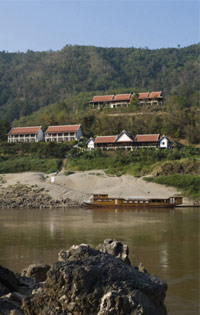
Pakbeng climbs steeply from its Mekong landing, so pier transfers can matter more than a hotel’s straight-line distance.
Budget guesthouses remain available for public-boat travelers, while riverside lodges cater to travelers who want more comfort, river views or a longer Pakbeng stay.

Comfortable Mekong lodges make Pakbeng more than a basic overnight stop for travelers who want to slow down for a second night.
Pak Beng Hydropower Construction and the Mekong Route
The Pak Beng Hydropower Project is the most important current change affecting the wider Pakbeng river landscape in 2026-2027. The 912 MW project is being built on the Mekong in Oudomxay Province upstream from Pakbeng, with commercial operation currently scheduled for January 2033.
China Datang confirmed active work in March 2026 around the dam foundation, right abutment, downstream approach channel and construction camp. Reporting based on information from the Mekong River Commission states that preparatory works are underway and the next major construction phase is expected to intensify after the 2026 wet season, beginning with first-stage cofferdam work.
This location matters to travelers because the Houay Xai-Pakbeng slow-boat route approaches town from upstream. The route remains in use, but construction equipment, altered scenery or temporary navigation arrangements may become more noticeable as work progresses.
The project’s own social-impact assessment identifies potential construction-period effects such as:
- visual and noise disturbance;
- construction traffic and dust;
- changes to river scenery;
- possible effects on cruise and boat navigation;
- the need to coordinate construction and vessel movements.
The design includes navigation infrastructure intended to allow vessels to pass the completed dam. That does not mean the post-2033 tourism route should be assumed to operate exactly as it does today.
For a 2026-2027 trip, the useful advice is simple: check current slow-boat operations shortly before departure rather than cancelling Pakbeng solely because the hydropower project exists.
Pakbeng Travel Tips
- Arrive early for the public boat: seating is generally not assigned, and places farther from the engine are usually quieter.
- Buy food before boarding: the public boat may sell snacks and instant noodles, but there is normally no proper lunch stop during the travel day.
- Carry water: a full Mekong day is long, especially in March and April heat.
- Keep passport, money and medicine with you: do not pack essential items where they are difficult to reach during the journey.
- Choose accommodation with luggage logistics in mind: Pakbeng rises sharply uphill from the river.
- Check PM2.5 in March and April: northern Laos experienced serious haze in 2026.
- Check roads after prolonged rain: Oudomxay experienced damaging flash floods in August 2026.
- Book Xay train seats early: current demand on the Laos-China Railway can exceed available passenger capacity.
- Reserve Mekong Elephant Park in advance: activities are small-group and reservation-based.
- Avoid elephant-riding attractions: the Pakbeng sanctuary itself has a non-riding and no tourist-bathing policy.
- Dress respectfully at temples: cover shoulders and knees and remove shoes where required.
- Carry Lao kip: small restaurants, market stalls, local transport and rural activities may rely on cash.
- Check the current dam-construction situation: hydropower work upstream is expected to become more visible through late 2026 and 2027.
Country-wide information on visas, currency, connectivity and etiquette is maintained in the practical guide to traveling to Laos.
Pakbeng Travel FAQ
Is Pakbeng worth visiting?
Pakbeng is worth a one-night stop for almost anyone using the Mekong slow boat. It becomes a destination in its own right if you add a second night for Mekong Elephant Park, countryside trekking or a slower look at local life. Travelers who prefer this planned as part of a wider itinerary can also browse organized Laos tours that include the Mekong route.
How many nights should I stay in Pakbeng?
One night is enough for the standard Houay Xai-Luang Prabang slow-boat journey. Two nights is better if you want to visit Mekong Elephant Park or take a guided walk into the surrounding countryside.
What time does the slow boat leave Pakbeng?
Current local information generally places public departures in the morning, around 08:30, but schedules can vary by season, direction and operator. Confirm the time at the pier or with your accommodation the day before departure.
How long is the slow boat from Pakbeng to Luang Prabang?
Allow most of the day. Boats normally leave in the morning and arrive in Luang Prabang during the late afternoon, with timing affected by river level, stops and the vessel used.
Can I travel from Pakbeng to Luang Prabang by road?
Yes. Current local transport listings advertise minivan services taking roughly five to six hours. The boat remains the more scenic route, while road transport is useful if your itinerary does not require the second Mekong day.
Can I connect Pakbeng with the Laos-China Railway?
Yes. Travel by road to Oudomxay and continue from Xay Station. Pakbeng itself does not have a railway station. Train seats should be secured early because Xay Station has experienced high demand in 2026.
Is Pakbeng in the Golden Triangle?
Pakbeng is in Oudomxay Province, southeast of the core Golden Triangle area around Bokeo, Houay Xai and the Thailand-Myanmar-Laos border region. It should not be described simply as a Golden Triangle town.
What is the best time to visit Pakbeng?
November to February offers the best balance of comfortable temperatures, low rainfall and easier road conditions. March and April can be smoky, while the green season has lush scenery but a greater risk of heavy rain and road disruption.
Is Mekong Elephant Park ethical?
The park currently describes itself as a non-riding elephant preservation sanctuary. Tourists are not allowed to ride elephants or enter the water to bathe with them. Visits focus on observing the animals, guided forest encounters and conservation education.
Will the Pak Beng dam stop the slow boats?
There is currently no basis for saying the Houay Xai-Pakbeng slow-boat route has stopped. Hydropower construction is active upstream, however, and may increasingly affect scenery and navigation arrangements. Travelers should check current boat operations before departure.