

Pak Ou Travel Guide
Pak Ou Caves Overview

Pak Ou Caves are a pair of sacred limestone caves about 25-30 kilometers upstream from Luang Prabang, overlooking the Mekong River close to its confluence with the Nam Ou. The site contains more than 4,000 Buddha images accumulated through centuries of Buddhist worship and pilgrimage, making it one of northern Laos’s best-known religious excursions.
Travelers usually know the attraction as Pak Ou Caves because it faces Ban Pak Ou village. Locally, the complex is commonly called Tham Ting. The popular English description “Cave of a Thousand Buddhas” is a descriptive nickname rather than a secure literal translation of Tham Ting.
The complex contains two distinct chambers. Tham Ting, the Lower Cave, opens directly toward the river and contains the densest concentration of Buddha images. Tham Theung, the Upper Cave, lies higher in the limestone cliff and is reached by a long forest staircase. Some older English and archaeological sources use the name Tham Phum for the upper chamber, which explains why different spellings still appear in older travel guides.
Pak Ou works best as a half-day or extended river excursion from Luang Prabang rather than as a destination where travelers need to stay overnight. A normal Mekong trip, including the cruise, village stop and caves, generally takes around four to six hours. Visitors who travel mostly by road can shorten the journey, but the final approach still requires a boat crossing from Ban Pak Ou.
Pak Ou Caves are closely associated with the cultural landscape of UNESCO-listed Luang Prabang, but the caves are not themselves a separately inscribed UNESCO World Heritage Site. Travelers exploring the wider country can place Pak Ou within a broader Laos travel itinerary focused on the Mekong and northern Buddhist heritage.

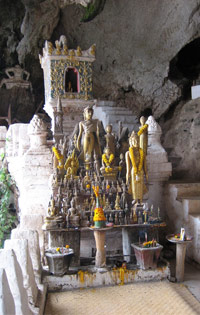
The Lower Cave is the most accessible and visually dense part of Pak Ou, with Buddha images arranged across natural rock and shrine platforms.
Pak Ou History, Buddhism and Royal Pilgrimage
Pak Ou’s sacred history is older and more complex than its famous collection of Buddha images. Religious traditions associated with the caves appear to preserve an earlier layer of spirit belief before the site developed into an important Buddhist shrine.
Local traditions connect the caves with phi, or nature spirits, particularly powers associated with the river landscape. As Theravada Buddhism became increasingly established around Luang Prabang and the Lan Xang royal sphere, the caves were incorporated into Buddhist religious practice. Devotees brought Buddha images to Pak Ou as acts of merit, gradually creating the collection visible today. Travelers interested in Buddhist architecture elsewhere in the country can also explore some of Laos’s most famous and beautiful temples.
The more than 4,000 figures should not be understood as a single collection made at one point in antiquity. More than 3,000 of the surviving Buddha images are broadly dated between the 18th and 20th centuries. Most are made from wood or lacquered materials, with smaller numbers in materials such as copper and stone. Red or black lacquer and gold leaf remain visible on some examples.
The figures also represent different Buddhist attitudes and postures rather than thousands of identical statues. Visitors can see seated meditation images alongside teaching, standing, walking and reclining forms. Their different sizes, finishes and states of preservation reflect generations of devotional offering rather than museum-style collecting.
Pak Ou and Pi Mai Lao
Pak Ou was part of Luang Prabang’s royal religious calendar. During Lao New Year, the royal family, monks and local devotees traditionally traveled to the caves to pour scented water over sacred Buddha images. The ritual expressed purification, merit-making and renewal.
The tradition did not disappear completely with the monarchy. Current Luang Prabang tourism information describes ceremonial visits continuing during April, involving monks and representatives participating in Buddha-washing rites. Travelers visiting during Pi Mai Lao therefore encounter Pak Ou as a living religious landscape rather than an abandoned historic shrine.
Local tradition also associates a small sacred structure near the Upper Cave with Pu Yer and Ya Yer, protective ancestral figures connected with Luang Prabang. These traditions show how Buddhist practice at Pak Ou became layered over older local beliefs rather than simply replacing them.
Rock Art at Pak Ou
Archaeological research has documented another cultural layer that most casual visitors overlook. Researchers have recorded more than 50 rock-art elements in the Upper Cave and on the cliff face around the cave complex.
The paintings include faded red human figures, handprints and animals, together with later imagery associated with Buddhist and historical periods. One unusual green painting has been interpreted as a steamship, possibly reflecting modern river transport on the Mekong. The rock art demonstrates repeated human engagement with this river-cliff landscape beyond the Buddha collection for which Pak Ou is now famous.
Tham Ting and Tham Theung: What to See in Each Cave
Tham Ting Lower Cave should be the priority for first-time visitors, while Tham Theung Upper Cave adds a darker and more physically demanding pilgrimage experience. The two chambers are close together but feel very different.
| Attribute | Tham Ting, Lower Cave | Tham Theung, Upper Cave |
|---|---|---|
| Setting | Open limestone recess facing the Mekong | Deeper chamber higher in the cliff |
| Light | Mostly natural daylight | Very dark interior |
| Access | Reached from the river landing by stairs | About 278 additional steps |
| Buddha collection | About 2,500 figures | Smaller remaining part of the 4,000+ collection |
| Best for | First-time visitors, photography, limited time | History, pilgrimage context and travelers comfortable with stairs |
| Mobility | Easier, but not step-free | Not suitable for many travelers with limited mobility |
What to See in Tham Ting Lower Cave
Tham Ting is the visually strongest part of Pak Ou. The shallow cave opening frames the Mekong while hundreds of Buddha figures rise across natural shelves, stone platforms and shrine structures.
Approximately 2,500 images are kept in the Lower Cave. Near the entrance, visitors can identify a principal altar where devotees leave flowers, candles and incense. A hermit figure associated with forest medicine stands above the lower platform, while a large stupa-like structure occupies one of the highest shrine levels.
The cave’s open orientation is part of its appeal. Daylight illuminates the statues while the river and opposite bank remain visible behind visitors. Morning light is generally easier for seeing details without the stronger afternoon heat.
What to See in Tham Theung Upper Cave
Tham Theung is reached after climbing about 278 steps above the Lower Cave. Tourism Laos describes the chamber as extending roughly 50 meters into the cliff and reaching about 17 meters across.
Unlike Tham Ting, very little daylight reaches the interior. Current official tourism information says flashlights may be borrowed at the entrance, although carrying a charged phone light or small torch remains sensible. The ornate entrance and the contrast between the bright forest outside and dark shrine chamber are as important to the experience as the smaller number of images inside.
If time, heat tolerance or mobility is limited, visiting only the Lower Cave is a reasonable choice. Travelers can experience Pak Ou’s main Buddha collection and river setting without completing the additional Upper Cave climb.

The darker cave chambers preserve Buddha images in a very different setting from the open, river-facing Lower Cave.
Pak Ou Opening Hours, Tickets and Accessibility
Pak Ou Caves currently open daily from 08:00 to 17:00, and the published foreign visitor entrance fee is 30,000 kip per person. Tickets are purchased at the site.
| Practical Detail | Current Information |
|---|---|
| Opening hours | Daily, 08:00-17:00 |
| Foreign visitor admission | 30,000 kip |
| Lao visitor admission | 15,000 kip |
| Recommended cave time | About 60-90 minutes for both caves |
| Upper Cave stairs | About 278 steps |
| Upper Cave lighting | Dark; flashlight recommended and may be available to borrow |
| Wheelchair access | Not step-free |
The physical challenge begins before the Upper Cave. Boat boarding, river landings and stairs make Pak Ou unsuitable as a fully accessible attraction. Travelers with reduced mobility should assess the river landing and Lower Cave steps before attempting the visit.
Families with children can usually manage the Lower Cave with close supervision, but the steep stairways and river edge require attention. Older travelers do not need to climb to Tham Theung to have a meaningful Pak Ou experience.
Opening hours and admission fees can change, so operational information should be reconfirmed for trips planned well after 2026.
Best Time to Visit Pak Ou: Weather, Haze and River Conditions
November to February is the best overall period for visiting Pak Ou Caves. These months combine lower rainfall, more comfortable temperatures and generally easier conditions for a long Mekong boat ride.
| Period | Travel Conditions | Pak Ou Trade-off |
|---|---|---|
| Nov-Feb | Cooler and mostly dry | Best overall conditions, but also the main tourism season |
| Mar-Apr | Hot and dry | Important Pi Mai culture, but heat and PM2.5 can be serious |
| May-Jun | Increasing rain and greener scenery | Beautiful river landscape with more variable weather |
| Jul-Sep | Wettest months | Lush scenery, but stairs become slippery and boat conditions vary |
| Oct | Transition toward dry season | Good compromise after the heaviest rains |
Luang Prabang’s climate normals illustrate the contrast clearly. Normal rainfall is only about 11 mm in February, rises to about 156 mm in May and reaches roughly 279 mm in July and 324 mm in August. Travelers interested in predictable river excursions will normally find the dry season in Laos easier to plan.
The rainy season in Laos should not automatically be avoided. Green hills and higher river levels can make the Mekong landscape especially dramatic. Carry waterproof protection and wear shoes with reliable grip because the cave stairs can become slippery.
March and April Haze
Air quality is an important late dry-season issue that older Pak Ou guides often overlook. On April 20, 2026, the Lao Department of Environment reported PM2.5 of 173 micrograms per cubic meter in Luang Prabang, well above the national safety standard cited by authorities.
Travelers with respiratory conditions, children and older adults should check current air-quality readings before committing to a several-hour outdoor boat journey in March or April. Pi Mai can make April culturally rewarding, but the combination of strong heat and smoke creates a genuine trade-off.
How to Get to Pak Ou Caves from Luang Prabang
Most first-time visitors should take a slow boat from Luang Prabang because the Mekong journey is part of the Pak Ou experience. Travelers short on time can drive to Ban Pak Ou, but they must still cross the river by boat to reach the caves.
| Route | Typical Journey | Best For | Main Trade-off |
|---|---|---|---|
| Slow boat from Luang Prabang | About 1.5-2 hrs upstream, faster downstream | First-time visitors, photography, slow travel | Longest option |
| Road to Ban Pak Ou + local boat | About 40-60 min by road plus short crossing | Families, limited time, flexible schedule | Misses most of the Mekong cruise |
| Private boat | Flexible | Couples, families, photographers, custom village stops | Higher cost |
Slow Boat from Luang Prabang
Official Luang Prabang Tourism currently describes daily morning slow-boat services from piers along the historic peninsula. Its Japanese-language visitor information lists a normal departure around 08:30, with registration roughly 30 minutes beforehand, but piers and departure arrangements can change.
The upstream journey takes about 1.5 to two hours depending on the boat, pier, river level and current. Returning downstream generally takes closer to one hour. Most excursions include a stop at Ban Xang Hai before reaching Pak Ou.
A standard slow-boat outing normally occupies four to six hours. Confirm the current pier, departure time and fare locally or through accommodation before travel because published boat details are less consistent than the official cave ticket information. Travelers who prefer this river journey pre-arranged rather than organized independently can also look at scheduled Mekong cruises that include a stop at Pak Ou.
Road to Ban Pak Ou
The faster alternative is to travel overland to Ban Pak Ou by tuk-tuk, motorbike or private vehicle. The drive takes roughly 40-60 minutes under normal conditions. A car with driver in Laos can be practical for families or travelers who also want flexibility for village stops.
The road does not reach the cave entrance. Ban Pak Ou sits across the Mekong from the cave cliff, so travelers transfer to a small local boat for the final crossing.
Mekong Boat Trip, Ban Xang Hai and Ban Pak Ou
The journey to Pak Ou is more rewarding when the Mekong corridor is treated as part of the attraction rather than as transportation to the cave. Rivers historically connected villages, markets, religious centers and royal settlements throughout northern Laos, and the same geography still shapes the trip today.
Ban Xang Hai
Ban Xang Hai is the most common cultural stop on the boat route. It is often marketed simply as “Whiskey Village,” but the settlement has a deeper craft history.
The village was historically associated with pottery and the production of clay jars. Traditional ceramic production has declined, while modern village activity is more visibly associated with lao-Lao rice liquor, weaving and handicrafts.
Visitors can observe sticky rice being fermented and distilled into clear rice spirit, along with sweeter versions made from darker sticky rice. Tastings are frequently offered. Buying alcohol is optional, and bottled snakes or other animals sold as medicinal products are better left unpurchased.
Ban Xang Hai lies roughly five kilometers before Ban Pak Ou, so it fits naturally into the river journey rather than functioning as a separate day trip.
Ban Pak Ou and Wat Pak Ou
Ban Pak Ou is the transport and village hub opposite the caves. Travelers arriving by road board the river crossing here, while several riverside restaurants provide an easy place for lunch before or after visiting the caves.
Wat Pak Ou adds another link to the area’s royal and religious history. Local tourism material dates the temple to the reign of King Setthathirath in 1547. It was later renovated during the reign of King Sisavangvong, when its terrace was expanded partly to accommodate Lao New Year Buddha-washing ceremonies.
This relationship helps explain why Pak Ou pilgrimage extends beyond the two caves. Village temple, river crossing and cave shrine once belonged to the same religious landscape.
What Else to See Around Pak Ou
Ban Xang Hai and the Nam Ou confluence are the most logical additions to a standard Pak Ou trip. Several smaller places become worthwhile mainly for travelers chartering a private boat.
Nam Ou Confluence
The Nam Ou enters the Mekong directly opposite the cave complex. A short cruise into the Nam Ou reveals steep limestone cliffs and orange-gray rock faces rising from the river. The confluence is not simply a geographic footnote, it explains the dramatic setting and Pak Ou’s long importance as a river landmark.
Donkhoun Island
Donkhoun Island has a small but interesting connection to Lao royal history. King Soukhaseum, who ruled from 1838 to 1851, used the island as a rest stop after making merit at Tham Ting. The royal household cultivated fruit and vegetables there, and a small temple remains on the island today.
Donkhoun is more appropriate for a flexible private-boat itinerary than a standard shared excursion.
Pha Ane Cliff
Pha Ane, sometimes called Swallow Cliff, rises opposite Ban Pak Ou. Local tourism material associates the limestone wall with swallow populations and rock-art traces. Its steep surface makes viewing from the river more realistic than attempting an independent climb.
Ban Muang Kham and Ban Muang Keo
Travelers arranging a slower private Mekong trip may encounter smaller villages such as Ban Muang Kham, associated with production of khai phaen, Luang Prabang’s dried river weed, and Ban Muang Keo, where weaving, farming and rice-liquor traditions have been documented. These are optional community stops rather than essential additions to a first Pak Ou visit.
Should You Combine Pak Ou with Kuang Si Waterfalls?
Pak Ou and Kuang Si can be combined in one long sightseeing day, but separating them produces a better experience if your Luang Prabang itinerary has enough time.
Pak Ou lies upstream to the north of the city, while Kuang Si Waterfalls lie roughly 30 kilometers south of Luang Prabang. Combining both usually means taking the boat to Pak Ou and then transferring by road across the city toward Kuang Si.
A combined day suits travelers with only two or three days in Luang Prabang. Those with four days or more gain more from giving Pak Ou a relaxed morning river journey and visiting Kuang Si separately, particularly if they want to explore both caves rather than rushing through the Lower Cave.
Pak Ou can also form part of a longer Mekong journey. Travelers arriving from northern Thailand commonly overnight at Pakbeng before continuing downstream toward Luang Prabang, and some multi-day cruises include Pak Ou shortly before reaching the city.
Luang Prabang Hydropower Construction and the Pak Ou River Route
A major hydropower project is currently changing the wider Mekong landscape near Pak Ou, although Pak Ou Caves remain open.
The Luang Prabang Hydropower Project is being constructed roughly 25 kilometers from Luang Prabang town and about four kilometers downstream from the Nam Ou-Mekong confluence. Reporting in July 2026 placed construction at more than 72% complete, with commercial operation targeted around 2030.
Because the construction site lies within the same river corridor used for Pak Ou excursions, industrial activity may be visible during parts of the journey. This does not mean the caves themselves are closed or that every boat trip is disrupted.
The UNESCO World Heritage Committee continued to address the hydropower project in its 2026 decision on the Town of Luang Prabang. UNESCO requested monitoring of potential effects on the World Heritage property’s Outstanding Universal Value and reporting on mitigation measures identified through heritage-impact assessment.
Travelers do not need to change a Pak Ou visit solely because of the project, but photographs and descriptions from older guidebooks may no longer represent every section of the river landscape exactly as it appears in 2026-2027.
Practical Pak Ou Travel Tips
- Prioritize the Lower Cave if time is short: it contains the largest Buddha collection and requires less climbing.
- Carry a light: the Upper Cave is dark. Flashlights may be available at the entrance, but a phone light or small torch provides a useful backup.
- Wear shoes with grip: stairs can be steep and become slippery during wet weather.
- Carry water: the Upper Cave climb becomes tiring in hot March and April conditions.
- Check PM2.5 in late dry season: smoke can significantly reduce air quality around Luang Prabang.
- Use sun protection on the boat: shade varies by vessel, and several hours on the Mekong can mean prolonged sun exposure.
- Dress for a sacred site: cover shoulders and knees and remove hats or footwear when local signs or attendants request it.
- Do not touch or move Buddha images: Pak Ou remains an active religious site, not an archaeological playground.
- Keep voices low: monks and Lao pilgrims may be worshipping during your visit.
- Confirm shared-boat logistics: morning departure points, fares and exact schedules can change.
- Road travelers still need a boat: vehicles stop at Ban Pak Ou before the short Mekong crossing.
- Allow four to six hours for the classic river trip: this leaves enough time for Ban Xang Hai and both caves without treating the excursion as a race.
Pak Ou Caves FAQ
How far are Pak Ou Caves from Luang Prabang?
Pak Ou Caves are roughly 25-30 kilometers upstream from Luang Prabang. A slow boat normally takes about 1.5-2 hours going upstream, while the mostly overland route takes roughly 40-60 minutes to Ban Pak Ou plus a short boat crossing.
How much is the Pak Ou Caves entrance fee?
Current official Luang Prabang Tourism information lists the foreign visitor entrance fee at 30,000 kip and the Lao visitor fee at 15,000 kip. The caves currently open daily from 08:00 to 17:00.
How many Buddha statues are in Pak Ou Caves?
The complex contains more than 4,000 Buddha images, including approximately 2,500 in the Lower Cave. More than 3,000 surviving figures are broadly dated to the 18th-20th centuries.
Which Pak Ou cave is better?
Tham Ting Lower Cave is the better choice for most first-time visitors because it contains the densest collection of Buddha images, receives daylight and requires less climbing. Tham Theung Upper Cave adds historical and pilgrimage context but involves about 278 additional steps and a dark interior.
Do I need a flashlight at Pak Ou Caves?
A flashlight is not essential for the daylight-filled Lower Cave but is strongly recommended for the Upper Cave. Current official tourism information says lights may also be borrowed at the Upper Cave entrance.
Is Pak Ou suitable for older travelers?
It can be, provided the traveler can manage boat boarding and some stairs. The Lower Cave is considerably easier than the Upper Cave. Travelers with limited mobility can skip the 278-step climb and still experience Pak Ou’s main shrine and Buddha collection.
Is it better to visit Pak Ou by boat or road?
The slow boat is better for first-time visitors because the Mekong scenery and village life form part of the experience. Road travel is faster, but visitors still need to cross the Mekong from Ban Pak Ou by small boat. Travelers who would rather have this planned for them can also browse organized Laos tours that include Pak Ou as part of a wider itinerary.
What is the best month to visit Pak Ou Caves?
December and January offer some of the most comfortable overall conditions, with low rainfall and cooler temperatures. November through February is the broader recommended period. March and April are hotter and can experience serious haze, while the wet season offers greener scenery but more slippery steps.
Are Pak Ou Caves part of the Luang Prabang UNESCO World Heritage Site?
Pak Ou Caves are a major cultural excursion from Luang Prabang, but the caves are not a separately inscribed UNESCO World Heritage property. UNESCO’s listed property is the Town of Luang Prabang.