

Phitsanulok Travel Guide
Phitsanulok Overview

Phitsanulok is a historic river province in lower northern Thailand where royal heritage, Buddhist pilgrimage, mountain national parks and modern transport routes meet. Phitsanulok Province covers about 10,589 square kilometers, while the Nan River forms the main geographic spine of Phitsanulok City.
Thailand’s 2025 Statistical Yearbook records 839,116 registered residents in Phitsanulok Province in 2024, with a population density of about 77.6 people per square kilometer. Forest covered approximately 3,959 square kilometers, or 37.38% of the province, which helps explain the contrast between the compact provincial capital and the mountain districts farther east and north.
The region’s history reaches much further back than the medieval city. Archaeological evidence places prehistoric occupation in the wider Phitsanulok area as far back as 15,000 to 12,000 years ago. Pha Tha Phon Cave in Noen Maprang has produced Hoabinhian stone tools dated to roughly 12,000-5,600 years ago and rock paintings around 3,000-2,000 years old.
Phitsanulok was historically known as Muang Song Khwae, a name associated with its two-river geography. During the Ayutthaya period, King Borommatrailokkanat established Phitsanulok as a royal center in 1463 and ruled from the city for about 25 years. The city is also closely associated with King Naresuan the Great, whose memory remains central to Chan Palace and the province’s cultural identity.
A full day is enough for Phitsanulok City’s temples, palace and museums, but two to three days reveal the destination much better. Travelers adding Khek River rafting, Phu Hin Rong Kla or Noen Maprang should avoid treating every attraction as a quick excursion from the city center.
Phitsanulok Weather and Best Time for Temples, Rafting and Mountain Trips
November to February offers the easiest overall weather for Phitsanulok, while the rainy months create the best conditions for Khek River rafting and greener mountain scenery. The ideal month therefore depends on whether the trip focuses on city heritage, white-water adventure or highland landscapes.
| Period | Climate pattern | Best for | What travelers should know |
|---|---|---|---|
| November-February | Mean temperature about 25-27°C; low rainfall | Temples, city walking, road trips | Most comfortable overall period |
| March-April | Hot and mostly dry; April mean temperature about 31.1°C | Early-morning heritage visits | Heat, haze and PM2.5 can affect outdoor plans |
| May-June | Rainfall rises to about 165 mm per month | Green countryside and waterfalls | Khek River conditions begin changing with rainfall |
| July-September | Wettest part of the year; September normal rainfall about 264 mm | Khek rafting, forests and waterfalls | Heavy rain can change river and road conditions quickly |
| October | Rain begins declining | Late rafting season and greener landscapes | Conditions vary considerably from year to year |
The dry season in Thailand suits travelers prioritizing Wat Yai, Chan Palace and long overland journeys. January and December normally receive only about 7 mm of rain in Phitsanulok, compared with more than 200 mm in August and September.
March and April deserve more caution than a simple “dry season” label suggests. On March 27, 2026, Phitsanulok City recorded a PM2.5 reading of 86.2 µg/m³, and provincial authorities intensified wildfire and haze controls during the late dry season. Travelers with respiratory sensitivities should check daily air quality before mountain trips.
The rainy season in Thailand is particularly relevant in Phitsanulok because rainfall creates the Khek River rafting season. Heavy rain can also raise flood and flash-flood risk, so rural road conditions and national-park notices should be checked before departure.
How to Get to Phitsanulok by Flight, Train and Bus
Phitsanulok is one of northern Thailand’s easiest secondary cities to reach because it has an airport, a station on the Northern Railway Line and multiple intercity bus connections. Travelers coming from Bangkok can choose speed, scenery or budget without relying on one transport mode.
| From Bangkok | Current option | Typical travel time | Best for |
|---|---|---|---|
| Flight | Don Mueang (DMK) to Phitsanulok (PHS) | About 1 hour | Shortest travel time |
| Special Express train | Krung Thep Aphiwat to Phitsanulok | About 4.5-5 hours on faster services | Comfortable overland travel |
| Rapid / ordinary train | Multiple Northern Line services | Roughly 6-8 hours depending on train | Budget and slow travel |
| Bus | Various Bangkok terminals | Usually about 5-6 hours | Frequent departures and competitive fares |
Current September 2026 flight schedules show Thai AirAsia and Thai Lion Air operating nonstop services between Don Mueang and Phitsanulok. Flight time is about one hour. Travelers connecting from an international flight at Suvarnabhumi should allow additional time to transfer between Bangkok’s two airports.
Rail travel from Bangkok requires closer attention because not every Phitsanulok train uses the same station. Most long-distance Northern Line express and rapid trains now depart from Krung Thep Aphiwat Central Terminal.
State Railway of Thailand’s current timetable lists Special Express 7 leaving Krung Thep Aphiwat at 07:30 and reaching Phitsanulok at 11:58. Ordinary train 201 follows a different pattern, leaving Bangkok Hua Lamphong at 10:15 and terminating in Phitsanulok at 17:55.
Always check the Bangkok departure station printed on the ticket. Searching only for “Bangkok to Phitsanulok train” can produce services from two different terminals.
Getting Around Phitsanulok Province
Phitsanulok City is compact enough for short taxi, tuk-tuk and songthaew trips, but the province’s major nature areas require much more transport planning. Khek River, Noen Maprang and Phu Hin Rong Kla lie in different directions and should not be planned as if they were adjacent city attractions.
| Area | Main attractions | Most practical transport |
|---|---|---|
| Phitsanulok City | Wat Yai, Chan Palace, museums, Nan River | Walking, taxi, tuk-tuk, songthaew |
| Wang Thong corridor | Khek River, Kaeng Sopha | Private vehicle or arranged activity transfer |
| Nakhon Thai / Phu Hin Rong Kla | Highland trails, historical sites, Phu Lom Lo | Private vehicle plus seasonal local shuttle |
| Noen Maprang | Ban Mung, limestone scenery, caves and orchards | Private vehicle |
| Chat Trakan | Waterfall and forest landscapes | Private vehicle |
A car with driver in Thailand is particularly useful in Phitsanulok when the itinerary extends beyond the provincial capital. Noen Maprang is roughly 100 kilometers from the city, while the Phu Hin Rong Kla highlands require a separate long road journey.
Phitsanulok also has Bus Terminal 1 and Bus Terminal 2. Current services to Sukhothai use both terminals, and some routes call at more than one station. Travelers should therefore follow the terminal printed on the booking rather than asking simply for “Phitsanulok Bus Station.”
Phra Buddha Chinnarat, Wat Yai and Phitsanulok’s Sacred Heritage
Wat Phra Si Rattana Mahathat Woramahawihan is Phitsanulok’s most important religious site and the home of Phra Buddha Chinnarat, one of Thailand’s most revered Buddha images. The temple is commonly called Wat Yai and remains an active royal monastery rather than only a historic monument.
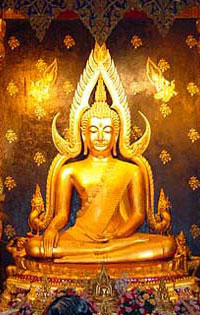
Phra Buddha Chinnarat dates traditionally to the Sukhothai-period foundation of Wat Yai and has been an object of royal and popular devotion for centuries. Thailand’s kings have maintained a long tradition of paying respects to the image when visiting Phitsanulok.
| Wat Yai visitor information | Current reference |
|---|---|
| Official name | Wat Phra Si Rattana Mahathat Woramahawihan |
| Common name | Wat Yai |
| Opening hours | 06:00-20:00 daily |
| Admission | No compulsory entrance fee; donations accepted |
| Recommended visit | 45-90 minutes, longer with the museum |
Visitors should dress conservatively and avoid blocking worshippers while photographing the interior. Phra Buddha Chinnarat remains a living religious focus, so early morning provides a quieter atmosphere than peak daytime tour periods.
Phra Buddha Chinnarat National Museum occupies buildings within the Wat Yai complex and interprets the history of the Buddha image, royal offerings and archaeological discoveries from Phitsanulok. The Fine Arts Department completed an upgraded permanent exhibition in 2024.
The museum’s current official page lists opening hours of 09:00-16:00 daily. This differs from an earlier 2024 museum brochure that listed Monday and Tuesday closures, so travelers visiting specifically for the museum should recheck the official notice shortly before arrival.
Wat Ratchaburana stands close to Wat Yai beside the Nan River and can be added without a separate transfer. The historic temple provides a quieter contrast to Wat Yai and preserves another layer of the city’s Buddhist architecture.
Wat Chulamani lies south of the central city and contains an ancient Khmer-style prang, a replica Buddha footprint and inscriptions associated with Phitsanulok’s royal period. King Borommatrailokkanat is historically connected with the temple and entered the monkhood there during his reign.
Travelers interested in the wider architectural context of sites such as Wat Yai and Wat Chulamani can connect Phitsanulok with other famous temples in Thailand, although Phitsanulok’s particular importance comes from its combination of royal history and continuing devotion to Phra Buddha Chinnarat.
Chan Palace, King Naresuan and Phitsanulok’s Royal History
Chan Royal Palace is the main place to understand why Phitsanulok mattered politically during the Ayutthaya period. The archaeological complex links King Borommatrailokkanat’s northern royal court with the local memory of King Naresuan the Great.
King Borommatrailokkanat moved his royal residence to Phitsanulok in 1463. Provincial historical records state that Phitsanulok held royal-capital status during approximately 25 years of his residence, strengthening Ayutthaya’s control over the former Sukhothai territories.
King Borommatrailokkanat’s reign also reinforced the relationship between royalty and Buddhism in Phitsanulok. Wat Chulamani, Wat Yai and the Chan Palace area all preserve parts of the city’s fifteenth-century royal landscape.
King Naresuan the Great is even more visible in modern local identity. Phitsanulok is traditionally associated with King Naresuan’s birth and early life, while the King Naresuan Shrine stands within the Chan Palace area.
The relationship is not merely historical branding. In February 2026, Chan Palace hosted the annual Land of King Naresuan the Great celebrations and historical performances, showing that the palace remains an active ceremonial and cultural space.
Chan Palace and Wat Yai can be visited on the same day without turning the experience into a rapid monument checklist. Wat Yai explains Phitsanulok’s sacred authority, while Chan Palace explains the city’s political importance within the Ayutthaya kingdom.
Museums, Buddha Casting and Nan River Life
Phitsanulok’s local culture is easiest to understand through the folk museum, traditional Buddha casting and evening life along the Nan River. These experiences balance the city’s royal monuments with material culture from ordinary households, farms and workshops.
Sgt. Maj. Thawee Folk Museum preserves household objects, agricultural tools, textiles and other artifacts connected with communities of lower northern Thailand. The collection is particularly useful for travelers who want cultural context beyond palaces and royal temples.
Buranathai Buddha Casting Factory stands about 300 meters from the folk museum. The workshop was established by Sergeant Thawee Buranakett in 1968 and demonstrates traditional techniques used to cast large bronze Buddha images.
| City experience | Main value | Suggested time |
|---|---|---|
| Sgt. Maj. Thawee Folk Museum | Household culture, farming and local material history | 45-60 minutes |
| Buranathai Buddha Casting Factory | Traditional Buddhist bronze casting | 30-45 minutes |
| Nan River waterfront | Walking, local dining and evening atmosphere | 1-2 hours |
The Nan River gives central Phitsanulok a natural north-south orientation. Wat Yai and Wat Ratchaburana sit close to the river, while restaurants and casual evening activity spread through the central riverfront area.
Phitsanulok does not need a dedicated nightlife section. Evening travel is more about local restaurants, markets, riverside walking and community events than a large bar or nightclub district.
The city also retains a Thai-Chinese cultural layer. Phitsanulok’s 2026 Yuan Xiao Festival used Chinese shrines and central city spaces for lion dances, Chinese opera, lantern activities and food, showing that local urban culture extends beyond its Buddhist and royal identity.
Khek River, Kaeng Sopha and Rainy-Season Adventure
Khek River rafting is Phitsanulok’s strongest seasonal adventure experience, with an approximately 8-kilometer route through 17 rapids in Wang Thong District. The activity depends directly on rainfall and river level, so it should be planned more carefully than an ordinary sightseeing stop.
| Khek River attribute | Planning value |
|---|---|
| Location | Wang Thong District, east of Phitsanulok City |
| Standard route | About 8 km |
| Rapids | 17 major rapids |
| Difficulty | Grades 1-5 depending on rapid and water conditions |
| Typical duration | About 2-3 hours |
| Main season | Usually rainy season, commonly July-October, with broader operation depending on rainfall |
Khek River water can change rapidly after heavy rain. A route manageable one week may be much more powerful the next, so reputable operators may delay, shorten or cancel departures when conditions are unsafe.
Travelers should reconfirm rafting conditions shortly before the activity and use operators providing helmets, buoyancy aids and trained river guides. The presence of Grade 5 sections means Khek River should not be treated as an unguided recreational paddle.
Kaeng Sopha Waterfall lies along the wider Wang Thong and Highway 12 travel corridor. Water volume is strongest during the wet season, making the waterfall a natural companion to rafting rather than a completely separate destination.
The corridor is also a useful food stop because Wang Thong is associated locally with Wang Thong Pad Thai, a dish Tourism Authority of Thailand highlights among Phitsanulok’s characteristic foods.
Phu Hin Rong Kla and Phitsanulok’s Highland Landscapes
Phu Hin Rong Kla National Park combines mountain scenery with twentieth-century political history, giving it a different identity from a conventional wildlife park. The protected highlands extend across parts of Phitsanulok, Loei and Phetchabun rather than belonging entirely to one province.
The park’s best-known landscapes include Lan Hin Taek and Lan Hin Pum, rock formations shaped into fractured surfaces and unusual stone fields. Trails also pass former sites associated with the Communist Party of Thailand, which used the highlands as a stronghold during the political conflicts of the 1960s and 1970s.
Phu Hin Rong Kla’s elevation creates cooler conditions than lowland Phitsanulok City. Mist, seasonal flowers and forest walks are major reasons to stay in the Nakhon Thai or mountain area rather than driving from the provincial capital for every visit.
Travelers interested in longer mountain routes can place Phu Hin Rong Kla within the broader tradition of trekking in Thailand, but conditions here vary sharply by season and individual trail.
Phu Lom Lo is the highlands’ most famous seasonal attraction. Wild Himalayan cherry trees normally flower around January and can continue into February, but exact timing changes with temperature and rainfall.
| Phu Lom Lo planning point | Current arrangement |
|---|---|
| Private cars | Not permitted in the main viewing area during the blossom season |
| Phitsanulok-side shuttle | Community vehicles from Phu Hin Rong Kla headquarters or Ban Rong Kla |
| 2026 reference fare | 1,000 THB per vehicle, up to 10 passengers, on the Phitsanulok side |
| Typical shuttle hours | Approximately 05:00-16:00 during the monitored blossom season |
| Facilities at the top | Very limited; no normal accommodation or food service in the viewing area |
The seven blossom plots cover a wide area, which is another reason community vehicles are required. Travelers should check current bloom reports before leaving Phitsanulok, because a fixed calendar date cannot guarantee pink landscapes.
Noen Maprang, Ban Mung and Phitsanulok’s Limestone Countryside
Noen Maprang offers Phitsanulok’s strongest rural landscape experience, combining limestone mountains, rice fields, fruit orchards, villages, caves and evening bat flights. The district lies roughly 100 kilometers from Phitsanulok City, so it deserves a full day or overnight stay rather than a brief detour.
Ban Mung sits beneath steep limestone formations rising abruptly from agricultural plains. Village roads pass paddies, orchards and small homesteads, creating a completely different environment from the Nan River city.
At dusk, large streams of bats emerge from limestone caves around Ban Mung. The bat flight is most rewarding when combined with the broader countryside rather than making a long drive only for the short evening spectacle.
| Noen Maprang experience | Best timing | Traveler fit |
|---|---|---|
| Ban Mung limestone scenery | Morning and late afternoon | Photographers, couples, slow travelers |
| Bat emergence | Around dusk | Families and nature travelers |
| Village roads and orchards | Morning | Cycling and rural travel |
| Pha Tha Phon archaeology | Daylight, with local access confirmation | History and archaeology travelers |
Noen Maprang is also agriculturally important. The Amazing Fruits and Unseen Noenmaprang Festival 2026 was held in March to promote local fruit, farm products and district tourism, reinforcing the area’s identity as an orchard landscape rather than just a limestone viewpoint.
Pha Tha Phon Cave adds a much deeper historical layer. Fine Arts Department research has identified Hoabinhian stone tools dating to approximately 12,000-5,600 years ago and red prehistoric pictographs around 3,000-2,000 years old.
This relationship between archaeology and the modern landscape makes Noen Maprang particularly valuable in a comprehensive Phitsanulok guide. Travelers are seeing a rural district with evidence of human occupation extending thousands of years before the royal city developed.
Chat Trakan, Thung Salaeng Luang and Other Nature Trips
Travelers with an extra day can extend beyond Phitsanulok’s best-known corridors to waterfalls, savanna-like grasslands, caves and mountain viewpoints. These sites are more dispersed and often more seasonal than Wat Yai, Noen Maprang or the city attractions.
| Nature area | Main reason to visit | Planning consideration |
|---|---|---|
| Chat Trakan Waterfall | Multi-level waterfall and forest scenery | Water flow and access vary seasonally |
| Thung Salaeng Luang National Park | Grassland, forest and mountain landscapes | Best explored with private transport |
| Nakhon Chum | Mist and mountain viewpoints | Early-morning conditions matter |
| Huai Sam Ruak Reservoir | Local water-based recreation and rafting | More local than international-tourist oriented |
Chat Trakan Waterfall is one of the province’s official tourism highlights and suits travelers continuing into northern Phitsanulok. The waterfall belongs within a longer rural or national-park route rather than the same compact itinerary as central Phitsanulok temples.
Thung Salaeng Luang National Park protects a large forest and grassland landscape spanning Phitsanulok and Phetchabun. Mountain roads, camping areas and seasonal vegetation make it more suitable for nature-focused travelers than visitors with only one night in the city.
Phitsanulok’s protected areas form part of a much larger network of national parks in Thailand. Remote trails, caves and waterfalls should be checked shortly before travel because rain, wildfire and maintenance can change access.
Phitsanulok and Sukhothai
Phitsanulok is one of the most practical air and railway gateways to Sukhothai, making the two destinations easy to combine in the same northern Thailand itinerary. Phitsanulok has direct trains and flights from Bangkok, while Sukhothai Historical Park provides the region’s most important UNESCO-listed monumental landscape.
The Historic Town of Sukhothai and Associated Historic Towns has been a UNESCO World Heritage property since 1991. Travelers arriving in Phitsanulok can continue by intercity bus, minivan or private transfer.
| Phitsanulok to Sukhothai | Current September 2026 reference |
|---|---|
| Bus | Multiple departures through the day |
| Typical journey | About 1-2 hours depending on service and stop |
| Departure point | Services may use Terminal 1 or Terminal 2 |
| Private transfer | Useful for hotel-to-hotel travel or visiting Historical Park directly |
This connection makes Phitsanulok particularly useful for travelers who prefer trains over long bus journeys. A practical route is Bangkok to Phitsanulok by Northern Line train, one night in Phitsanulok, then an onward road transfer to Sukhothai.
Where to Stay in Phitsanulok by Area
Central Phitsanulok is the best base for first-time visitors, while Wang Thong, the Nakhon Thai highlands and Noen Maprang work better for travelers whose priorities lie outside the city. Choosing the correct base can remove several hours of unnecessary driving.
| Area | Best for | Main trade-off |
|---|---|---|
| City center / Nan River | Wat Yai, Chan Palace, station, museums and food | Long drives to mountain attractions |
| Railway station area | Early trains, budget travelers and overnight connections | Less riverside atmosphere |
| Wang Thong | Khek River rafting and Highway 12 nature trips | Fewer city attractions and evening options |
| Nakhon Thai / Phu Hin Rong Kla | Mountain scenery, trails and Phu Lom Lo | Long distance from Phitsanulok’s historic center |
| Noen Maprang / Ban Mung | Rural scenery, bats, orchards and photography | Private transport is much more useful |
Travelers staying only one night should normally choose central Phitsanulok near the Nan River or railway station. Wat Yai, Chan Palace and the main urban cultural sites remain much easier to combine from this area.
Travelers specifically visiting Phu Lom Lo should consider accommodation around Nakhon Thai, Phu Hin Rong Kla or Ban Rong Kla instead. Leaving Phitsanulok City before dawn only to join a mountain shuttle adds unnecessary travel time.
What to Eat in Phitsanulok
Phitsanulok’s most useful food experiences are tied to the Nan River, Wang Thong and the province’s banana-growing districts rather than a generic list of national Thai dishes.
- Kuaitiao Hoi Kha: “hanging-leg noodles” associated with relaxed seating beside the Nan River, making the eating style almost as distinctive as the noodles.
- Wang Thong Pad Thai: a local variation strongly associated with Wang Thong District and promoted by Tourism Authority of Thailand as a Phitsanulok specialty.
- Sun-dried bananas: Bang Krathum District is particularly known for processed banana products and dried bananas.
- Banana crisps: one of Phitsanulok’s most recognizable portable snacks and souvenirs.
| Food | Where it connects to the destination | Best context |
|---|---|---|
| Kuaitiao Hoi Kha | Nan River, Phitsanulok City | Lunch or casual riverside meal |
| Wang Thong Pad Thai | Wang Thong District | Khek River / Highway 12 travel day |
| Sun-dried bananas | Bang Krathum and provincial shops | Snack and souvenir |
| Banana crisps | Markets and souvenir shops | Portable local product |
Travelers looking for broader national context can place these specialties within Thai cuisine, but Phitsanulok’s travel guide should prioritize dishes and products with a direct relationship to the province.
Festivals and Seasonal Events in Phitsanulok
Phitsanulok’s event calendar is closely tied to Phra Buddha Chinnarat, the city’s royal history, Thai-Chinese communities and the changing seasons of the surrounding countryside. Major events can affect traffic and accommodation demand in the central city.
| 2026 event | Timing | Travel relevance |
|---|---|---|
| Land of King Naresuan the Great | February 14-28, 2026 | Historical performances, local products and Chan Palace activities |
| Yuan Xiao Festival | March 2-6, 2026 | Thai-Chinese culture, lion dances, opera and food |
| SongKhwae Splash Festival | April 11-15, 2026 | Songkran celebrations, road activity and evening entertainment |
| King Borommatrailokkanat Festival | May 20-31, 2026 | Historical exhibitions and cultural events around Chan Palace |
| Khek River rafting season | Mainly rainy season | Adventure tourism changes with river level |
The Land of King Naresuan the Great Festival has become one of the province’s main historical events. In 2026 it ran for 15 days around the provincial hall and Chan Palace, with historical interpretation, performances and community products.
The King Borommatrailokkanat Festival ran from May 20 to 31 in 2026 and included cultural-street activities, light-and-sound performances, exhibitions and historical talks. The event reinforces the importance of the fifteenth-century royal period to modern Phitsanulok identity.
SongKhwae Splash Festival transformed central Phitsanulok from April 11 to 15, 2026, with activity around the railway station, city parks and major intersections. Travelers arriving during Songkran should expect heavier traffic and temporary road restrictions.
Annual dates can shift from year to year. Broader religious and public-holiday context is covered in the guide to festivals in Thailand, while Phitsanulok-specific schedules should always be checked for the exact travel year.
Practical Phitsanulok Travel Tips
- Check the Bangkok railway station on the ticket: most long-distance Northern Line trains use Krung Thep Aphiwat, while ordinary train 201 currently starts at Hua Lamphong.
- Check the Phitsanulok bus terminal: Terminal 1 and Terminal 2 both handle intercity services, including routes toward Sukhothai.
- Dress respectfully at Wat Yai: Phra Buddha Chinnarat remains an active object of worship, so shoulders and knees should be covered.
- Monitor PM2.5 in March and April: late dry-season haze affected Phitsanulok City and forest districts in 2026.
- Reconfirm Khek River rafting: river level determines difficulty, route and whether operators can run safely.
- Do not drive a private car to Phu Lom Lo during controlled blossom seasons: visitors use designated community shuttles.
- Allow more time for rural districts: Noen Maprang and Phu Hin Rong Kla are not short city-center excursions.
- Keep country-level information separate: visa, currency, national entry rules and broader planning are maintained in the Thailand Travel Guide.
Phitsanulok Travel FAQ
Is Phitsanulok worth staying overnight?
Yes. One night allows time for Wat Yai, Chan Palace, local museums and the Nan River without using Phitsanulok only as a transport connection. Two or three nights are better if adding nature areas.
How many days do you need in Phitsanulok?
One full day covers the main city heritage. Two days allow a Wang Thong or Noen Maprang excursion. Three days work better if Phu Hin Rong Kla, rafting or another mountain route is a priority.
Is Phitsanulok a good base for Sukhothai?
Yes. Phitsanulok has direct flights and Northern Line trains from Bangkok, while current road services reach Sukhothai in roughly one to two hours depending on the departure and stop.
Can I visit Phu Lom Lo from Phitsanulok City?
Yes, but it is a long outing. Travelers focused on sunrise or cherry blossoms should stay closer to Nakhon Thai, Phu Hin Rong Kla or Ban Rong Kla and use the required seasonal community shuttle.
Is Khek River rafting suitable for beginners?
Some sections are easier, but the standard Khek River route includes rapids rated up to Grade 5. Travelers should book an experienced operator that selects the route according to water level and participant ability.