

Lopburi Travel Guide
Lopburi Overview

Lopburi is a historic province in central Thailand, about 150 kilometers north of Bangkok, where the old city preserves more than a thousand years of Dvaravati, Khmer-influenced and Ayutthaya history. Lop Buri Province covers about 6,493 square kilometers. Registered population stood at 725,266 in 2024, while approximately 988 square kilometers, or 15.22% of the province, was classified as forest.
The city was historically associated with Lavo or Lawo, an important settlement of the central plains. Archaeological material in the Somdet Phra Narai National Museum reaches back to prehistoric periods, while Dvaravati Buddhist culture later shaped the region. From around the eleventh century, Lopburi developed strong political and artistic links with Angkor. Khmer-language inscriptions and Bayon-style architecture survive from this period, but Lopburi should not be described simply as a former capital of the Khmer Empire.
Lopburi became especially important again during the reign of King Narai of Ayutthaya. He ordered a royal palace built here in 1666 and spent about eight to nine months each year in the city. Lopburi consequently functioned as a second royal center where Siamese officials, Persian courtiers, European diplomats and Jesuit scholars interacted.
The modern destination extends far beyond ruins and macaques. Winter brings sunflower fields and the Pa Sak reservoir sightseeing season, Khao Wong Phrachan draws Buddhist pilgrims, and Wang Kan Lueang Waterfall provides a spring-fed nature trip throughout the year. A Bangkok day trip works for the historic center, but one or two nights are more practical for travelers adding seasonal countryside or mountain attractions.
Lopburi Weather and Best Time for Historic Sites, Sunflowers and Outdoor Trips
November to February is the easiest overall period to visit Lopburi, combining relatively comfortable temperatures with dry-season sightseeing, sunflower fields and the province’s main cultural events. March and April are much hotter, while the wetter months create greener countryside but require more flexibility for rural travel.
| Travel period | Typical mean temperature | Best for | Planning notes |
|---|---|---|---|
| November-February | About 26.5-28.6°C | Old town, sunflowers, Pa Sak Reservoir, festivals | Best overall outdoor conditions; sunflower bloom varies by field |
| March-April | About 30.0-30.9°C | Early-morning heritage visits | Hot afternoons make exposed ruins and mountain climbs tiring |
| May-July | About 28.9-30.2°C | Green countryside, santol season, Wang Kan Lueang | Rain becomes more frequent |
| August-October | About 28.2-28.7°C | Rural landscapes and local cultural travel | Heavy rain can affect low areas, waterways and country roads |
Lopburi’s most convenient sightseeing window overlaps with Thailand’s dry season. January has a long-term mean temperature of about 26.9°C, while April rises to about 30.9°C.
Mid-February deserves separate attention. In 2026, the King Narai Festival ran from February 13 to 22, while the Khao Wong Phrachan pilgrimage ran from February 17 to March 3. The overlap creates one of Lopburi’s richest cultural periods, but also increases domestic visitor numbers.
The rainy season should not automatically be avoided. Wang Kan Lueang Waterfall flows throughout the year, and agricultural landscapes become greener. However, Lopburi issued heavy-rain, flash-flood and rising-water alerts during August 2026, so travelers heading into rural districts should check current provincial weather and water conditions.
How to Get to Lopburi from Bangkok
Lopburi is easy to reach from Bangkok by train or road, but rail travelers must now distinguish between Lop Buri Station in the historic center and the newer Lop Buri 2 Station at Tha Wung.
| Route | Mode | Typical travel time | Best for |
|---|---|---|---|
| Bangkok-Lopburi | Train to Lop Buri Station | About 2.5-3 hours on ordinary services | Self-guided old-town day trips |
| Bangkok-Lopburi | Rapid train to Lop Buri 2 | About 2-2.5 hours on faster services | Long-distance rail connections |
| Bangkok-Lopburi | Bus / minivan | Usually about 2-3 hours | Flexible departure times |
| Bangkok-Lopburi | Private car | About 2-2.5 hours in favorable traffic | Sunflowers, Pa Sak and rural attractions |
Travelers coming from Bangkok specifically for the old town should favor a service stopping at Lop Buri Station. Wat Phra Si Rattana Mahathat stands opposite the station, and Phra Prang Sam Yot, San Phra Kan and King Narai’s Palace are within the compact historic area.
Lop Buri 2 Station opened in December 2025 as part of the railway bypass around the old city. State Railway of Thailand places it about 10 kilometers from the original station, with a local transfer of roughly 10-15 minutes. Many long-distance rapid and express services now use Lop Buri 2, while ordinary and suburban trains continue to serve the original city-center station.
Always confirm the station name on the ticket. “Lop Buri” and “Lop Buri 2” are not interchangeable for a traveler arriving on foot.
Getting Around Lopburi City and Province
The historic center is best explored on foot, while a private vehicle becomes much more useful for sunflower fields, Khao Wong Phrachan, Pa Sak Jolasid Dam and rural districts.
- Walking: ideal between Lop Buri Station, Wat Phra Si Rattana Mahathat, Phra Prang Sam Yot, San Phra Kan and the palace area.
- Songthaew: useful for local transfers, including connections involving Lop Buri 2 Station.
- Tuk-tuk / local taxi: practical for short urban transfers when the midday heat makes walking uncomfortable.
- Private vehicle: the most efficient option for scattered provincial attractions and seasonal sunflower fields.
A private car in Thailand is particularly useful when a Lopburi itinerary includes more than one rural corridor. Pa Sak Jolasid Dam, Khao Wong Phrachan and Wang Kan Lueang Waterfall lie well beyond the old-town walking cluster.
Phra Prang Sam Yot, Wat Mahathat and Lopburi’s Ancient Heritage
Lopburi’s old town preserves a rare sequence of central Thai history, from Dvaravati-era Lavo through Angkorian influence to early Ayutthaya architecture. The most useful way to explore it is as a connected archaeological landscape rather than as a collection of unrelated ruins.
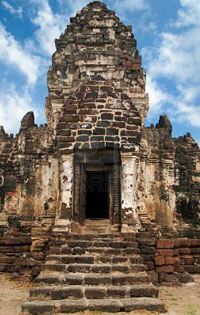
Phra Prang Sam Yot represents the strongest surviving Angkorian architectural layer. The complex consists of three connected laterite towers decorated in the Bayon tradition and dates broadly to the late twelfth or early thirteenth century. Its religious use changed over time, including later Buddhist modifications.
Wat Phra Si Rattana Mahathat, directly opposite Lop Buri Station, illustrates a later architectural transition. Its principal prang became an important model for prang architecture developed during the Ayutthaya period. King Narai also added structures to the complex, including a royal viharn with architectural details reflecting the international influences of his court.
Archaeological evidence makes the history more complex than the old idea that one culture simply replaced another. The Somdet Phra Narai National Museum preserves inscriptions and objects associated with Dvaravati culture, Lavo and Angkor-connected political networks. One Khmer-language inscription refers to the relationship of King Suryavarman I with Lopburi roughly a thousand years ago.
| Historic site | Main significance | Practical relationship |
|---|---|---|
| Phra Prang Sam Yot | Three connected laterite towers in Bayon-style Khmer art | Near San Phra Kan and the railway |
| Wat Phra Si Rattana Mahathat | Major prang marking the transition toward Ayutthaya architecture | Directly opposite Lop Buri Station |
| San Phra Kan | Important city shrine with older architectural remains | Beside the main macaque and Prang Sam Yot area |
| Prang Khaek | Compact Khmer-style monument within the modern city | Easy secondary stop while walking between heritage areas |
Opening arrangements for individual Fine Arts Department archaeological sites can change during restoration work, public holidays and special evening events. Travelers should confirm current hours locally rather than relying on an old fee or timetable copied from earlier guidebooks.
King Narai Palace, Ban Wichayen and Lopburi’s Global Seventeenth Century
King Narai’s seventeenth-century Lopburi was an international royal center where Siamese government, European diplomacy, Persian influence and early modern science intersected. Phra Narai Ratchaniwet, Ban Wichayen and Kraison Siharat Hall provide the clearest surviving evidence of this period.
King Narai ordered Phra Narai Ratchaniwet built in 1666 on a palace compound of about 41 rai. Fine Arts Department records describe French and Italian craftsmen participating in its design and construction. The palace included halls for government business, foreign audiences and the king’s private residence.
King Narai spent roughly eight to nine months of each year in Lopburi, giving the city the role of a second royal capital after Ayutthaya. After his death in 1688, the palace lost much of its royal function. King Mongkut, Rama IV, later restored part of the site and added a nineteenth-century palace group.
Somdet Phra Narai National Museum now occupies part of this complex. Its galleries provide the best chronological introduction to Lopburi because they cover prehistoric finds, Dvaravati culture, Khmer-influenced art, the Ayutthaya court and later royal restoration.
| Somdet Phra Narai National Museum | Current visitor information |
|---|---|
| Opening days | Wednesday-Sunday |
| Opening hours | 09:00-16:00 |
| Closed | Monday-Tuesday |
| Thai admission | 30 THB |
| Foreign admission | 150 THB |
| Recommended time | 1-2 hours for palace grounds and museum galleries |
Ban Wichayen, also called Ban Luang Rap Ratchathut, adds the diplomatic story. The complex contained the residence associated with Constantine Phaulkon, buildings used to receive foreign envoys and the Notre-Dame de Laurette church. The French embassy led by Chevalier de Chaumont stayed in the complex during its 1685 mission to Siam.
Archaeological studies show that the western residential zone also contains Indo-Persian architectural influences, reflecting the Persian commercial and court networks that existed before and during King Narai’s reign. Excavations have identified underground rooms, water systems and remains interpreted as a possible Persian-style hammam.
Lopburi also became a site of scientific exchange. On December 11, 1685, King Narai joined French Jesuit mathematicians and astronomers at Kraison Siharat Hall to observe a lunar eclipse using telescopes and calculated eclipse diagrams. This episode makes Lopburi’s King Narai period broader than a conventional palace story.
Lopburi Monkeys and the Changing Old Town
Lopburi’s macaques remain part of the city’s identity, but the visitor experience in 2026 is very different from older images showing thousands of monkeys occupying streets and buildings. Large-scale capture, sterilization and municipal care have substantially reduced the free-roaming population in the historic center.
On January 28, 2026, wildlife officials reported only slightly more than 100 macaques remaining around the San Phra Kan and Phra Prang Sam Yot core after population-management operations. By February 2026, Lopburi municipality was caring for approximately 3,500 macaques in managed animal facilities.
The program includes health examinations, sterilization and separation of macaque groups according to their original territories. Management continued through 2026, including work toward a longer-term funding and animal-care structure. Travelers should therefore not expect the scale of uncontrolled monkey encounters described in older Lopburi guides.
| Around Lopburi macaques | Recommended behavior |
|---|---|
| Food | Keep snacks inside a closed bag and avoid carrying visible food |
| Phones and glasses | Hold them securely when macaques are close |
| Interaction | Do not tease, chase or attempt to touch macaques |
| Feeding | Avoid hand-feeding free-roaming animals |
| Families | Keep young children close around San Phra Kan and Prang Sam Yot |
The changing monkey population also affects the annual Monkey Buffet tradition. Because Lopburi’s macaque-management system has changed significantly since 2024, travelers planning around the festival should verify the current date, venue and format instead of relying on schedules from older travel articles.
Sunflower Fields, Pa Sak Jolasid Dam and Winter Travel
November to January is Lopburi’s main sunflower period, but there is no single permanent “Lopburi sunflower field” that blooms on the same dates every year. Farmers and landowners stagger planting, so the best field can change from week to week.
The province’s main sunflower areas include parts of Mueang Lopburi, Phatthana Nikhom, Khok Samrong and Nong Muang. Bloom conditions depend on planting date, temperature and rainfall. Travelers should check the exact field name and current flowering status before driving out from the city.
A useful example came from Khao Chin Lae in January 2026. The Special Warfare Center opened more than 140 rai of sunflower fields near the mountain backdrop, about 10 kilometers from the provincial hall. That particular planting remained open only until January 10, illustrating why old field recommendations become outdated quickly.
| Winter experience | Season / current reference | Planning note |
|---|---|---|
| Sunflower fields | Mainly November-January | Check current bloom field by field |
| Khao Chin Lae | 2026 field peaked around early January | Seasonal military-area access, not a permanent year-round attraction |
| Pa Sak Jolasid Dam | Year-round reservoir | Winter is especially popular when water levels are high |
| Pa Sak “Floating Train” | Last published season: November 2025-February 1, 2026 | Seasonal special train only; confirm the next SRT schedule |
Pa Sak Jolasid Dam adds a second reason to explore eastern Lopburi. The reservoir was developed as part of a royal water-management project designed to reduce flood and drought pressure in the Pa Sak basin.
The seasonal State Railway of Thailand sightseeing service is popularly called the “Floating Train” because the railway crosses the broad reservoir and appears to run across the water. The 2025-26 season operated on selected Saturdays and Sundays from November 1, 2025 through February 1, 2026, for a total of 24 operating days.
The train is not a normal daily transport option. The next season should be confirmed directly with State Railway of Thailand before accommodation or connecting transport is booked.
Khao Wong Phrachan and Lopburi’s Mountain Pilgrimage
Khao Wong Phrachan is Lopburi’s most demanding pilgrimage experience, requiring a climb of 3,790 steps to reach the mountaintop religious complex. The journey combines Buddhist devotion with a strenuous ascent and wide views across central Thailand.
| Khao Wong Phrachan attribute | Planning information |
|---|---|
| Stair count | 3,790 steps |
| Main experience | Buddhist pilgrimage and mountain viewpoint |
| 2026 pilgrimage festival | February 17-March 3 |
| Festival duration | 15 days and 15 nights |
| Best timing | Early morning or evening, especially outside extreme midday heat |
| Suitable for | Travelers comfortable with a sustained stair climb |
During the 2026 pilgrimage festival, the stairway was illuminated at night and rest points and community vendors operated along the route. The festival overlaps with the latter part of the King Narai Festival period, so mid-February can be culturally rewarding but busy.
The climb is not a practical choice for travelers with significant mobility limitations. Outside the main pilgrimage period, carry sufficient water and confirm temple access before making a dedicated journey.
Wang Kan Lueang, Ban Mi and Rural Lopburi
Rural Lopburi adds year-round waterfalls, canal communities, agricultural landscapes and living local traditions to a destination often associated only with archaeology. These attractions are widely dispersed, so they work best as separate half-day or full-day road trips.
- Wang Kan Lueang Waterfall: a spring-fed waterfall in Tha Luang District with clear turquoise water flowing across low limestone terraces throughout the year.
- Ban Suan Khwan: a community experience around canals, older wooden houses, farming culture, wickerwork and local craft demonstrations.
- Ban Mi: a cultural district associated with Thai Phuan textiles and communities including Thai Yuan, Lao Ngaew, Lao Luang and Thai-Chinese groups.
- Wat Lai: the center of the Phra Sri Ariya Metteyya procession, a religious tradition practiced for more than a century.
Wang Kan Lueang Waterfall is particularly useful outside the sunflower season. Its water comes from a large natural spring rather than depending only on seasonal runoff, allowing water to flow even during the dry months. Natural pools form below low limestone cascades, and the surrounding trees provide shaded picnic areas.
Ban Mi provides one of the clearest windows into Lopburi’s contemporary cultural diversity. The 2026 Ban Mi festival featured Thai-Chinese, Thai Yuan, Lao Ngaew, Lao Luang and Thai Phuan performances alongside mudmee textiles, OTOP products and longboat racing.
Nearby Wat Lai preserves a different type of living heritage. Its procession of Phra Sri Ariya Metteyya has been practiced for more than 100 years and is registered as national intangible cultural heritage. In 2026, worshippers pulled the ceremonial structure along a 12-kilometer round-trip route between Wat Lai and Wat Thong Khung.
Where to Stay in Lopburi
The old town is the most convenient base for first-time visitors, while travelers focused on sunflowers or Pa Sak Reservoir may benefit from staying closer to the eastern countryside.
| Area | Best for | Main consideration |
|---|---|---|
| Old town / Lop Buri Station | Ruins, palace, museum, train travelers | Best walkability for the historical core |
| Central Mueang Lopburi | Restaurants, road transport and general sightseeing | Some attractions require short local transfers |
| Phatthana Nikhom / Pa Sak corridor | Reservoir, winter fields and early rural starts | Less convenient for old-town museums |
A traveler making a simple Bangkok day trip does not need to stay overnight. One night becomes worthwhile if the itinerary includes Somdet Phra Narai National Museum, Ban Wichayen and a slower exploration of the old town.
Two nights are more practical when combining the city with Pa Sak, a sunflower field, Khao Wong Phrachan or Wang Kan Lueang. These provincial attractions lie in different directions and should not be compressed into one rushed circuit.
What to Eat and Buy in Lopburi
Lopburi’s most distinctive food products reflect the province’s orchards, local mineral resources and agricultural landscape rather than the national dishes found throughout Thai cuisine.
- Talung santol: a Lopburi GI fruit with sweet-tart flesh, harvested mainly from May to July.
- Din sor phong salted eggs: eggs traditionally cured in Lopburi’s local chalk mixture before being coated with rice-husk ash.
- Som fak: fermented fish prepared with cooked rice, salt and garlic for a distinctly sour local flavor.
- Sunflower products: roasted seeds, snacks and other farm products appear around winter sunflower fields and seasonal markets.
Talung santol, or krathon Talung, has the strongest current agricultural identity. The GI production area centers on Talung, Pho Kao Ton and Ngio Rai in Mueang Lopburi. The fruit appears from May to July and reaches its main harvest in June.
In 2026, Lopburi recorded 168 santol growers across more than 600 rai. Fresh fruit is sold alongside processed versions such as santol in syrup, seasoned santol and preserved products.
| Specialty | Where to look | Best period |
|---|---|---|
| Talung santol | Orchards, roadside stalls and Mueang Lopburi markets | May-July, peak in June |
| Din sor phong salted eggs | Local markets and souvenir shops | Year-round |
| Som fak | Traditional local markets | Year-round |
| Sunflower products | Seasonal fields and Pa Sak-area markets | November-January |
Festivals and Seasonal Events in Lopburi
Lopburi’s strongest events are tied directly to King Narai, Buddhist pilgrimage, rural religious traditions and seasonal agriculture. Dates follow different systems, so travelers should confirm the exact calendar each year alongside the broader schedule of festivals in Thailand.
| 2026 event | 2026 dates | Main experience |
|---|---|---|
| King Narai the Great Reign Festival | February 13-22 | Historical processions, period dress, palace illumination and cultural performances |
| Khao Wong Phrachan Pilgrimage | February 17-March 3 | 3,790-step mountain pilgrimage and nighttime climb |
| Wat Lai Phra Sri Ariya Metteyya Festival | April 29-May 3 | Religious ceremonies and traditional 12-km procession |
| Lopburi Sweet Santol Festival | June 24-July 5 | GI santol, orchard products and local food |
| Ban Mi Longboat and Local Products Festival | July 10-19 | Longboat racing, mudmee textiles and multicultural performances |
King Narai the Great Reign Festival is Lopburi’s main annual heritage event. The 38th edition ran for 10 days and nights in 2026 at Phra Narai Ratchaniwet and nearby monuments. Activities included historical processions, traditional Thai dress, cultural markets, performances and illuminated archaeological sites.
Evening is especially useful during the King Narai Festival. Provincial visitor guidance for 2026 recommended exploring after about 18:00, when illuminated palace architecture and performances become central to the experience.
The Wat Lai procession follows a lunar religious calendar and is traditionally organized twice a year. The April 2026 event demonstrated the scale of the tradition, with worshippers pulling the Phra Sri Ariya Metteyya ceremonial structure through villages between Tha Wung and Ban Mi.
The famous Monkey Buffet has traditionally been associated with late November, but Lopburi’s large-scale macaque management program has changed the number and distribution of monkeys in the old city. Travelers should confirm the current year’s official format before treating an older festival date as fixed.
Practical Lopburi Travel Tips
- Check the station name: Lop Buri Station serves the old town, while Lop Buri 2 is about 10 kilometers away.
- Avoid Monday and Tuesday for museum-focused trips: Somdet Phra Narai National Museum is normally closed both days.
- Secure food, phones and glasses around macaques: free-roaming groups are smaller but still present near key heritage sites.
- Check sunflower bloom before driving: fields open and finish on different planting schedules.
- Carry water for Khao Wong Phrachan: the 3,790-step climb is physically demanding.
- Monitor rainy-season alerts: rural roads and low areas can be affected by intense rainfall or rising waterways.
- Use the Thailand Travel Guide for national entry, currency and country-level planning information.
Lopburi Travel FAQ
Can Lopburi be visited as a day trip from Bangkok?
Yes. A train to the original Lop Buri Station places you directly beside the historic core, making Wat Phra Si Rattana Mahathat, Phra Prang Sam Yot, San Phra Kan and King Narai’s Palace realistic in one long day.
How many days do you need in Lopburi?
One day covers the main old-town monuments. One night allows a deeper palace and museum visit. Two nights are more practical when adding sunflowers, Pa Sak Reservoir, Khao Wong Phrachan or Wang Kan Lueang Waterfall.
Are there still monkeys everywhere in Lopburi?
No. Population-control operations have greatly reduced the number roaming through the old town. Monkeys remain around San Phra Kan and Phra Prang Sam Yot, but thousands are now managed in municipal animal-care facilities.
When can you see sunflower fields in Lopburi?
The main period is usually November to January, although individual plantings can bloom earlier or continue into February. Check the current field and expected closing date because Lopburi has many separate sunflower plots rather than one permanent attraction.
Which Lopburi train station is best for tourists?
The original Lop Buri Station is much more convenient for first-time visitors because it sits beside the historic center. Lop Buri 2 mainly serves long-distance trains and requires an additional local transfer into old Lopburi.