

Quang Binh Travel Guide
Quang Binh Overview

Quang Binh is a historic travel region in central Vietnam, extending from the Truong Son Mountains and Laos border to the East Sea. The former Quang Binh Province covered about 8,000 km² and had roughly 116 km of coastline. Dong Hoi remains its main urban and transport gateway.
Before Vietnam’s 2025 administrative reorganization, the former province had 895,423 residents in the 2019 census. Kinh people accounted for more than 97% of the population. About 26,300 residents belonged to ethnic minority communities, particularly the Bru-Van Kieu and Chut peoples. Bru-Van Kieu communities include Van Kieu, Khua, Ma Coong and Tri groups. Chut communities include Sach, May, Ruc, A Rem and Ma Lieng.
The region’s defining natural entity is Phong Nha-Ke Bang, where karst formations began developing about 400 million years ago. In 2025, UNESCO expanded the World Heritage property across the Laos border to include Hin Nam No National Park. The transboundary property now covers 217,447 hectares and contains more than 220 km of documented caves and underground waterways.
Phong Nha-Ke Bang gained another international designation in 2026 when UNESCO added the 515,830-hectare Phong Nha-Ke Bang Biosphere Reserve to its Man and the Biosphere Programme. UNESCO records 2,954 vascular plant species and 1,399 animal species within the reserve. The landscape also supports Bru-Van Kieu and Chut communities and preserves sections of the wartime Ho Chi Minh Trail. This combination of biodiversity, culture and history adds several important reasons to visit Quang Binh beyond its famous caves.
Quang Binh has not been a separate province since Vietnam’s 2025 administrative reorganization. The former Quang Binh and Quang Tri provinces merged into a new Quang Tri Province covering 12,700 km² with a population of 1,870,845. The new provincial administration began operating on July 1, 2025. Travelers will still see “Quang Binh” widely used for Dong Hoi, Phong Nha, Tan Hoa and the surrounding historic travel region.
When to Visit Quang Binh for Caves, Beaches and Trekking
March to May offers the best overall balance for sightseeing, caves and outdoor travel in Quang Binh. June to August is hotter but suits beaches and most cave experiences. September to November brings the highest flood and storm risk, which can affect roads and adventure routes.
| Travel period | Typical conditions | Best for | Cave and outdoor considerations |
|---|---|---|---|
| December-February | Cooler, variable rain | Heritage, sightseeing and selected trekking routes | Some adventure tours operate; water and cave conditions can feel cold |
| March-May | Warm and generally drier | Caves, trekking, cycling and general sightseeing | Best overall balance of weather and outdoor access |
| June-August | Hot and sunny with occasional storms | Nhat Le Beach, rivers and caves | Most major cave products operate; midday heat can be intense |
| September-November | Wettest period; storms and flooding possible | Flexible cultural trips when conditions allow | Several wet-cave expeditions pause or modify their operating seasons |
Weather and cave access should be checked separately. Son Doong expeditions currently run from January to August. Hang En operates from December to mid-September, while the Tu Lan Cave Encounter normally runs from mid-November to mid-September.
April and May usually offer comfortable conditions before peak summer heat, while June and July work better for swimming and coastal trips. The wider seasonal pattern is similar to other destinations discussed in the Central Vietnam weather guide, although Quang Binh’s cave operations make local planning more specific.
Getting to Quang Binh by Air, Train and Road
Dong Hoi is the main gateway for reaching the historic Quang Binh travel region. The city has both an airport and a station on Vietnam’s North-South railway, while National Route 1 and the Ho Chi Minh Highway provide road access.
| From | Travel option | Typical journey | Reference price |
|---|---|---|---|
| Hanoi | Flight to Dong Hoi | About 1 hr 5 min-1 hr 25 min | From about 800,000 VND; varies by date |
| Hanoi | Train | About 10-11 hours | From about 400,000 VND depending on seat or berth |
| Ho Chi Minh City | Flight to Dong Hoi | About 1 hr 40 min | From about 1,000,000 VND; varies by date |
| Hue | Train | About 3 hours | From about 150,000 VND |
Dong Hoi Airport lies about 6 km from central Dong Hoi. Its new T2 passenger terminal remains under construction in August 2026. The terminal is designed for about three million passengers annually and is scheduled to enter service near the end of the fourth quarter of 2026.
Air connectivity expanded on August 16, 2026. Sun PhuQuoc Airways began a daily Hanoi-Dong Hoi round trip and three weekly Dong Hoi-Cam Ranh round trips on Tuesdays, Fridays and Sundays. Flight schedules remain perishable information, so confirm the exact service before booking accommodation or transfers.
Dong Hoi Railway Station lies on Vietnam’s North-South railway, which connects Quang Binh with Hanoi, Hue, Da Nang and destinations farther south. Phong Nha lies roughly 45-50 km from Dong Hoi and normally requires another road transfer.
Hue lies directly south of Quang Binh and adds Nguyen-dynasty imperial heritage to a central Vietnam itinerary. Train and road connections make the two destinations relatively straightforward to combine.
Getting Around Quang Binh
Quang Binh’s attractions are widely dispersed, so road transport is necessary for most itineraries. Dong Hoi works as the coastal transport hub, while Phong Nha is the practical base for caves and national-park activities.
- Taxi or private car: the easiest choice between Dong Hoi, Phong Nha and attractions spread across the former province.
- Motorbike: flexible around Phong Nha, Bong Lai Valley and rural roads; wet-season riding requires more experience.
- Bicycle: useful around Phong Nha, Bong Lai Valley and quieter village roads rather than long-distance transfers.
- Walking: practical within central Dong Hoi or central Phong Nha but unsuitable between major attraction clusters.
- Expedition transfers: Son Doong, Hang En, Tu Lan and similar organized tours normally provide transport to controlled trailheads.
Phong Nha-Ke Bang Caves: From Boat Trips to Multi-Day Expeditions
Quang Binh’s cave experiences range from easy boat trips to some of Vietnam’s most demanding guided expeditions. Fitness, swimming ability, age, available time and booking requirements matter more than simply choosing the most famous cave.

Phong Nha – Ke Bang National Park
Phong Nha-Ke Bang combines caves with cycling, forest hiking, river activities, ziplining and wartime sites. Travelers can therefore build a varied itinerary without spending every day underground.
| Experience | Best suited to | Physical level | Main format | Booking |
|---|---|---|---|---|
| Phong Nha Cave | First-time visitors and families | Easy | Boat journey and short cave walk | Normal visitor ticket |
| Paradise Cave 1 km route | Most travelers | Easy-Moderate | Forest approach, stairs and boardwalk | Normal visitor ticket |
| Chay River-Dark Cave | Active travelers | Moderate | Zipline, swimming, kayaking and mud cave | Choose a service package |
| Hang En | Fit adventure travelers | Moderate | 2-day trek and cave camping | Advance booking required |
| Tu Lan Cave System | Active and adventure travelers | Easy to demanding by route | Trekking, swimming and camping | Advance booking required |
| Son Doong Cave | Highly fit expedition travelers | Hard | Controlled multi-day expedition | Very limited advance booking |
| Cha Loi Cave | Travelers seeking a less conventional cave route | Moderate | Guided cave trekking and water sections | Guided trip required |
Phong Nha Cave is the easiest introduction to the national park’s underground rivers. The cave measures 7,729 metres in total, while the standard visitor trip explores about 1,200 metres by boat and on foot.

Son River, the boat route into Phong Nha Cave within Phong Nha-Ke Bang National Park
- Entrance: 150,000 VND per person; children under 1.3 m enter free.
- Boat: 700,000 VND round trip for up to 12 passengers.
- Opening hours: 07:15-16:30 in summer and 07:30-15:45 in winter.
- Typical visit: About 2.5 hours.
Paradise Cave extends for 31.4 km and reaches about 60 metres high in some sections. The standard visitor route follows a one-kilometre wooden walkway. A separate seven-kilometre adventure route reaches deeper sections and Heaven’s Well.
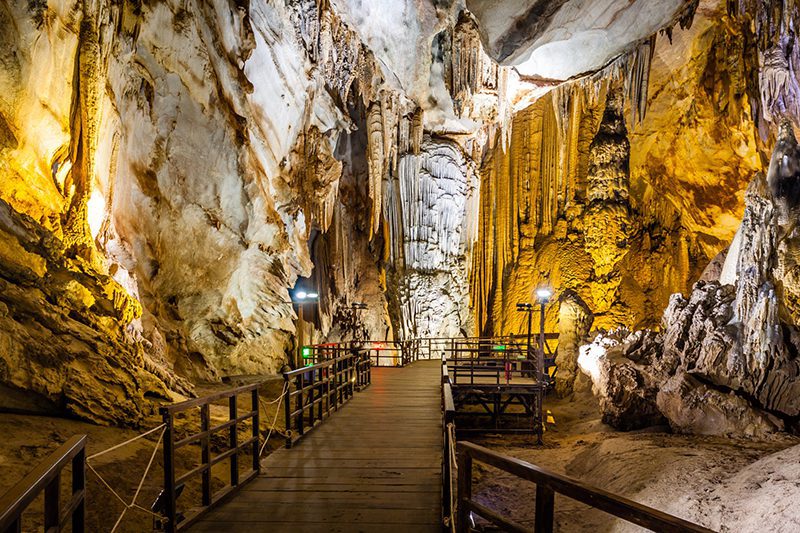
Paradise Cave, Quang Binh
- Standard ticket: 270,000 VND for adults; 145,000 VND for children 1.1-1.3 m; free below 1.1 m.
- Standard route: 1 km inside the cave on a wooden walkway.
- 7 km one-day adventure: 2,000,000 VND per person; minimum two participants.
- 7 km two-day adventure: 4,000,000 VND per person; minimum five participants.
- Adventure restriction: The 7 km route is not available to children under 16 or travelers with certain health conditions.
Chay River-Dark Cave is an activity-based cave experience rather than a conventional sightseeing visit. Its full package combines a 400-metre zipline, Dark Cave exploration, a natural mud bath, kayaking and river activities.

Kayaking on Chay River, Quang Binh
- Exploration package: 450,000 VND per adult; 150,000 VND for children 1.1-1.3 m.
- Standard package: 220,000 VND per adult; 110,000 VND for children 1.1-1.3 m.
- Recreation package: 150,000 VND per adult; 110,000 VND for children 1.1-1.3 m.
- 400 m zipline: Participants must weigh more than 40 kg.
- Mud cave: Participants must be at least 1.1 m tall.
Son Doong Cave is the world’s largest known natural cave by volume, measured at about 38.5 million cubic metres. Local resident Ho Khanh found the entrance in 1990. A British-Vietnamese expedition surveyed the cave in 2009.
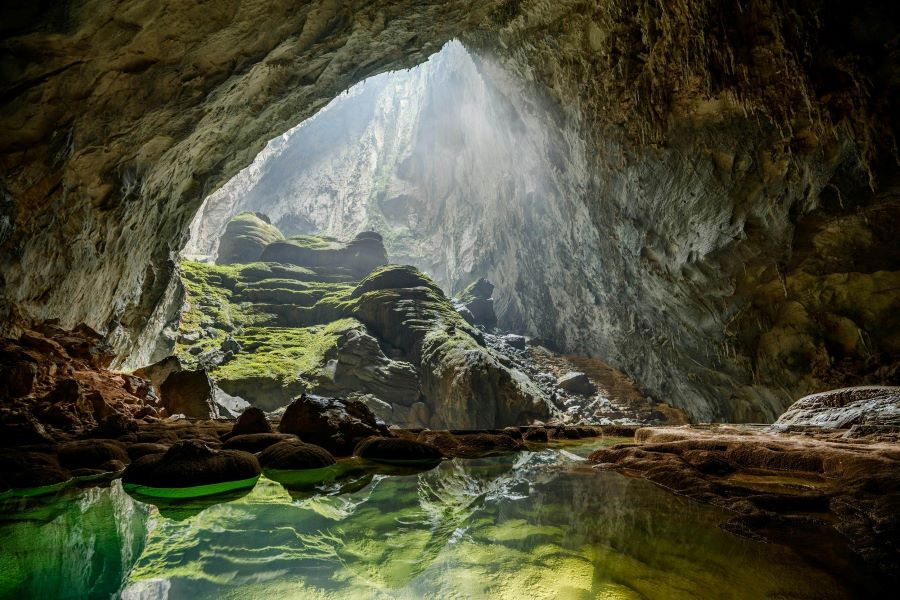
Son Doong Cave, Quang Binh
- Expedition price: USD 3,000 per person, approximately 80,000,000 VND.
- Operating season: January-August.
- Participant age: 18-70 years.
- Maximum group: 10 guests.
- Adventure level: Hard.
Son Doong is not a walk-in attraction. The expedition requires advance booking, physical preparation and specialized guides and safety staff. Visitor numbers are controlled for conservation.
Hang En combines one of the world’s largest cave passages with an overnight underground campsite. The two-day route passes through Ban Doong, a Bru-Van Kieu community inside the national park.

Hang En, one of the world’s largest cave passages with an overnight underground campsite
- Duration: 2 days / 1 night.
- Adventure level: Moderate.
- Participant age: 16-70 years.
- Maximum group: 16 guests.
- Operating season: December to mid-September.
- Current price: 8,800,000 VND per person.
- From November 15, 2026: 9,500,000 VND per person.
Tu Lan Cave System lies around the Tan Hoa landscape northwest of Phong Nha. Its tours range from introductory experiences to demanding multi-day expeditions involving jungle trekking, underground swimming and camping.

Tu Lan Cave, Quang Binh
- Tu Lan Cave Encounter: 7,700,000 VND per person.
- Participant age: 16-70 years for the Cave Encounter.
- Adventure level: Easy for the Cave Encounter, with harder Tu Lan routes available.
- Operating season: Mid-November to mid-September.
- From November 15, 2026: The Cave Encounter price rises to 7,900,000 VND per person.
- Tu Lan Expedition: 18,000,000 VND for a more demanding multi-day expedition.
Several other cave routes add meaningful alternatives without needing the same detail as the main sites.
| Cave or route | Why it is different | Area |
|---|---|---|
| Tien Son Cave | Dry cave above the Phong Nha boat route, commonly paired with Phong Nha Cave | Phong Nha |
| Phong Nha 4.5 km route | Guided kayaking and trekking into deeper sections of the Phong Nha system | Phong Nha Cave |
| Hang Va-Nuoc Nut | Adventure route known for rare cone-shaped formations and river passages | Phong Nha-Ke Bang |
| Commander Cave | Combines a cave with VR interpretation of wartime Route 20 | Thuong Trach Commune |
| Cha Loi Cave | Three-level cave linked with Bru-Van Kieu landscapes south of Dong Hoi | Kim Ngan Commune |
| Hang Tien | Large dry cave and calcite formations within the wider Tu Lan system | Kim Phu area |
Quang Binh dominates Vietnam’s adventure-caving scene, but it is not the country’s only karst destination. Vietnam’s major caves also extend through limestone landscapes in Ninh Binh, Ha Long and northern mountain provinces.
Nhat Le, Bao Ninh and the Quang Binh Coast
The former Quang Binh Province had about 116 km of coastline, with its easiest beach experiences concentrated around Dong Hoi. Nhat Le and Bao Ninh suit short stays, while Da Nhay and Hai Ninh provide different coastal landscapes farther away.
- Nhat Le Beach: Dong Hoi’s principal urban beach, convenient for travelers staying near the city center.

Nhat Le Beach, the main beach convenient for travelers staying in central Dong Hoi
- Bao Ninh Beach: long sandy coast across the Nhat Le River from central Dong Hoi.
- Da Nhay Beach: northern beach distinguished by wave-eroded coastal rock formations.
- Quang Phu Beach: northern Dong Hoi coast that pairs naturally with the nearby Quang Phu sand dunes.
- Hai Ninh Beach: quieter southern coast associated more closely with local fishing landscapes.
June and July generally provide the strongest combination of hot weather and beach activity, although storm conditions should always be checked. Nhat Le represents Quang Binh in Paradise Travel’s wider comparison of notable Vietnamese beaches.
Forests, Springs and Outdoor Experiences Beyond the Caves
Quang Binh also offers forest trails, karst springs, sand dunes and rural valleys for travelers who do not want a cave-focused itinerary. Most of these experiences can be combined with Phong Nha or Dong Hoi rather than requiring separate overnight bases.
- Mooc Spring: karst spring with forest boardwalks, swimming and seasonal water activities near the national park.

Mooc Spring, a natural karst spring offering swimming and forest trails near Phong Nha
- Phong Nha Botanical Garden: forest trails, Gio Waterfall and environmental interpretation inside Phong Nha-Ke Bang.
- Quang Phu Sand Dunes: coastal dunes north of Dong Hoi, more comfortable outside the midday heat.
- Khe Nuoc Trong Nature Reserve: protected forest landscape used for guided nature and trekking experiences.
- Duong Cam Waterfall: forest waterfall reached through organized routes in the Khe Nuoc Trong landscape.
- Bang Hot Spring: mineral-spring area south of Dong Hoi associated with bathing and wellness experiences.
- Bong Lai Valley: countryside cycling area with farms, rice fields and limestone hills near Phong Nha.
The Duck Stop in Bong Lai Valley combines a small farm experience with duck feeding and buffalo activities. Its current listed duck experience costs 100,000 VND, while buffalo riding is listed at 50,000 VND.
Phong Nha-Ke Bang remains the region’s major conservation anchor. It also appears among Vietnam’s principal national parks for travelers interested in forests, wildlife and protected landscapes.
Dong Hoi, Bau Tro and Quang Binh’s Historical Landscape
Quang Binh’s historical landscape ranges from prehistoric Bau Tro archaeology to Nguyen-period defenses and the wartime Ho Chi Minh Trail. These sites add chronological depth that is easily missed when the destination is treated only as a base for caves.
Quang Binh Quan formed part of the Luy Thay defensive system associated with military strategist Dao Duy Tu. The gateway dates to 1631 during the period of conflict between the Trinh lords in the north and Nguyen lords in the south.

Quang Binh Quan, a historic gateway built by Dao Duy Tu as part of the Luy Thay defenses
Bau Tro adds a much older archaeological layer near Dong Hoi. Archaeological work began there in 1923. The site’s name later became the label for the Bau Tro culture, associated with coastal communities living in north-central Vietnam roughly four millennia ago.
| Historical site | Key entity or attribute | Area |
|---|---|---|
| Quang Binh Quan | Defensive gateway dating to 1631 within the Luy Thay system | Dong Hoi |
| Bau Tro Archaeological Site | Site that gave its name to the prehistoric Bau Tro culture | Dong Hoi |
| Mother Suot Monument | Commemorates Nguyen Thi Suot and her wartime crossings of the Nhat Le River | Dong Hoi |
| Vung Chua-Dao Yen | Coastal burial and memorial site of General Vo Nguyen Giap | Northern former Quang Binh |
| Hoang Phuc Pagoda | Buddhist site with a history extending for more than seven centuries | Le Thuy area |
| Eight Ladies Cave | Route 20 memorial connected with eight youth volunteers killed in 1972 | Phong Nha-Ke Bang |
| General Vo Nguyen Giap Memorial House | Family and historical site connected with the Vietnamese general | Le Thuy area |
Inside Phong Nha-Ke Bang, the newer Commander Cave route connects cave tourism directly with Route 20 history. The experience lasts about 60-90 minutes and uses exhibitions and VR interpretation before entering the seven-storey cave.
| Commander Cave ticket, Monday-Thursday | 250,000 VND |
|---|---|
| Commander Cave ticket, Friday-Sunday | 300,000 VND |
Tan Hoa and the Cultural Landscapes of Western Quang Binh
Western Quang Binh combines living Bru-Van Kieu and Chut traditions with rural communities adapting to forests, karst terrain and seasonal flooding. Tan Hoa is now the most visible example of community tourism in this landscape.
The former Quang Binh Province’s two principal ethnic minority groups were the Bru-Van Kieu and Chut. Bru-Van Kieu communities include Van Kieu, Khua, Ma Coong and Tri groups. Chut communities include Sach, May, Ruc, A Rem and Ma Lieng. UNESCO’s 2026 Biosphere Reserve profile specifically identifies Bru-Van Kieu and Chut traditions as part of the living cultural landscape.
The wider Minh Hoa area also has a distinct Nguon cultural community. Its speech and folk traditions include Ho thuoc ca, a communal work-song practice added to Vietnam’s National Intangible Cultural Heritage list in 2021.
Tan Hoa gained international recognition as a UN Tourism Best Tourism Village in 2023. The village developed weather-adaptive tourism around a landscape that can experience substantial seasonal flooding. Floating houses and raised accommodation form part of that adaptation.

Tan Hoa, a weather-adaptive community and the main gateway to the Tu Lan Cave System
Administrative names around Tan Hoa changed after the 2025 reorganization. Former Tan Hoa Commune is now part of Kim Phu Commune, Quang Tri Province. Kim Phu was officially recognized as a provincial-level tourism area on June 12, 2026, reinforcing Tan Hoa and the Tu Lan landscape as a separate visitor cluster.
- Tan Hoa: UN Tourism Best Tourism Village 2023 and principal gateway to the Tu Lan Cave System.
- Ban Doong: Bru-Van Kieu community crossed on the approach to Hang En and Son Doong.
- Ma Coong communities: Bru-Van Kieu cultural communities in the western border landscape around Thuong Trach.
- Bong Lai Valley: accessible rural landscape of farms and villages near the main Phong Nha visitor area.
Boat Racing, Ma Coong Drums and Quang Binh’s Living Traditions
Quang Binh’s strongest festival traditions are tied to rivers, agriculture and the spiritual life of upland communities. Lunar-calendar celebrations move to different Gregorian dates each year, so their current schedule should be confirmed before planning travel around them.
Kien Giang River Boat Racing Festival is closely associated with Vietnam’s National Day period around September 2 in Le Thuy. Men’s and women’s boat teams race along the Kien Giang River. The tradition entered Vietnam’s National Intangible Cultural Heritage list in 2019.

Kien Giang River Boat Racing Festival, a national intangible cultural heritage tradition in Le Thuy
Ma Coong Drum-Beating Festival takes place on the 16th day of the first lunar month. Ma Coong communities perform rituals associated with Giang and prayers for favorable weather, health and crops. The festival received national intangible-cultural-heritage recognition in 2019.
Bru-Van Kieu Tria Lua Festival is an agricultural ritual traditionally associated with the seventh lunar month. Ceremonies relate to upland-rice cultivation and offerings connected with natural deities. The tradition entered Vietnam’s National Intangible Cultural Heritage list in 2021.
Where to Stay in Quang Binh: Dong Hoi or Phong Nha?
Choose Dong Hoi for beaches and transport, and choose the Phong Nha area when caves and national-park activities dominate the itinerary. Staying close to the activity cluster avoids repeated 45-50 km transfers between Dong Hoi and Phong Nha.
Dong Hoi
- voco Quang Binh Resort: Lot 202 Vo Nguyen Giap Street, Dong Hoi Ward, Quang Tri Province
- Muong Thanh Luxury Nhat Le Hotel: 121 Truong Phap Street, Dong Hoi
- Muong Thanh Holiday Quang Binh Hotel: Truong Phap Street, Dong Hoi
Phong Nha and the national-park area
- Chay Lap Farmstay: Ho Chi Minh West Road, Phong Nha Commune, Quang Tri Province
- Phong Nha Farmstay: Hoa Son Hamlet, Bo Trach Commune, Quang Tri Province
What to Eat in Quang Binh
Quang Binh cuisine combines central Vietnamese seasoning with freshwater fish, coastal seafood, rice-flour cakes and practical local snacks. The region fits within the bolder flavor profile described in the Vietnamese Food Guide’s overview of Central Vietnamese cuisine.
- Chao canh: thick local noodle soup commonly served with fish, shrimp or pork and crispy ram.
- Banh bot loc: translucent tapioca dumplings commonly filled with shrimp and pork.
- Banh khoai: crisp central-style pancake served with shrimp, pork, bean sprouts and dipping sauce.
- Banh beo tom chay: small steamed rice cakes topped with dried or shredded shrimp.
- Lau ca khoai: seasonal Bombay-duck hotpot linked closely with Quang Binh’s coastal cuisine.
- Ga nuong muoi cheo: grilled chicken served with aromatic cheo seasoning around the Phong Nha countryside.
- Khoai deo: chewy dried sweet potato traditionally produced as a portable local snack.
- Seafood: fish, squid, shrimp and shellfish are widely served around Nhat Le and Bao Ninh.
Where to eat:
| Dish | Restaurant | Address | Reference price |
|---|---|---|---|
| Banh khoai | Banh Khoai Tu Quy | 17 Co Tam Street, Dong Hoi | About 20,000-60,000 VND |
| Banh khoai and local cakes | Banh Khoai Co Nam | 13 Tran Hung Dao Street, Dong Hoi | Check current menu |

Banh khoai, a signature dish in Quang Binh’s Central Vietnamese food culture
Practical Quang Binh Travel Tips for International Visitors
- Check expedition calendars: a sunny forecast does not guarantee that every wet-cave route is operating.
- Book serious cave trips early: Son Doong, Hang En and Tu Lan expeditions have controlled capacity and fixed departures.
- Check insurance exclusions: standard policies may not cover trekking, guided caving or emergency evacuation.
- Carry some cash: remote villages and smaller businesses outside Dong Hoi and central Phong Nha may not accept cards.
- Use proper footwear: cave and forest routes can be muddy, wet and slippery even outside the main rainy season.
- Expect flood disruption: September-November brings the greatest risk of heavy rain, flooding and temporary attraction closures.
- Check current administrative addresses: many older maps still show Quang Binh Province and pre-2025 district or commune names.
- Book border-area adventure products through operators: some western communes now fall within border-management zones and may require additional procedures for foreign visitors.
Quang Binh Travel FAQ
How many days do I need in Quang Binh?
Two to three days is enough for Phong Nha Cave, Paradise Cave and one river, forest or beach experience. A longer trip is necessary for Tan Hoa or overnight expeditions. A two-day Phong Nha itinerary can combine the main visitor caves with above-ground nature experiences.
Should I stay in Dong Hoi or Phong Nha?
Stay in Dong Hoi for the airport, railway, Nhat Le Beach and city restaurants. Stay around Phong Nha when caves, trekking and national-park activities are the main purpose of the trip.
Can children visit the caves in Quang Binh?
Yes, but cave suitability varies. Phong Nha Cave and the standard Paradise Cave route work for many families. Dark Cave uses height and weight restrictions, while overnight expeditions set separate age and fitness requirements.
Can I visit Son Doong Cave independently?
No. Son Doong is a controlled multi-day expedition rather than a walk-in attraction. Current expeditions operate from January to August, accept travelers aged 18-70 and limit groups to 10 guests.
Is Quang Binh still a province?
No. The former Quang Binh Province merged with the former Quang Tri Province in 2025. The new administrative unit is Quang Tri Province, although “Quang Binh” remains widely used as the travel-region name.