

Dien Bien Travel Guide
Dien Bien Overview

Dien Bien is a northwestern border province best known for the 1954 Dien Bien Phu battlefield, but its wider travel identity also includes Thai and Hmong culture, the Muong Thanh rice valley, mountain scenery and remote frontier landscapes. The province covers about 9,563 km² and is the only Vietnamese province bordering both Laos and China. Its international boundary extends for more than 450 km.
Dien Bien had an average population of about 667,400 in 2025 and remains one of Vietnam’s most ethnically diverse provinces. Nineteen ethnic groups live here. Hmong people account for about 38.1% of the population, Thai people about 35.7% and Kinh people about 17.4%. Thai communities are particularly visible in river valleys and rice-growing areas, while Hmong settlement is stronger across many higher mountain zones.
The geographical center of travel is the Muong Thanh basin, an elongated valley about 18 km long and 6-8 km wide. Modern Dien Bien Phu, Dien Bien Airport, the main battlefield sites and large areas of wet-rice agriculture all occupy this basin. Its broad, relatively flat floor also explains why French Union forces developed a major fortified camp here in late 1953.
The Battle of Dien Bien Phu lasted from March 13 to May 7, 1954. Roughly 16,200 French Union troops occupied a fortified system of 49 strongpoints when the campaign began. Viet Minh forces under General Vo Nguyen Giap gradually isolated and captured these defensive positions over 56 days. The French defeat became a decisive event in the First Indochina War and strongly influenced the Geneva negotiations later that year.
Dien Bien’s administrative structure changed substantially on July 1, 2025. The former district-level system was replaced by 45 commune-level administrative units, including 42 communes and three wards. Travelers will still encounter former names such as Dien Bien Phu City, Dien Bien District, Tua Chua District and Muong Nhe District on older maps, hotel listings and travel resources.
Two days are enough for the principal Dien Bien Phu battlefield and Muong Phang. Three days allows time for Ban Phu, community villages or nearby rural landscapes. Tua Chua and A Pa Chai require longer extensions because they are separate highland destinations rather than quick attractions outside the city.
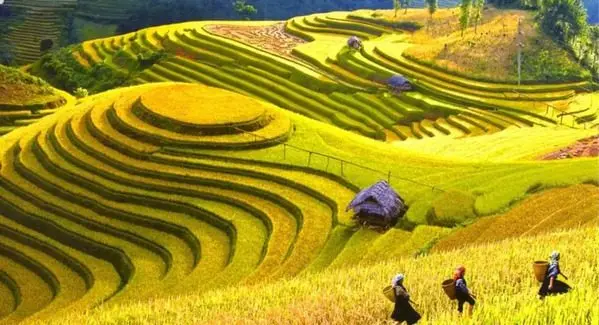
Rice agriculture adds a very different landscape to Dien Bien beyond its famous battlefield
When to Visit Dien Bien for History, Ban Flowers and Highland Scenery
March-May and September-November offer the easiest overall conditions for most Dien Bien trips. March brings ban flowers and the province’s major cultural festival, while September-November usually provides better conditions for rice landscapes and long mountain-road journeys.

Dien Bien weather
| Travel period | Typical conditions | Best for | Planning considerations |
|---|---|---|---|
| December-January | Cool and generally drier | Battlefield visits, mountain scenery and Muong Phang cherry blossoms | Cold mornings, mountain fog and reduced visibility are possible |
| February-March | Mild spring weather | Ban flowers, cultural events and city sightseeing | Festival dates change annually |
| April-May | Warmer with increasing rainfall | Dien Bien Phu history and May 7 commemorations | Hotels can become busier around anniversary events |
| June-August | Warm and wet | Green mountain scenery when weather is stable | Heavy rain can trigger flash floods and landslides |
| September-November | Cooling and generally more stable | Rice landscapes, road trips and remote highlands | One of the stronger periods for Tua Chua and frontier travel |
March has the strongest cultural appeal. Ban flowers bloom across the Northwest at this time and hold particular cultural meaning for Thai communities. The annual Hoa Ban Festival in Dien Bien combines performances, traditional clothing, folk games, food and cultural activities. Its Gregorian dates should be checked each year. In 2026, the final program ran from March 6 to 12.

Ban flowers bloom across Dien Bien in spring and are closely connected with the cultural identity of local Thai communities
April and early May suit travelers whose main interest is the battlefield. May 7 is the anniversary of the Dien Bien Phu victory, so commemorative events can increase visitor numbers around the museum and major historical sites.
January provides a different seasonal reason to visit Muong Phang and Pa Khoang. Cherry trees bloom around the lake area, and the 2026 Cherry Blossom Festival was held from January 9 to 11.
Summer requires more caution. Prolonged heavy rain can damage mountain roads and trigger landslides. Check local warnings before driving toward Pu Nhi, Tua Chua, Muong Nhe or A Pa Chai after extended rainfall.
Getting to Dien Bien by Air and Road
Flying is the fastest way to reach Dien Bien Phu from Hanoi or Ho Chi Minh City, while road travel works better as part of a longer Northwest Vietnam itinerary.
| From | Travel option | Typical journey | Planning note |
|---|---|---|---|
| Hanoi | Direct flight | About 1 hour | Most practical choice for short trips |
| Ho Chi Minh City | Direct flight | About 2 hrs 20 min | Lower-frequency service, confirm exact operating days |
| Hanoi | Sleeper bus / coach | About 10-12 hours | Long overnight or full-day journey |
| Son La | Road via Pha Din | About 4-5 hours | Useful as part of a Northwest road journey |
| Sapa / Lao Cai area | Road via Lai Chau | Full-day mountain transfer | Better as part of a multi-destination trip |
Dien Bien Airport has IATA code DIN and lies within the urban area. Following its expansion, the airport returned to operation in December 2023 with a 2,400 x 45 m runway capable of handling Airbus A320 and A321 aircraft. The passenger terminal has a designed capacity of 500,000 passengers per year.
Vietnam Airlines operates the Hanoi route and launched a direct Ho Chi Minh City-Dien Bien service on December 24, 2025. The route was introduced at two flights per week with a flight time of about 2 hours 20 minutes. Frequencies can change, so confirm the exact date before arranging accommodation around the flight.
Travelers arriving overland from the east cross Pha Din Pass, the historic mountain route between Son La and Dien Bien. The old scenic pass extends for about 32 km and reaches approximately 1,648 m.

Pha Din Pass, a historic Northwest mountain crossing on the road toward Dien Bien
Pha Din also played a logistical role during the 1954 campaign because supplies and personnel moving toward Dien Bien had to cross this corridor. The modern through-route and the older scenic pass do not follow exactly the same experience, so road travelers interested in the historic section should plan their route deliberately.
International travelers crossing between Laos and Vietnam can use Tay Trang International Landport. Tay Trang appears on Vietnam’s current list of land ports accepting e-visa holders. Entry rules for Laos must be checked separately.
Getting Around Dien Bien
The central Dien Bien Phu battlefield is compact enough for short taxi rides and some walking, but almost every important attraction outside the city requires road transport.
- Walking: useful around selected central historical sites, restaurants and urban streets.
- Taxi or private car: the easiest option for A1, D1, Him Lam, Ban Phu and airport transfers.
- Local bus: a public transport corridor serves the bus station, airport and parts of the central urban area.
- Motorbike: suitable for experienced riders in stable weather, especially for countryside routes near the basin.
- Private driver or guided vehicle: preferable for Muong Phang, Tua Chua and the far-west border region.
The airport is very close to central Dien Bien Phu, but the province itself is large. Muong Phang lies around 40 km away by road, Tua Chua is roughly 130 km from the central area, and A Pa Chai requires a much longer journey through the western mountains.
Dien Bien Phu Battlefield: Museum, A1 Hill and the Central Strongpoints
The best introduction to the battlefield is the Dien Bien Phu Victory Museum, followed by A1 Hill, the French command area and selected strongpoints across the Muong Thanh basin. The protected battlefield currently contains 46 component sites, so first-time visitors do not need to visit every position.
Dien Bien Phu Victory Museum provides the chronological and geographical context needed to understand the outdoor sites. Its collection contains more than 1,000 documents and artifacts connected with the First Indochina War and the campaign.
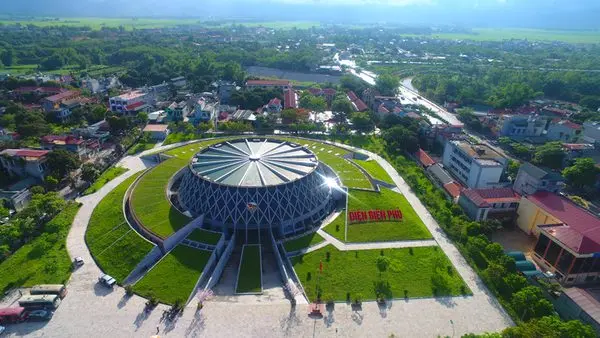
Dien Bien Phu Victory Museum is the most useful starting point before exploring the battlefield
Its defining feature is the circular Dien Bien Phu Campaign Panorama. The painting covers about 3,225 m², runs for 132 m around the cylindrical interior and depicts more than 4,500 human figures. Four continuous scenes portray mobilization, battlefield preparation, the fighting and the final phase of the campaign.
- Adult admission: 100,000 VND under the current fee policy.
- Visitors under 18: currently exempt from the museum admission fee.
- Opening hours from July 13, 2026: 07:30-12:00 and 13:30-21:00 until a new notice is issued.
- Suggested visit: about 1.5-2 hours for the galleries, panorama and additional interpretation.
- Panorama: visitors remove footwear and leave bags, food, drinks, hats and certain personal items outside the viewing space.
- 3D film: individual screening sessions last about 30 minutes.
The later museum closing time is useful for itinerary planning. Travelers can spend daylight at outdoor sites or Muong Phang and visit the museum after returning to Dien Bien Phu.
One of the collection’s better-known objects is a heavily reinforced bicycle used to transport supplies during the campaign.

A reinforced supply bicycle illustrates the logistics used to move equipment toward the Dien Bien Phu battlefield
A1 Hill, known as Eliane 2 in the French defensive system, was one of the most heavily contested positions on the eastern side of the fortified camp. Trenches, military remains and the crater created by a large Viet Minh explosive charge remain visible.

A1 Hill, one of the most important preserved battlefield positions in Dien Bien Phu
The adjacent A1 Martyrs’ Cemetery adds a commemorative dimension to the visit and should be treated as a memorial space rather than simply another attraction.
De Castries Bunker stands in the former French central command zone on the Muong Thanh plain. It is not in Muong Phang. The bunker lies roughly 500 m west of A1 and close to Muong Thanh Bridge, helping visitors understand the relatively compact geography of the final French defensive center.

De Castries Bunker, the preserved French command position in the Muong Thanh plain
D1 Hill and the Dien Bien Phu Victory Monument provide one of the clearest elevated views over the basin. The main stairway to the monument contains about 320 steps, making D1 less suitable for travelers with limited mobility.
Him Lam Resistance Center marks the area where the campaign opened on March 13, 1954. Following conservation and restoration works, the site reopened to visitors on April 28, 2026 with restored trenches, bunkers, visitor infrastructure and historical interpretation.

Him Lam, the battlefield position where the Dien Bien Phu Campaign opened in March 1954
| Battlefield site | Key attribute | Suggested visit | Accessibility |
|---|---|---|---|
| Dien Bien Phu Victory Museum | Campaign interpretation and panorama | 1.5-2 hours | Most accessible major site |
| A1 Hill | Major eastern strongpoint | 45-60 minutes | Hill walking and uneven ground |
| De Castries Bunker | French central command position | 20-30 minutes | Relatively straightforward |
| D1 Hill | Victory Monument and basin viewpoint | 30-45 minutes | About 320 steps on the main approach |
| Him Lam | Opening battlefield of March 13, 1954 | 30-45 minutes | Outdoor historical terrain |
Outdoor battlefield sites use seasonal opening hours. From March 1 to September 30, the current schedule is 07:00-11:00 and 13:30-18:00. From October 1 to the end of February, hours are 07:00-11:00 and 13:30-17:30.
Muong Phang and Pa Khoang: Campaign Headquarters, Forest and Lake
Muong Phang combines the campaign’s Vietnamese command headquarters with forest scenery, Pa Khoang Lake and nearby Thai community tourism. It works best as a half-day or full-day trip from Dien Bien Phu.
The Viet Minh campaign headquarters moved through several locations, including Tham Pua and Huoi He, before settling at Muong Phang for the decisive final period of the campaign. The forest complex contains reconstructed working shelters, communications facilities and command structures associated with General Vo Nguyen Giap and senior officers.
The wooded setting differs sharply from the exposed strongpoints in the Muong Thanh basin. Forest paths and dispersed shelters show how the command area relied on concealment and physical separation from the French defensive system.
A large cable-car and cultural tourism development around Muong Phang was formally started in May 2026. The project includes a planned route toward Pu To Co, associated with the campaign observation area. It remains under development and should not be treated as an operating visitor attraction.
Pa Khoang Lake adds the strongest natural landscape to this historical cluster. Forested slopes, villages and broad water views make it easy to combine with Muong Phang on the same trip.

Pa Khoang Lake, a forest and community landscape that pairs naturally with Muong Phang
January provides a seasonal variation when cherry trees bloom around Pa Khoang and the nearby island landscape. Travelers interested in village culture can also include Che Can, a Thai community tourism village in the Muong Phang area.
Ban Phu and Muong Thanh: Dien Bien Before the 1954 Battle
Dien Bien’s history extends far beyond 1954, and Ban Phu provides the clearest introduction to the eighteenth-century political landscape of Muong Thanh.
The Muong Thanh basin has supported settlement and wet-rice cultivation for centuries. The Nam Rom River and broad valley floor allowed Thai communities to develop an agricultural landscape that remains visible around the modern urban area.

Muong Thanh Valley, the agricultural basin that later became the setting of the Dien Bien Phu battlefield
Ban Phu Citadel developed in the eighteenth century under Hoang Cong Chat after his forces established control in the Muong Thanh region. Its main construction is associated with approximately 1758-1762. Earth ramparts, defensive planting and moats once enclosed a much larger fortified settlement than the surviving structures suggest today.
The site lies around 8 km from central Dien Bien Phu and received additional recognition as a provincial tourism point in 2026.
Hoang Cong Chat Temple stands within the historical complex and commemorates the leader associated with the eighteenth-century defense of Muong Thanh. Its annual festival traditionally takes place on the 24th and 25th days of the second lunar month. In 2026, the program was held on April 11-12.
Thai, Hmong and Highland Community Life in Dien Bien
Thai and Hmong communities shape much of Dien Bien’s living culture, from valley agriculture and stilt houses to highland farming, textiles and seasonal rituals.

Dien Bien is home to 19 ethnic groups, with Hmong and Thai communities forming the two largest populations
Thai communities are particularly associated with the Muong Thanh basin, Muong Phang and Muong Lay. Wet-rice cultivation, stilt-house architecture, textile production, music and xoe dancing remain visible parts of community life. The wider traditions of Thai people in northwestern Vietnam provide useful background before visiting these villages.
Hmong communities are distributed more strongly through mountainous areas such as Tua Chua, Pu Nhi and several western highland zones. Their cultural landscape includes upland agriculture, textile traditions, household rituals, markets and seasonal festivals.
Recognized community tourism areas include Phiêng Lơi, Che Căn, Nà Sự, A Pa Chải, Quan Chiêng, Bản Lồng and Huổi Nhả.
| Community | Main cultural context | Best combined with |
|---|---|---|
| Phiêng Lơi | Thai community life close to the main basin | Dien Bien Phu and Muong Thanh |
| Che Can | Thai stilt houses and community tourism | Muong Phang and Pa Khoang |
| Na Su | Community tourism and regional culture | Northwestern rural itinerary |
| Ban Long | Hmong culture and mountain setting | Pha Din road corridor |
| A Pa Chai | Ha Nhi frontier community | A Pa Chai borderland journey |
Visitors should treat community villages as residential spaces rather than staged attractions. Ask before entering homes or photographing people at close range, and arrange more involved cultural activities through local hosts or recognized community tourism providers.
Tua Chua Stone Plateau, Ancient Tea and Highland Markets
Tua Chua is Dien Bien’s strongest secondary destination for travelers interested in karst landscapes, old Shan Tuyet tea, Hmong culture, caves and highland markets. Its distance from Dien Bien Phu makes an overnight stay more practical than a rushed day trip.
The Tua Chua highlands lie roughly 130 km from Dien Bien Phu and rise from about 800 m to more than 1,800 m in places. Limestone plateaus, rocky valleys and mountain agriculture create a landscape very different from Muong Thanh.
One of its most distinctive agricultural entities is ancient Shan Tuyet tea. The wider area contains thousands of old tea trees, including groups recognized as Vietnamese Heritage Trees. Tea cultivation remains closely connected with Hmong livelihoods in the cool highlands.
The Ta Phin stone plateau adds broad karst scenery, while several cave systems provide a stronger nature component.
| Tua Chua entity | Key attribute | Best for |
|---|---|---|
| Ancient Shan Tuyet tea | Old high-altitude tea trees | Agriculture and cultural travel |
| Ta Phin stone plateau | Exposed karst highland landscape | Photography and road trips |
| Xa Nhe Cave | Nationally recognized cave landscape | Nature-focused travelers |
| Kho Chua La Cave | Limestone cave system | Nature and exploration |
| Pe Rang Ky Cave | National scenic site | Karst landscapes |
| Tham Khen Cave | Nationally recognized cave | Cave and highland travel |
| Tua Chua Market | Highland products and local trade | Culture-focused travelers |
Terraced fields around Chieu Tinh, De De Hu and Hang Khua add another seasonal landscape. Tua Chua also has evening market activity, giving an overnight visit more value than returning immediately to Dien Bien Phu.
A Pa Chai and the Far-West Borderlands
A Pa Chai is Dien Bien’s most remote frontier experience and should be planned as a dedicated extension rather than a normal day trip from Dien Bien Phu.
The destination lies in Sin Thau Commune in the far west of the province, close to the point where the borders of Vietnam, Laos and China meet. Tourism activities at the tri-border marker and A Pa Chai Flag Tower were officially launched on September 1, 2026.
The A Pa Chai Flag Tower rises about 45 m and is approached by 519 stone steps. The tri-border marker stands at approximately 1,866 m above sea level and lies about 1.3 km from the flag-tower area.
The experience now includes the symbolic tri-border visit, Ha Nhi cultural elements and a souvenir stamp associated with reaching Vietnam’s western frontier.
A Pa Chai should not be confused with an international immigration crossing. Visitors cannot treat the tri-border attraction as a route for casually continuing into China or Laos. Tay Trang is the relevant international landport in Dien Bien for normal immigration procedures.
Because A Pa Chai remains within a sensitive international frontier area and its tourism operation is newly expanded, foreign visitors should confirm the current access requirements shortly before departure rather than relying on old permit instructions.
The wider western region can also be associated with Muong Nhe Nature Reserve, a large protected forest landscape with substantial plant and animal diversity. It should be referred to as a nature reserve, not Muong Nhe National Park.
Other Natural Landscapes Near Dien Bien Phu
Travelers with limited time can still add rice terraces, caves and mineral springs without driving as far as Tua Chua or A Pa Chai.
Pu Nhi rice terraces provide one of the most practical scenery trips close to Dien Bien Phu. The terraced landscape around Phu Long B lies roughly 20 km from the central urban area. Water-filled paddies appear around the planting season, while later agricultural stages create green and golden hillside patterns.
The Pu Nhi area also has historical connections with Vu Pa Chay, whose Hmong uprising against French colonial rule lasted from 1918 to 1922. This relationship gives the landscape additional cultural significance beyond rice-field photography.
Pa Thom Cave remains a relevant secondary natural site west of the main basin. Its limestone interior contains stalactites and stalagmites, although current access conditions should be checked before planning a dedicated trip.
U Va and Hua Pe are associated with mineral hot-spring resources and developing wellness tourism. Facilities can change, so these work better as optional stops than as essential attractions.
Festivals and Evening Life in Dien Bien
The Hoa Ban Festival is Dien Bien’s most important annual cultural event, while new evening spaces are gradually expanding what travelers can do after the historical sites close.
The Hoa Ban Festival celebrates a flower closely connected with the cultural symbolism of the Northwest. Programs commonly include ethnic performances, folk games, traditional clothing, food, community activities and cultural exhibitions.
The festival is normally organized during the March flowering season, but the exact dates should always be confirmed. In 2026, its schedule was adjusted before the final program ran from March 6 to 12.
Hoang Cong Chat Temple Festival belongs to an older historical tradition. It is associated with the 24th and 25th days of the second lunar month and combines ceremonies with local performances and community activities.
Dien Bien Phu gained a new evening space when Muong Thanh Walking Street opened on March 7, 2026. The area is intended for cultural programs, local food, entertainment, crafts and community activities. Because the product remains relatively new, check the current event calendar rather than assuming performances take place every night.
Where to Stay in Dien Bien
Central Dien Bien Phu is the most practical base for first-time visitors because the airport, battlefield, restaurants and urban services are concentrated here. Tua Chua and the far-west border region require separate overnight planning.
Central Dien Bien Phu
- Muong Thanh Luxury Dien Bien: Residential Group 2, Dien Bien Phu Ward, Dien Bien Province
- Muong Thanh Grand Dien Bien Phu: 514, Residential Group 21, Dien Bien Phu Ward, Dien Bien Province
- Pharma Hotel: Residential Group 3, Dien Bien Phu Ward, Dien Bien Province
- Muong Phang Hotel: 266, Residential Group 2, Dien Bien Phu Ward, Dien Bien Province
- Nam Rom Hotel: Residential Group 4, Dien Bien Phu Ward, Dien Bien Province
Community and countryside stays
- Eco Rose Homestay: Alley 175, Sung Phai Sinh Street, Dien Bien Phu Ward
- Ecolodge Ke Nenh: Ke Nenh Village, Dien Bien Phu Ward
- Phuong Duc Homestay: Che Can Village, Muong Phang Commune
- Chung Thinh Homestay: Che Can Village, Muong Phang Commune
- Pi Noong Homestay: Huoi Luc Village, Tua Chua Commune
Muong Thanh Luxury Dien Bien opened in May 2025 and was officially recognized as a 5-star hotel in July 2026. Accommodation demand is higher around the Hoa Ban Festival and May 7 commemorations.
What to Eat in Dien Bien
Dien Bien cuisine combines Muong Thanh rice with Thai and Hmong highland cooking, especially grilled fish, smoked meat, sticky rice, mountain spices and seasonal plants. Many of these dishes belong to the wider traditions of Northwest Vietnamese food.
- Nep nuong sticky rice: fragrant glutinous rice associated with the fertile Muong Thanh basin.
- Pa pinh top: Thai-style freshwater fish filled with herbs and spices before slow grilling.
- Grilled chicken with mac khen: chicken seasoned with the aromatic, lightly numbing Northwest mountain spice.
- Thit trau gac bep: buffalo meat seasoned and slowly smoked above a household fire.
- Com lam: rice cooked inside bamboo tubes and commonly served with grilled highland dishes.
- Hmong banh day: glutinous-rice cake pounded until smooth and closely associated with Hmong celebrations.
- Hoa ban dishes: young flowers and buds are used seasonally in several Thai preparations.
- Tua Chua Shan Tuyet tea: high-altitude tea produced from old tea trees in the northeastern highlands.
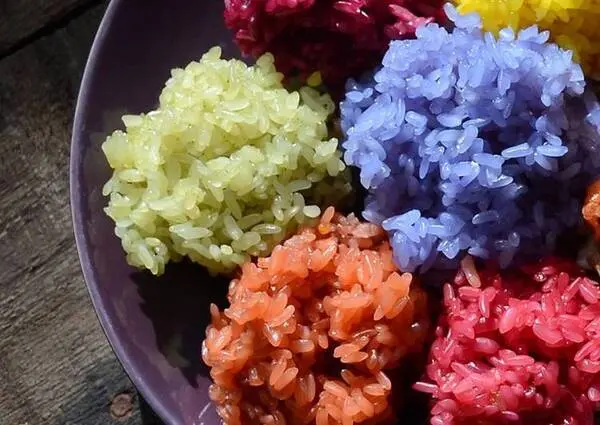
Sticky rice is one of the most recognizable foods made from Dien Bien’s fragrant glutinous rice

Banh day, a glutinous-rice cake closely connected with Hmong food traditions
Where to eat:
| Food focus | Restaurant | Address | Reference price |
|---|---|---|---|
| Northwest and local dishes | Huong Vi Tay Bac | Residential Group 5, Dien Bien Phu Ward | Check current menu |
| Local and regional dishes | Dong Doi Restaurant | 138, Residential Group 3, Dien Bien Phu Ward | Check current menu |
| Thai and local food | Lau Then Quan | Pom Loi Village, Muong Thanh Ward | Check current menu |
| Hotel restaurant | Muong Thanh Luxury Dien Bien | Residential Group 2, Dien Bien Phu Ward | Check current menu |
Community tourism villages can provide a stronger cultural food experience than ordering isolated specialties in town. Thai household meals often combine sticky rice, fish, grilled meat, vegetables and mountain herbs as a shared meal.
Practical Dien Bien Travel Tips for International Visitors
- Start with the museum: its chronology and panorama make the battlefield geography easier to understand.
- Plan around midday closures: outdoor battlefield sites currently close between 11:00 and 13:30.
- Use the museum’s evening hours: it currently remains open until 21:00, leaving daylight for outdoor sites.
- Expect stairs at D1: the principal approach to the Victory Monument has about 320 steps.
- Check mountain weather: prolonged summer rain can trigger landslides, flash floods and road disruption.
- Do not treat A Pa Chai as a border crossing: the tourist site is separate from immigration facilities such as Tay Trang.
- Confirm A Pa Chai procedures: access arrangements in the frontier area can change, especially for foreign visitors.
- Book festival periods early: the Hoa Ban Festival and May 7 anniversary can increase accommodation demand.
- Carry Vietnamese dong outside the city: smaller villages and rural services may not consistently accept international cards.
Dien Bien Travel FAQ
How many days do I need in Dien Bien?
Two days is enough for the main Dien Bien Phu battlefield, Muong Phang and Pa Khoang. Three days allows time for Ban Phu, community villages or Pu Nhi. Tua Chua and A Pa Chai require additional overnight travel.
Can I visit all Dien Bien Phu battlefield sites in one day?
You can visit the museum and the most important central sites in one day, but covering all 46 component sites is unnecessary. Museum, A1, De Castries Bunker, D1 and Him Lam provide the strongest first-time overview.
Is Dien Bien suitable for older travelers?
Yes, with route planning. The museum and De Castries Bunker are relatively straightforward. A1 has uneven terrain, D1 requires a substantial stair climb, and remote destinations involve long mountain-road transfers.
Can I fly directly from Ho Chi Minh City to Dien Bien?
Yes. A direct Vietnam Airlines service began in December 2025 with a flight time of about 2 hours 20 minutes. The route operates less frequently than Hanoi-Dien Bien, so confirm the current flight days before booking.
Can foreigners visit A Pa Chai?
Tourism activities at A Pa Chai officially expanded in September 2026, but the site remains within an international border area. Foreign travelers should confirm current access requirements with local authorities or a licensed operator before departure.