

8 Best Places to Visit in Vietnam in May 2027
May 2027 marks a real seasonal turning point across Vietnam. The national climate outlook currently expects above-normal temperatures, while rainfall from May through July should return closer to long-term averages after a drier February-April period. Northern rains begin filling rice terraces, the Mekong’s orchards move into fruit season, and Central Vietnam remains hot but relatively favorable for coastal travel.
The month also changes from week to week. Early May follows the April 30 and May 1 national holidays, while late May brings Tam Coc’s rice toward harvest, Mu Cang Chai’s water-pouring season, rising turtle activity at Con Dao, and the Bà Chúa Xứ pilgrimage in Chau Doc. Choosing the right dates therefore matters almost as much as choosing the destination.

May in Vietnam – Hagiang
Weather in Vietnam in May
May sits at the end of spring in Vietnam and begins the shift toward summer-like heat and rainfall. The broader Vietnam travel guide helps compare these regional patterns with other months.
The figures below are long-term climate averages rather than a forecast for specific travel dates. For 2027, Vietnam’s National Center for Hydro-Meteorological Forecasting currently expects temperatures above the long-term average. Rainfall from May through July is forecast to be near normal, while tropical-cyclone activity remains relatively unlikely through the first half of May before becoming more possible from late May onward.
Northern Vietnam becomes hot, humid and substantially wetter in May. Hanoi averages roughly 26-33°C (78-91°F), with about 185 mm of precipitation and relative humidity near 78%. This is a clear change from April, when average rainfall is much lower.
Rain is not entirely a disadvantage. It supplies the water that creates reflective terraces in Mu Cang Chai and supports the young rice appearing across mountain valleys. The trade-off is less predictable road travel. Thunderstorms, fog, wet mountain passes and localized landslide risk become more relevant, so flexible timing matters on remote northern routes.
Central Vietnam remains the most straightforward region for sunshine in May, but heat is increasingly important. Da Nang averages around 25-34°C (77-93°F), approximately 75 mm of precipitation and relative humidity near 77%.
May is hotter than April but still precedes Central Vietnam’s main autumn rainy and typhoon season. Beach and outdoor plans remain practical, although exposed attractions are more comfortable early or late in the day. Travelers going offshore should still check marine forecasts rather than treating the dry-season pattern as a guarantee of calm seas.
Southern Vietnam enters its rainy-season transition in May. Ho Chi Minh City averages about 26-34°C (78-94°F), with precipitation increasing to roughly 166 mm and relative humidity near 78%. That is more than three times April’s average precipitation in the same climate dataset.
This shift does not make the south unsuitable. May is precisely when Mekong fruit orchards become more interesting and Con Dao’s wildlife season develops. Travelers should instead expect more frequent tropical showers, carry rain protection and keep boat or island plans flexible, especially toward the end of the month.

May brings rising heat nationwide, while rainfall increases much faster in northern and southern Vietnam than along much of the central coast.
Festivals and Events in Vietnam in May 2027
The events below have dates that can be established for 2027. Festivals with only a previous-year program, including the Red Flamboyant Festival in Hai Phong, are not assigned an exact 2027 schedule until organizers publish one.
International Labour Day, May 1, 2027
International Labour Day falls on Saturday, May 1, 2027 and is a national public holiday in Vietnam. It comes immediately after Reunification Day on April 30, creating one of the country’s important domestic travel periods.
Flights, trains, beach accommodation and popular short-break destinations can experience stronger demand around the beginning of May. International visitors arriving during this period should confirm transport first rather than assuming May begins with normal weekday traffic and hotel availability.
IRONMAN Vietnam and IRONMAN 70.3 Da Nang, May 9, 2027
IRONMAN Vietnam and IRONMAN 70.3 Da Nang will both take place on May 9, 2027. Organizers and Da Nang authorities opened registration in August 2026, making this one of the month’s confirmed international sporting events.
The full-distance race combines a 3.8 km swim, 180 km cycling course and 42 km run. The 70.3 event uses shorter triathlon distances. Travelers staying in Da Nang around May 9 should check the final race route and traffic notices once organizers publish detailed road arrangements.
Vesak, May 20, 2027
Vesak falls on May 20, 2027, corresponding to the fifteenth day of the fourth lunar month. In Vietnamese Buddhism, this full-moon date is associated with the celebration of the Buddha’s birth.
Temples and Buddhist communities may hold ceremonies, lantern activities and acts of charity, but individual 2027 programs vary by institution. Travelers should therefore use May 20 as the calendar date while confirming the schedule directly with any temple they intend to visit.
Bà Chúa Xứ Festival at Sam Mountain, May 27 to June 1, 2027
The Festival of Bà Chúa Xứ Goddess at Sam Mountain runs from May 27 to June 1, 2027, corresponding to the 22nd through 27th days of the fourth lunar month. UNESCO added the tradition to the Representative List of the Intangible Cultural Heritage of Humanity in 2024.
The festival brings together Kinh, Khmer, Cham and Hoa communities through religious ceremonies, offerings, music and dance. Major traditional elements include a palanquin procession and the ritual bathing and changing of the Goddess statue.
Travelers should notice that the festival does not finish in May. Anyone leaving Chau Doc on May 31 will miss the final day on June 1, so accommodation and onward transport should be planned around the specific ceremonies they want to experience.
Best Places to Visit in Vietnam in May 2027
May rewards travelers who choose a destination for what is actually happening there during the month. The strongest options range from two different nature windows in Ninh Binh to mountain planting seasons, fresh plum harvests, regulated wildlife experiences and the first major fruit crops of the Mekong Delta.
1. Ninh Binh: Best for Butterflies and Late-May Golden Rice
For nature photographers and families who can choose their dates carefully, Ninh Binh offers two separate May experiences rather than one month-long peak. Late April through May is associated with butterfly season in Cuc Phuong National Park, while the rice fields beside the Ngo Dong River normally turn gold from late May into early June.

Ninh Binh is one of May’s strongest seasonal choices, shifting from butterfly season toward golden rice later in the month.
Those windows should not be treated as guaranteed to peak together. An early or mid-May trip is better suited to Cuc Phuong, where butterfly activity is influenced by sunshine, humidity and recent rain. Travelers arriving near the end of May can instead prioritize a Tam Coc boat ride between the ripening paddies, followed by the roughly 500-step climb at Hang Mua for a higher view over the river landscape.
Ninh Binh lies about 90 km south of Hanoi, with road transfers typically taking around 1.5 to 2 hours. Two nights make it easier to combine Cuc Phuong with Tam Coc or Trang An without rushing. Mountain goat and crispy rice remain reliable local specialties, while mountain snails become more seasonal from spring into summer.
May’s caveat is heat and rain. Late-month boat rides can feel exposed around midday, and thunderstorms become more common than in March or April. The exact 2027 Ninh Binh Tourism Week schedule has not yet been confirmed, so travelers should not assume a festival date based on previous years.

Take sampan boat rides through rice fields and limestone mountains in Ninh Binh.
2. Mu Cang Chai: Best for Water-Pouring Rice Terraces
For landscape photographers who prefer reflective paddies to September’s golden harvest, Mu Cang Chai changes dramatically as the first sustained rains reach the mountains. May and June form the water-pouring period, when farmers channel mountain water into terraces before planting young rice.
The most recognizable reflections often develop from late May into early June. La Pan Tan, Che Cu Nha and the valleys around Khau Pha offer broad views across the terraced landscape. Sunrise and late afternoon give softer light, but field conditions are agricultural rather than staged for tourism. Water levels can differ from one commune to another depending on rainfall and each farming schedule.
Mu Cang Chai is roughly 300 km from Hanoi. Road journeys commonly take six to eight hours, so two or three nights are more practical than a rushed overnight turnaround. The long drive is also why the destination works best for photographers, mountain travelers and experienced road-trippers rather than visitors trying to fit several northern highlights into three days.
The rain that creates the scenery is also the main caveat. Khau Pha Pass can develop fog, wet surfaces, loose gravel and poor visibility. Avoid mountain riding after dark or during heavy rain. Independent motorbike travelers should have genuine mountain-road experience rather than treating the route as an ordinary scooter trip.
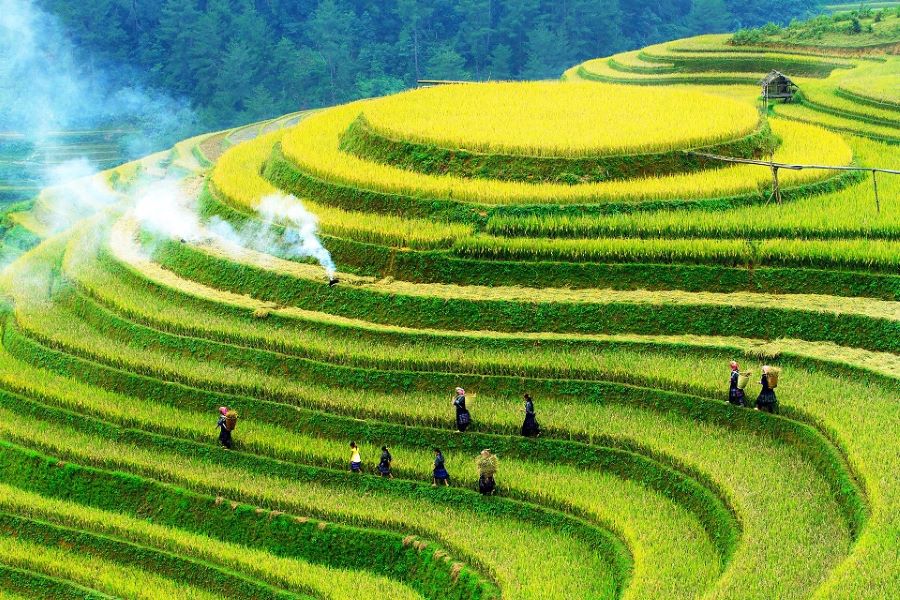
Mist rises gently over Mu Cang Chai’s terraced rice fields at dawn.
3. Moc Chau: Best for Plum Picking Instead of Plum Blossoms
For families and agritourism travelers, the Mai Chau-Moc Chau 3-day route takes on a different character in May. The white flowers associated with January and February have disappeared, and the reason to return is now the fruit itself. Vietnam Tourism places Moc Chau’s plum-picking window from March through May.
Orchards around the plateau allow visitors to see and taste the crop much closer to harvest. Individual gardens decide whether guests can pick directly, pay an entrance fee or buy fruit by weight, so confirm the arrangement on arrival. May also keeps Moc Chau’s tea hills green and makes fresh plums the most genuinely seasonal food item in the destination.
The plateau is about 200 km from Hanoi, making a two-night trip more comfortable than driving both directions in one day. Families can pair an orchard morning with tea plantations, local farms or a slower village visit rather than trying to collect every waterfall and viewpoint.
May weather is wetter than the blossom months, and fruit maturity varies from orchard to orchard. A photograph from one garden does not prove the entire plateau is ready for picking. Travelers going specifically for ripe plums should ask local accommodation providers or orchards about crop conditions shortly before departure.

The fields of white mustard flowers captivate tourists in Moc Chau.
4. Con Dao: Best for the Beginning of Turtle Conservation Season
For wildlife travelers who value conservation more than guaranteed dry beach weather, the things to do in Con Dao begin changing in May. Con Dao National Park’s regulated turtle experiences operate during the broader April-October nesting period, while activity builds toward the stronger summer months.
The important distinction is that May is an early wildlife window, not the peak promised in June-August summer content. Visitors can join authorized eco-tours that may include observing nesting turtles at night or hatchling releases when conditions and nesting cycles allow. Artificial light, loud noise and direct contact are restricted because these are conservation activities, not wildlife performances.
Allow at least three nights if turtles are a major reason for the trip. A longer stay gives more flexibility around weather and tour capacity while leaving time for Con Dao Museum, the former prison sites, forest walks and quieter beaches. Seafood remains easy to find, but the wildlife cycle, rather than a particular seasonal dish, is the reason to choose May.
The trade-off is rain. Historical May averages are around 27-33°C, approximately 223 mm of precipitation and 79% humidity, much wetter than April. Turtle sightings are never guaranteed, and travelers should reserve a regulated experience rather than arriving on a protected nesting beach independently.

May marks the early phase of Con Dao’s broader sea turtle conservation season, before nesting activity reaches its stronger summer period.
5. Chau Doc: Best for the Bà Chúa Xứ Pilgrimage
For cultural travelers interested in a living religious tradition rather than a staged attraction, a Chau Doc city tour has its strongest May reason during the Bà Chúa Xứ Festival. The UNESCO-listed festival begins on May 27 in 2027 and continues through June 1 at Sam Mountain.
Bà Chúa Xứ Temple is the central pilgrimage site, but the surrounding mountain also contains Tay An Pagoda, Thoai Ngoc Hau Tomb and Hang Pagoda. The festival’s processions, offerings and rituals reveal the shared cultural landscape of Kinh, Khmer, Cham and Hoa communities in the border region. Bun ca and Chau Doc’s fermented fish products provide a distinctly local food layer without needing to describe them as May-only specialties.
One to two nights are enough for the main Sam Mountain sites, but festival travelers should decide which ritual days matter before choosing their departure date. Staying into June 1 is necessary for anyone who wants to experience the festival through its traditional final day.
Late May is hot, humid and increasingly rainy in the Mekong Delta. Festival crowds also make the area substantially busier than on an ordinary Chau Doc visit. Reserve accommodation before the final week of May and allow extra time around the temple complex instead of planning a tight same-day connection onward.

The Bà Chúa Xứ Festival brings major pilgrimage activity to Sam Mountain from May 27 to June 1, 2027.
6. Can Tho: Best for the Start of Mekong Fruit Season
For food travelers and families who would rather enter an orchard than simply photograph boats, Can Tho becomes more interesting from May as the Mekong fruit season begins. The city has more than 24,500 hectares of fruit trees, and local tourism authorities describe May as the point when more crops begin entering harvest.
Phong Dien and Con Son are better fits for this May angle than treating Cai Rang as the entire reason to visit. Depending on the garden and week, travelers may encounter Ha Chau langsat, mangosteen, durian, rambutan, longan or other local fruit. Each crop follows its own calendar, so May should be described as the start of the orchard season rather than the moment every fruit reaches peak ripeness.
Two nights give enough time for an orchard day plus an early Cai Rang visit if river commerce also matters. Ho Chi Minh City to Can Tho takes roughly 3 to 3.5 hours by road, making an overnight stay much more sensible than leaving the city before dawn for a rushed return trip.
The rainy season also begins in May. Keep orchard plans flexible around showers and ask what fruit is actually ripe before choosing a garden. Phong Dien Floating Market should not be treated as a guaranteed substitute for Cai Rang because its current trading activity is much less consistent.

May starts Can Tho’s broader orchard season, although individual fruits ripen on different schedules.
7. Pu Luong: Best for Young Green Rice and Village Walking
For slow travelers who prefer short village walks to a demanding mountain road trip, the best things to do in Pu Luong take on a fresh green character in late May. Vietnam Tourism specifically identifies late May and early June as a good period for seeing young rice across the reserve’s valleys.
This is deliberately different from Mu Cang Chai’s May story. Mu Cang Chai is stronger for large-scale photography of flooded mountain terraces, while Pu Luong suits walking between villages, rice paddies, forest edges and traditional waterwheels. Its position roughly 160 km southwest of Hanoi also makes it easier to fit into a shorter northern itinerary.
Two nights allow time for a village route around areas such as Don, Uoi or Kho Muong without turning every morning into a transfer. Homestays add access to local family meals and a slower rhythm that fits the destination better than trying to treat Pu Luong as another sightseeing checklist.
Late-May greenery comes with wetter trails. Bring footwear with reliable grip and keep a shorter walking option available after heavy rain. Travelers who mainly want perfectly golden terraces should wait for the later harvest season rather than expecting May fields to resemble September photographs.

Pu Luong’s waterwheels and village trails complement the young green rice appearing toward the end of May.
8. Hai Phong: Best for Red Flamboyants and Port-City Food
For travelers who want a May city experience that does not repeat Hanoi, Hai Phong has a seasonal identity built around red flamboyant trees, warmer coastal weather and its May 13 liberation anniversary. The port city has long been nicknamed the Red Flamboyant City because the trees become closely associated with the approach of summer.
Central Hai Phong works particularly well as a food-and-heritage day. The Opera House, Tam Bac riverfront and older civic streets can be combined on foot before trying banh da cua, square-shaped nem cua be or the small pate-filled baguettes known as banh mi cay. A direct railway and expressway connect the city with Hanoi, so visitors do not need a domestic flight for a short trip.
One night is sufficient for the urban core, while two or three nights make Cat Ba or Do Son realistic additions. Travelers interested primarily in May’s flamboyant trees can stay in central Hai Phong rather than immediately transferring offshore.
May also begins the city’s wetter, hotter period. Cat Ba and other sea activities require separate marine checks as summer approaches. The Red Flamboyant Festival normally takes place around May, but its 2027 program has not yet been officially published, so no exact festival date should be inferred from the 2025 or 2026 editions.
Plan Your Vietnam Trip with Paradise Travel
Paradise Travel is a licensed international tour operator and destination management company headquartered in Hanoi. The company has operated tours across Vietnam and Southeast Asia since the early 2000s and holds International Tour Operator License No. 01-2161/2023/TCDL-GP LHQT. Paradise Travel has received the TripAdvisor Travelers’ Choice Award in 2018, 2019 and 2024.
A North Vietnam tour in May can be timed around Ninh Binh’s changing nature windows, Moc Chau’s plum harvest and the first water-filled mountain terraces. A Central Vietnam tour works well for travelers using the comparatively drier coast or attending the May 9 IRONMAN event, while a South Vietnam tour can combine Can Tho’s orchard season with Chau Doc’s late-May pilgrimage or a conservation-focused extension to Con Dao. If your dates depend on a short harvest, festival, mountain road or island connection, get in touch with our team to build the route around confirmed services and realistic travel times.

Address: 81 Alley 12 Dao Tan Street, Giang Vo Ward, Hanoi, Vietnam
Hotline: 0989391076
Email: sales@vietnamparadisetravel.com
FAQs About Visiting Vietnam in May

Start planning your tailor-made Southeast Asia tour by contacting one of our specialists…


