15 Specific Places to Visit in South Vietnam for a Deeper Tri
The best places to visit in South Vietnam are more useful to travelers when they are defined as specific attractions and landscapes, not entire provinces. This list therefore focuses on places you can actually put into an itinerary: Cholon, the Cu Chi Tunnels, Cao Dai Holy See, Tra Su Cajuput Forest, Cai Rang Floating Market, Con Dao National Park and other distinct destinations.
Southern Vietnam covers very different travel environments. Ho Chi Minh City provides history and urban culture. The Mekong Delta adds floating commerce, orchards, wetlands and multi-ethnic religious traditions. The southern coast and islands bring mangroves, beaches, coral reefs and protected marine ecosystems. Administrative boundaries changed substantially in 2025, so some familiar destinations now belong to different provinces or cities than older guidebooks indicate.
The region is also too large for one universal “best season.” Mainland Ho Chi Minh City and much of the Mekong generally have a drier period from December to April and a wetter period from May to November. Flooded forests such as Tra Su become especially distinctive when water levels rise, while island trips depend more heavily on wind, waves and marine visibility.

Dry-season weather generally makes road travel and outdoor sightseeing easier across mainland Southern Vietnam, although island conditions follow their own marine patterns.
How to Choose Where to Go in South Vietnam
Choose places by travel experience and route rather than province name. A short trip from Ho Chi Minh City works well with Cholon, Cu Chi or Can Gio. Travelers with three or more days can continue into the Mekong. Con Dao and Phu Quoc deserve separate island time rather than being treated as quick extensions.
| Travel Interest | Best Specific Places | Recommended Time |
|---|---|---|
| Urban culture | Cholon and Binh Tay Market | Half day |
| War history | Cu Chi Tunnels | Half to full day from central Ho Chi Minh City |
| Religious culture | Cao Dai Holy See, Sam Mountain | Half day each |
| Mountain views | Ba Den Mountain | Half to full day |
| Mekong river life | Con Phung, Cai Rang Floating Market | Half day to overnight |
| Wetland nature | Tan Lap, Tra Su, Tram Chim | Half to full day each |
| Nature near Ho Chi Minh City | Can Gio Mangrove Biosphere Reserve | Full day |
| Mainland beach escape | Ho Tram Beach | 1-2 nights |
| Protected island nature | Con Dao National Park | 2-4 nights |
| Snorkeling and island hopping | An Thoi Archipelago | Full day within a Phu Quoc stay |
| Deep Mekong journey | Ca Mau Cape | 1 day from Ca Mau, longer from Can Tho |
1. Explore Cholon and Binh Tay Market
- Location: Western Ho Chi Minh City
- Best for: Chinese-Vietnamese culture, food, temples and markets
- Time needed: About 3-5 hours
- Main places: Binh Tay Market, Thien Hau Pagoda, Hao Sy Phuong and Dai Quang Minh Market
- Cost: Free to explore the streets and religious sites; food and shopping are extra
Cholon gives travelers a more specific cultural experience than a general tour of Ho Chi Minh City. Its identity developed around Chinese-Vietnamese trading communities, particularly Cantonese, Teochew and other southern Chinese groups. Commercial streets, assembly halls, temples and wholesale markets remain part of everyday city life rather than existing only for visitors.
Binh Tay Market is the commercial anchor. More than 2,000 shops and stalls sell spices, mushrooms, dried seafood, household goods and other wholesale products. Nearby Dai Quang Minh Market specializes in craft materials such as beads, ribbons and fabrics. Travelers interested in food can add Cantonese dim sum, Teochew-style dishes and Chinese-Vietnamese desserts to the walk.
Thien Hau Pagoda adds an important religious layer. The temple is dedicated to Mazu, the sea goddess widely worshipped by southern Chinese communities. Visitors should keep voices low, avoid blocking worshippers and ask before photographing people at close range. The broader history of Cholon in Ho Chi Minh City helps explain why the district still feels different from the city’s modern central business area.
2. Go Underground at the Cu Chi Tunnels
- Location: About 70 km northwest of central Ho Chi Minh City
- Best for: Modern history and military engineering
- Time needed: About 2-3 hours on site, plus transfers
- Foreign adult entrance: Approximately VND 70,000
- Optional Liberation Zone area: Approximately VND 65,000
- Practical limitation: Tunnel sections are unsuitable for severe claustrophobia or restricted mobility
The Cu Chi Tunnels are most valuable when treated as a historical site rather than an adventure attraction. The underground system supported communication, shelter, storage, cooking and military operations during decades of conflict. Visitor routes explain how people lived and moved below ground under difficult conditions.
Sections opened to visitors are narrow and low. Even modified passages can require crouching or kneeling. Travelers who dislike confined spaces can remain above ground and still see tunnel entrances, ventilation systems, wartime equipment and reconstructed living areas. Visitors can also try cassava with sesame salt, a simple food associated with wartime life at Cu Chi.
A half-day visit is possible, but road travel from central Ho Chi Minh City means the excursion occupies a significant part of the day. The detailed Cu Chi Tunnels guide is useful for travelers deciding between the Ben Dinh and Ben Duoc areas.
3. Observe a Ceremony at Cao Dai Holy See
- Location: Hoa Thanh, Tay Ninh Province
- Best for: Religion, architecture and cultural history
- Daily worship: Traditionally at 00:00, 06:00, 12:00 and 18:00
- Easiest ceremony for visitors: Around noon
- Time needed: About 1-1.5 hours
- Combine with: Ba Den Mountain
Cao Dai Holy See is one of Southern Vietnam’s most distinctive religious places because Caodaism developed in Vietnam rather than being imported as a complete religious tradition. Its teachings combine ideas associated with Buddhism, Taoism, Confucianism and other belief systems. The Divine Eye is the most recognizable symbol inside the temple.
Construction developed over several decades. The main Holy See was completed in 1947 and formally inaugurated in 1955. Its architecture combines towers, dragon columns, symbolic colors and a sanctuary organized around the Divine Eye. Daily worship follows four traditional prayer periods, with the noon ceremony generally easiest for day visitors to observe.
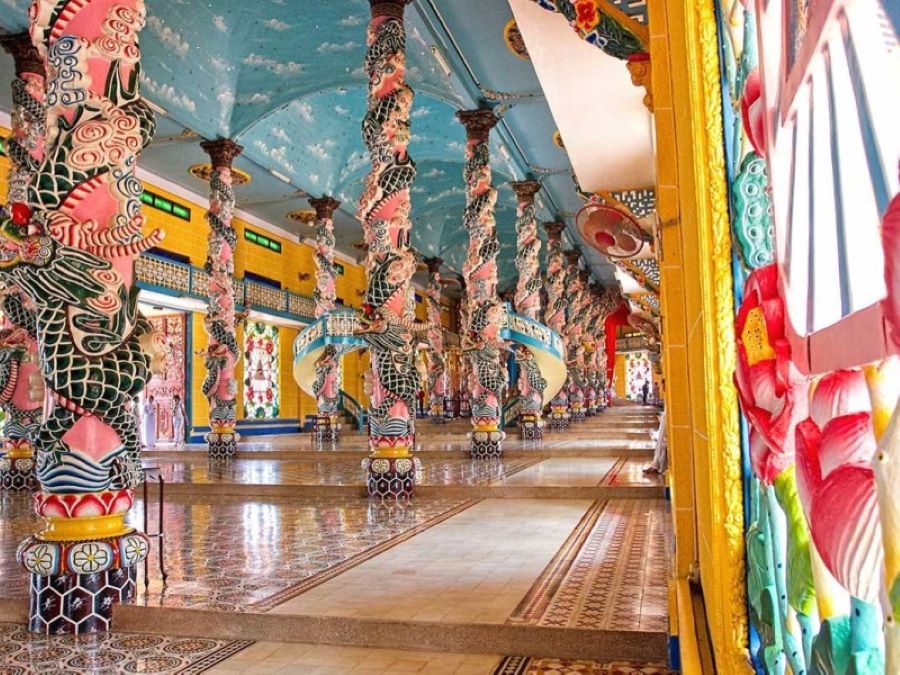
Cao Dai Holy See uses symbolic colors, dragon columns and the Divine Eye to express the theology of Caodaism.
Remove shoes before entering the main worship space. Men traditionally enter through the right-hand side and women through the left. Dress modestly and follow local instructions during ceremonies. The site’s dedicated guide to the Cao Dai Holy See provides additional religious and architectural context.
4. Reach the 986-Meter Summit of Ba Den Mountain
- Location: Tay Ninh Province
- Summit elevation: 986 m
- Best for: Mountain views, pilgrimage and accessible highland scenery
- Main cable routes: Van Son summit route and Chua Hang pilgrimage route
- Reference cable-car price: About VND 450,000 for the Van Son summit route
- Combined reference price: About VND 650,000 for Van Son and Chua Hang
Ba Den Mountain gives travelers a true mountain viewpoint without requiring a technical hike. At 986 m, it is the highest natural point in Southern Vietnam. The modern cable-car system separates two useful experiences: the Van Son route reaches the summit zone, while the Chua Hang route serves the Ba Temple religious complex.
The summit has become a substantial spiritual and sightseeing area rather than only a hiking destination. Visitors can see panoramic plains from the mountain and visit Buddhist monuments around the upper station. Travelers interested in older pilgrimage traditions should also allow time for the temple complex below the summit rather than riding up and immediately returning.
Operating hours vary by weekday, weekend and weather. Cable cars generally begin early in the morning and continue into the evening, but the operator changes schedules when necessary. Check the current timetable before departure. Ba Den pairs naturally with Cao Dai Holy See, but doing both well usually requires most of a day because the two places offer very different religious and landscape experiences.
5. Walk through Tan Lap Floating Village’s Cajuput Forest
- Location: Tay Ninh Province, in the former Long An area
- Best for: Wetland scenery and an easier nature extension from Ho Chi Minh City
- Core ecological area: More than 135 ha
- Buffer area: About 500 ha
- Forest walkway: Approximately 5 km
- Observation tower: About 38 m high
Tan Lap is useful for travelers who want a Dong Thap Muoi wetland experience without traveling as far west as Tra Su or Tram Chim. The ecotourism area protects a large block of cajuput forest surrounded by lotus, water lilies, grasses and seasonally flooded terrain.
The site’s most recognizable feature is a long paved walkway that runs through the cajuput forest. Visitors can also use small boats on wetland channels and climb the observation tower for a broad view over the forest canopy. The wider complex includes more than 135 ha in its core area and about 500 ha of buffer landscape.

Tan Lap lies within the wider Dong Thap Muoi wetland landscape, where cajuput forest and seasonally flooded vegetation replace the open river scenery farther south.
Older tourism sources list entrance prices that are no longer reliable enough for an evergreen guide, so confirm the current package directly before visiting. Tan Lap is best understood as the convenient wetland choice. Travelers prioritizing birding should consider Tram Chim, while those wanting the strongest flooded-forest boat imagery may prefer Tra Su.
6. Experience Mekong River Culture at Con Phung Islet
- Location: Tien River, Vinh Long Province, formerly part of Ben Tre Province
- Best for: First-time Mekong visitors and families
- Tourism area: More than 30,000 m²
- Main experiences: Riverboat access, gardens, local crafts and Coconut Religion heritage
- Time needed: About 2 hours within the tourism area, longer as part of a wider river excursion
Con Phung works best as an accessible introduction to the Tien River’s garden and island culture. The islet forms part of the traditional Long, Lan, Quy and Phung group of river islands. Its established tourism area covers more than 30,000 m² and combines garden scenery, local-product demonstrations and river activities.
The unusual historical layer is connected with Nguyen Thanh Nam, who established the Coconut Religion movement on the islet during the 20th century. Remnants of that religious complex remain part of the visitor area. They make Con Phung more than a generic coconut-garden stop, although visitors should understand that the site is a developed tourism attraction rather than an untouched Mekong village.
Administrative labels can be confusing because older maps place Con Phung in Ben Tre. After the 2025 reorganization, the former Ben Tre area became part of Vinh Long Province. Boats and packaged excursions remain the practical way to experience the river landscape, so costs depend heavily on the chosen transfer and activity package.
7. See Cai Rang Floating Market before Breakfast
- Location: Can Tho City
- Distance from central Can Tho: About 5 km
- Boat time from Ninh Kieu Wharf: About 30 minutes
- Best time: Approximately 05:00-08:00
- Heritage status: National intangible cultural heritage since 2016
- Time needed: Around 60-90 minutes at the market
Cai Rang is worth visiting only if you are willing to start early. Trading begins before sunrise and activity is strongest in the early morning. The market sits about 5 km from central Can Tho and takes roughly 30 minutes to reach by boat from Ninh Kieu Wharf.
The distinctive trading signal is the cây bẹo, a bamboo pole usually 3-5 m long. Sellers hang fruit or other goods from the pole so buyers can identify what a boat carries from a distance. Visitors can also buy breakfast dishes, coffee and drinks from small boats serving the market.

Cai Rang is most active around sunrise, when produce boats, breakfast vendors and buyers gather on the river.
An overnight stay in Can Tho produces a better market experience than leaving Ho Chi Minh City on the same morning. By the time a long road transfer arrives, the most active trading period may already have passed. The dedicated guide to Cai Rang Floating Market explains the river-trading culture in greater depth.
8. Boat through Tra Su Cajuput Forest
- Location: An Giang Province
- Forest area: About 850 ha
- Best for: Flooded forest, photography and birdlife
- Best seasonal character: Usually strongest during the high-water months around September-November
- Reference entrance: About VND 120,000
- Reference boat services: About VND 60,000 each for motorboat and rowing-boat services
Tra Su is the most visually immersive flooded-forest experience on this list. Small boats travel beneath cajuput trees through narrow channels that can become covered with bright green aquatic plants during favorable water conditions. The protected tourism landscape covers roughly 850 ha.
The visit normally combines faster motorboat transport with a quieter hand-rowed section. Birdlife includes waterbirds and forest species, with early morning and later afternoon generally better for wildlife activity than midday. An elevated observation area provides a broader view over the wetland beyond the narrow boat channels.
High-water months typically create the strongest flooded-forest appearance, but water levels vary with rainfall and hydrology. Travelers should not expect an identical bright-green surface every day of the year. The site’s Tra Su Cajuput Forest article can provide more ecological background.
Tra Su pairs especially well with Chau Doc and Sam Mountain. The combination gives one itinerary a wetland ecosystem and a major southern pilgrimage landscape without repeating the same experience.
9. Explore Sam Mountain and Ba Chua Xu Temple
- Location: Chau Doc area, An Giang Province
- Best for: Pilgrimage culture, religion and multi-ethnic heritage
- Main sites: Ba Chua Xu Temple, Tay An Pagoda, Thoai Ngoc Hau Tomb and Hang Pagoda
- Major festival: 22nd-27th days of the fourth lunar month
- UNESCO recognition: Festival inscribed on the Representative List of the Intangible Cultural Heritage of Humanity in 2024
Sam Mountain is one of Southern Vietnam’s strongest places for understanding popular religion rather than simply viewing temple architecture. The foothills contain several important religious sites, with Ba Chua Xu Temple forming the center of one of the country’s major pilgrimage traditions.
The annual Ba Chua Xu Goddess Festival runs from the 22nd to the 27th day of the fourth lunar month. UNESCO recognizes the festival for practices shared by Kinh, Khmer, Cham and Hoa communities. Major rituals include a palanquin procession, bathing and changing the goddess statue’s clothing, music, dance and offerings.
The festival period brings cultural intensity but also major crowds. Travelers interested mainly in architecture and religious history may prefer a quieter date. Clothing should cover shoulders and knees when entering active worship spaces. Avoid standing between worshippers and altars, especially during ceremonies.
Sam Mountain and Tra Su complement each other well. A Chau Doc-based itinerary can devote one part of the day to wetland ecology and another to religious and cultural heritage.
10. Go Birdwatching in Tram Chim National Park
- Location: Dong Thap Province, about 40 km from Cao Lanh
- Park area: 7,313 ha
- Recorded plants: About 130 species
- Recorded waterbirds: More than 198 species
- Official visitor reference: Approximately 2 hours
- Opening reference: 07:00-18:00
Tram Chim is the strongest choice on this list for travelers whose priority is wetland ecology and birds rather than scenic boat photography. The 7,313 ha national park preserves representative habitats of the Dong Thap Muoi floodplain, including seasonally flooded grasslands, lotus, wild rice and wetland channels.
More than 198 waterbird species have been recorded. The park is also historically important habitat for the red-crowned crane, but visitors should never treat crane sightings as guaranteed. Migration, water depth, feeding habitat and conservation conditions determine whether particular birds are present.
Boat and wetland routes change character with the hydrological cycle. Some seasons emphasize open grassland and birds, while higher water transforms access routes and vegetation. Early morning is preferable for birding and cooler temperatures.
Tra Su and Tram Chim therefore serve different travelers. Tra Su provides a stronger flooded-cajuput boat image. Tram Chim offers broader conservation and birding value. Travelers with limited time do not need to include both simply because they are wetlands.
11. Explore Can Gio Mangrove Biosphere Reserve
- Location: Southeastern Ho Chi Minh City
- UNESCO biosphere designation: 2000
- Reserve area: 75,740 ha
- Best for: Mangroves, environmental education and a nature day from the city
- Habitats: Mangrove forest, mudflats, salt marshes, wetlands and seagrass areas
- Main visitor areas: Vam Sat and Rung Sac
Can Gio provides the sharpest natural contrast to central Ho Chi Minh City without requiring a domestic flight. The UNESCO biosphere reserve covers 75,740 ha around a dense network of tidal rivers and estuaries. Mangroves, mudflats, wetlands and coastal habitats support fish, crustaceans, birds and other wildlife.
Can Gio’s present forest also represents an environmental recovery story. Much of the mangrove ecosystem was severely damaged during wartime, followed by extensive restoration and protection. This history makes the landscape relevant to both conservation and modern regional planning.
Most first-time visitors use Vam Sat or the Rung Sac historical area as an entry point. Some experiences require boats, and individual sub-sites have separate tickets or activity fees. Plan Can Gio as a full-day nature excursion rather than squeezing it between urban landmarks.
Can Gio and Cholon make an especially useful contrast within today’s expanded Ho Chi Minh City. One explains dense commercial and religious urban culture; the other reveals a protected coastal ecosystem.
12. Slow Down at Ho Tram Beach
- Location: Ho Chi Minh City, in the former Ba Ria-Vung Tau area
- Distance from central Ho Chi Minh City: Roughly 120-125 km
- Typical road time: About 2-2.5 hours under normal conditions
- Best for: Couples, families and short resort stays
- Recommended stay: 1-2 nights
- Nearby nature: Binh Chau-Phuoc Buu Nature Reserve
Ho Tram is the practical mainland beach choice for travelers who want to leave Ho Chi Minh City without adding an island flight or ferry. The coast lies roughly 120-125 km from the central city, making an overnight road trip more relaxed than a rushed return journey.
The destination is increasingly resort-oriented, so travelers should choose accommodation according to travel style. Large beachfront resorts suit families and travelers prioritizing facilities. Smaller properties provide a quieter base but may require transport for restaurants and other services.
The surrounding area adds enough variety for a two-night stay. Binh Chau-Phuoc Buu Nature Reserve protects coastal forest, while the wider Binh Chau area offers hot-spring and wellness facilities. These experiences distinguish Ho Tram from an urban beach day in Vung Tau.
Administrative labels on older websites may still say Ba Ria-Vung Tau Province. Since the 2025 reorganization, the former province has become part of the expanded Ho Chi Minh City. Weather and sea conditions still matter, especially during periods of strong wind or heavy rain.
13. Combine Nature and History in Con Dao National Park
- Location: Con Dao Special Zone, Ho Chi Minh City
- Archipelago: 16 islands
- National park forest: About 6,000 ha
- Protected marine area: About 14,000 ha
- Best for: Hiking, marine nature, quieter beaches and historical travel
- Recommended stay: At least 2-3 nights
Con Dao stands out because protected nature and difficult modern history occupy the same small island landscape. Much of the archipelago belongs to Con Dao National Park, which protects about 6,000 ha of tropical forest and 14,000 ha of marine environment.
Natural experiences include forest hikes, snorkeling, coral reefs and offshore islands such as Bay Canh. Sea-turtle conservation is an important part of the park’s work, but turtle-related visitor programs are seasonal and regulated. Never assume nesting or hatchling release is available simply because it appears in an older itinerary.
The historical layer requires a different tone. Con Son contains former prison sites, cemeteries and memorial locations associated with colonial rule and the wars of the 20th century. These are places of remembrance, not entertainment attractions. The site’s guide to things to do in Con Dao can help balance nature and historical visits.
Con Dao now belongs administratively to Ho Chi Minh City as a special zone. Access still feels like an island journey, so allow several nights rather than treating it as a simple extension of a city stay.
14. Island-Hop through the An Thoi Archipelago
- Location: South of Phu Quoc, An Giang Province
- Best for: Snorkeling, swimming and island hopping
- Main sub-entities: Mong Tay, Gam Ghi, May Rut and Hon Thom
- Time needed: Half day to full day
- Access: Boat, speedboat or selected cable-car combinations
- Practical limitation: Water visibility changes with wind, waves and recent rainfall
An Thoi is a better toplist entity than simply naming Phu Quoc because it identifies the part of the island region that travelers actually visit for coral and island hopping. Tours depart from southern Phu Quoc toward small islands with beaches, reef areas and swimming stops.
Mong Tay is commonly used as a beach stop. Gam Ghi is known for coral and snorkeling, while May Rut appears on many multi-island routes. Hon Thom adds the option of reaching the southern archipelago by an almost 8 km over-sea cable car from the main island.
Marine conditions should drive the itinerary. Snorkeling quality depends on underwater visibility, wind, wave height and the actual reef selected by the operator. Avoid descriptions that promise transparent water every day. Responsible tours should also prevent guests from standing on or collecting coral.
Phu Quoc is now part of An Giang Province after the 2025 provincial reorganization. Travelers planning several days on the island can use the Phu Quoc itinerary guide to combine An Thoi with northern beaches, local food and inland attractions.
15. Reach the Southern Mainland Landmark at Ca Mau Cape
- Location: Dat Mui area, Ca Mau Province
- Best for: Deep Mekong routes, mangrove scenery and geographic landmarks
- Signature landmark: National Coordinate Marker GPS0001
- Related sites: Hanoi Flag Tower replica, Ho Chi Minh Trail endpoint and coastal mangroves
- Trip role: Final extension of a longer Mekong journey, not a practical day trip from Ho Chi Minh City
Ca Mau Cape deserves a place because geographic position is part of the experience itself. National Coordinate Marker GPS0001 identifies the southern mainland extremity of Vietnam. Nearby visitor areas include the boat-shaped cape symbol, the Hanoi Flag Tower replica and the endpoint associated with the Ho Chi Minh Trail.
The more meaningful reason to travel this far south is the mangrove landscape. Water, alluvial mudflats and forest dominate the horizon, showing a very different Mekong environment from the fruit orchards around the upper delta or the flooded forests farther north.
Ca Mau Cape fits travelers already making a multi-day journey through the Mekong. Driving there from Ho Chi Minh City only to photograph the coordinate marker wastes much of the destination’s value. A better route moves gradually through Can Tho and the lower delta, then allows time for mangroves, seafood and community tourism around Dat Mui.
The article on Ca Mau and Hon Khoai provides another option for travelers continuing beyond the standard Mekong circuit.
How to Build a South Vietnam Itinerary
The 15 places above should not be treated as one checklist. Southern Vietnam is too large, and several items serve the same travel need. A good itinerary selects contrasting places that fit the available time.
| Trip Length | Realistic Focus |
|---|---|
| 3-4 days | Ho Chi Minh City + Cholon + Cu Chi, with either Can Gio or a short Mekong extension |
| 5-7 days | Ho Chi Minh City + Tay Ninh or Cu Chi + Can Tho + one deeper Mekong destination |
| 8-10 days | Ho Chi Minh City + Mekong circuit + Ho Tram, Con Dao or Phu Quoc |
| 10+ days | Combine urban culture, a western Mekong route and a southern island or Ca Mau extension |
A practical western Mekong route might link Can Tho, Chau Doc, Tra Su and Sam Mountain. Travelers more interested in conservation can choose Tram Chim instead. Ca Mau requires additional travel south, while Con Dao and Phu Quoc usually work better as separate island blocks.
For broader transport, accommodation and seasonal planning, the Mekong Delta travel guide provides regional context without repeating the attraction-level detail above.
Practical Tips for Visiting Southern Vietnam
- Do not rely on old province names alone: Major administrative mergers took effect in 2025. Older travel pages may still use Long An, Ben Tre, Ba Ria-Vung Tau or Kien Giang as province labels.
- Start floating-market days early: Cai Rang is most active around sunrise, not late morning.
- Keep wetland itineraries flexible: Flood depth, rain and seasonal vegetation change Tan Lap, Tra Su and Tram Chim.
- Respect active religious spaces: Dress modestly at Cao Dai Holy See, Ba Chua Xu Temple and other temples. Follow local rules about shoes and photography.
- Do not over-schedule islands: Wind and sea conditions can cancel snorkeling, turtle or boat activities even when the weather looks acceptable on land.
- Use one wetland, not three, on a short trip: Choose Tan Lap for convenience, Tra Su for flooded-forest scenery or Tram Chim for birding.
- Allow overnight stays where timing matters: Can Tho is better overnight for Cai Rang, while Ho Tram, Con Dao and Phu Quoc deserve more than a rushed day visit.
Plan Your Vietnam Trip with Paradise Travel
Paradise Travel is a licensed international tour operator based in Hanoi and established in 2005. We design private and tailor-made journeys for international travelers in Vietnam and neighboring Southeast Asian countries.
Southern Vietnam tour is particularly suited to customized planning because early market hours, seasonal wetlands, long road transfers and island weather do not fit neatly into a fixed sightseeing checklist. A private itinerary can connect the places that match your interests while avoiding unnecessary transfers between similar experiences.
Contact our travel consultants if you want to combine Ho Chi Minh City, the Mekong Delta, Southern Vietnam’s cultural sites and an island or beach stay in one route.

Address: 81 Alley 12 Dao Tan Street, Giang Vo Ward, Hanoi, Vietnam
Hotline: 0989391076
Email: sales@vietnamparadisetravel.com
Frequently Asked Questions

Start planning your tailor-made Southeast Asia tour by contacting one of our specialists…