Laos or Vietnam (2026): Which Country Should You Choose for Your Trip?
At Vietnam Paradise Travel, we often help travelers weigh the choice between Vietnam and Laos — and sometimes both. Based on recent travel data up to 2026 and what we see in real trip planning, this guide breaks down the practical differences so you can decide what truly fits your itinerary.
Laos or Vietnam 2026: Which Destination Is Better for Your Trip?
Vietnam is usually the better choice for first-time visitors, families, and travelers who want variety (culture, cities, nature, and beaches) in one trip. Laos is best suited to slow travel, river journeys, and a quieter atmosphere with fewer tourist-heavy zones.
For families traveling with children or mixed-age groups, Vietnam’s shorter travel distances and wider hotel choices often make planning easier. You can see typical routes and pacing in our Vietnam tours designed for families, which are designed around comfort and flexible schedules.
Vietnam vs Laos Travel Comparison: Key Highlights at a Glance
| Criteria | Vietnam | Laos |
|---|---|---|
| UNESCO World Heritage Sites | 9 sites | 3 sites |
| Coastline and beaches | About 3,260 km of coastline | Landlocked (no coastline) |
| International arrivals (most recent full year) | Over 21 million visitors (2025) | Nearly 4.6 million visitors (2025) |
| Flight connectivity | Multiple international gateways and dense domestic routes | Limited international gateways, fewer direct routes |
| Getting around | Efficient multi-stop travel across regions | Slower transfers, travel rewards flexibility |
| Best-fit travel style | Diverse, flexible itineraries | Slow, low-volume journeys |
| For detailed context and official data sources, please refer to the sections below. | ||
If Vietnam is already standing out after this quick comparison, it helps to step back and look at the country as a whole before diving into details. This Vietnam travel guide 2026 gives a broad overview of routes, regions, and what travelers typically experience on the ground.
UNESCO heritage and cultural depth
UNESCO-listed sites provide a clear, internationally recognized way to compare how each country’s cultural and natural heritage is acknowledged and distributed. As of February 2026, the number and classification of UNESCO World Heritage Sites offer a practical snapshot of how heritage recognition differs between Vietnam and Laos.
Vietnam
Vietnam has 9 UNESCO World Heritage Sites, including 6 cultural sites, 2 natural sites, and 1 mixed (cultural and natural) site. This places Vietnam among the countries in Southeast Asia with the most diverse and geographically distributed World Heritage listings. The classification and timeline of these sites are consistent with publicly available UNESCO records and summaries, including those referenced on Wikipedia’s list of World Heritage Sites in Vietnam.
The current UNESCO World Heritage Sites in Vietnam include:
- Cultural heritage (6):
- Complex of Hué Monuments (1993)
- Hoi An Ancient Town (1999)
- My Son Sanctuary (1999)
- Central Sector of the Imperial Citadel of Thang Long – Hanoi (2010)
- Citadel of the Ho Dynasty (2011)
- Yen Tu – Vinh Nghiem – Con Son, Kiep Bac Complex (2025)
- Natural heritage (2):
- Ha Long Bay – Cat Ba Archipelago (1994, 2000, extended 2023)
- Phong Nha – Ke Bang National Park (2003, extended 2015)
- Mixed heritage (1):
- Trang An Landscape Complex (2014)

For travelers, the practical advantage lies in variety. Vietnam’s UNESCO sites are spread across northern, central, and southern regions, making it possible to combine natural wonders, historic cities, and cultural landmarks within a single itinerary rather than focusing on one heritage hub.
Laos
Laos has 3 World Heritage Sites, all classified as cultural heritage. Unlike Vietnam, Laos does not currently have any UNESCO-listed natural or mixed (cultural and natural) sites. The country’s World Heritage recognition is therefore more focused on historical, architectural, and archaeological value.
The UNESCO World Heritage Sites in Laos include:
- Luang Prabang Town (1995): Recognized for its well-preserved urban fabric, where traditional Lao wooden houses coexist with French colonial architecture, reflecting a unique blend of local and colonial heritage.
- Wat Phou and Associated Ancient Settlements within the Champasak Cultural Landscape (2001): An extensive Hindu temple complex dating from the 5th to the 15th century, illustrating the historical influence of Khmer civilization in southern Laos.
- Megalithic Jar Sites in Xiengkhouang – Plain of Jars (2019): A remarkable archaeological landscape featuring thousands of large stone jars scattered across the plateau, dating back to the Iron Age.

According to publicly available UNESCO summaries, including the reference list on
Wikipedia’s overview of World Heritage Sites in Laos, all three sites are classified as tangible cultural heritage. Laos also has several locations on the UNESCO Tentative List, indicating potential future nominations.
Practical takeaway: Laos works best for travelers seeking deeper cultural immersion in a small number of heritage locations, while Vietnam is generally better suited to multi-region itineraries that combine a wider range of cultural and natural landmarks.
Nature, scenery, and the beach question
Vietnam’s coastal advantage
Vietnam is a coastal country with roughly 3,260 km of coastline. If beaches, islands, or a “culture plus relaxation” trip are priorities, Vietnam has a clear structural advantage. Coastal destinations range from historic central Vietnam to southern islands and quieter beach towns.

Vietnam beaches and culture
Laos: river and mountain landscapes
Laos is landlocked, so the natural experience is different rather than “less.” Think riverside life along the Mekong, limestone scenery, caves, waterfalls, and mountainous rural areas. Laos can be excellent for travelers who want inland nature and slower journeys built around scenery and local rhythm.
Food and dining experience
Vietnam

Food is a major highlight for many travelers to Vietnam. The country offers strong regional variety, from northern noodle dishes to central street food and southern flavors. Dining options are everywhere — from casual street stalls to mid-range restaurants and high-end dining in major cities. This regional contrast is one of the reasons many visitors find Vietnamese cuisine easy to explore even on short trips. For a closer look at how flavors change from north to south, this Vietnamese Food Guide for Travelers offers a helpful overview.
Laos

Laos cuisine is simpler and more localized. Meals often revolve around sticky rice, grilled meats, fresh herbs, and river fish, with fewer regional variations compared to Vietnam. Dining tends to be informal and closely tied to daily local routines. Travelers who enjoy discovering food through everyday markets and small eateries often find this part of Laos especially rewarding. For an overview of what visitors commonly try, this guide to must-try Lao dishes highlights some of the most typical flavors.
Practical takeaway: Vietnam is generally more appealing for travelers who see food as a key part of the journey, while Laos suits those who prefer simple, local meals as part of a slower, everyday experience.
Tourism scale and what it means in real life
Tourism scale affects more than just crowd levels. It influences how many transport options are available, how competitive prices can be, and how much flexibility travelers have when choosing hotels, tours, or making last-minute changes.
Vietnam
Vietnam’s tourism market is larger and more diversified than most destinations in mainland Southeast Asia. In 2025, Vietnam welcomed more than 21 million international visitors, marking a strong post-pandemic recovery and reinforcing the country’s position as one of the region’s leading inbound travel markets.
This scale of tourism demand translates into practical advantages for travelers: more international flight connections, a denser network of domestic routes, and a wider range of accommodation options across different regions and price segments. As a result, travelers generally have greater flexibility when adjusting itineraries due to weather, timing, or personal preferences.
Official government data on Vietnam’s tourism performance and recovery trends are published by the Vietnam Ministry of Culture, Sports and Tourism, which highlights sustained growth in international arrivals and the expanding role of tourism within the national economy.
Laos
Laos receives a smaller volume of international visitors compared to Vietnam, but recent figures show steady growth. In 2025, Laos welcomed nearly 4.6 million international tourists, exceeding its annual tourism target and marking a notable recovery for the sector.
This lower tourism scale is often seen as an advantage by travelers seeking a quieter and less commercialized atmosphere, particularly in heritage towns such as Luang Prabang and in rural regions along the Mekong corridor. At the same time, the smaller market size means fewer daily transport options and, in some areas, a more limited range of accommodation categories and services.
Recent reporting on Laos’ tourism performance, including international arrival figures for 2025, has been covered by regional media outlets such as The Laotian Times, alongside information released through national tourism channels.
Practical takeaway: Laos is best suited to travelers who value a slower pace and are comfortable planning around limited transport frequency, while Vietnam generally offers greater convenience for travelers on fixed schedules.
Transportation and accessibility
Flights and entry points
Vietnam has a relatively dense aviation network, with more than 20 civilian airports in operation, including multiple international gateways and frequent domestic flights linking major cities and tourist regions. This makes it realistic to combine several destinations within a short itinerary, even when traveling long distances from north to south.
Laos, by contrast, has a much smaller aviation network, with only a handful of international airports serving the entire country. International arrivals are concentrated at key gateways, and domestic flights operate on a limited number of routes with lower frequency. As a result, travelers often rely on regional connections or overland travel, which can increase overall transit time.
Road travel and ground transportation
Vietnam offers one of the most flexible and affordable ground transport environments in Southeast Asia. In addition to long-distance buses, sleeper coaches, private cars, and tourist shuttles, local mobility is strongly supported by motorbike taxis (“xe ôm”) and app-based ride-hailing motorbike services, which are widely available in cities and tourist areas.
Traditional “xe ôm” are easy to find almost everywhere, but it is advisable to agree on the fare in advance before starting the trip to avoid misunderstandings, especially in busy tourist areas. While most drivers are honest, confirming the price beforehand helps prevent rare cases of overcharging.

Ride-hailing motorbike services stand out for their transparency and cost efficiency. Prices are clearly shown before the trip begins, routes are tracked digitally, and travelers often benefit from promotional discounts or fare incentives. For short urban journeys, this makes motorbike taxis not only one of the fastest options but also one of the most economical and predictable.
In Laos, road travel plays a more central role due to limited flight coverage, but options are generally simpler. Long-distance journeys are typically made by buses, minibuses, or shared vans. Within towns and tourist centers, transport commonly includes taxis, tuk-tuks, and motorcycle taxis, where fares are usually negotiated directly and pricing can vary depending on distance, time, and local demand.
River transport along the Mekong and its tributaries remains important in parts of Laos, particularly in rural areas. While scenic and culturally immersive, these routes are slower and require greater flexibility compared to road or air travel.
Practical implication: Vietnam’s transport ecosystem supports fast, low-cost, and highly predictable movement at both city and regional levels, making it well suited to fixed itineraries. Laos rewards travelers who are comfortable with slower ground transport, fewer daily connections, and a more flexible travel pace.
Accommodation and travel services
Vietnam
Vietnam offers one of the most diverse accommodation markets in Southeast Asia. Travelers can choose from budget hostels and homestays, well-developed mid-range hotels, boutique properties, and a growing number of international-standard luxury resorts and city hotels. Beachfront villas in destinations such as Da Nang and Phu Quoc, along with high-end hotels in Hanoi and Ho Chi Minh City, make Vietnam particularly attractive for travelers seeking comfort and premium experiences.

This diversity is closely supported by a robust and varied transport system. Frequent domestic flights, extensive bus networks, and improving intercity infrastructure make it easier to move quickly between regions. As a result, Vietnam suits travelers who want convenience, predictable travel times, and the ability to combine multiple destinations within one trip.
Laos
Laos focuses more on small-scale, intimate accommodation, including guesthouses, boutique hotels, teak houses, and riverside bungalows. Budget options are widely available, and in some popular destinations, accommodation can be extremely inexpensive by regional standards. This makes Laos appealing to budget-conscious travelers and those seeking a more traditional or locally grounded stay.
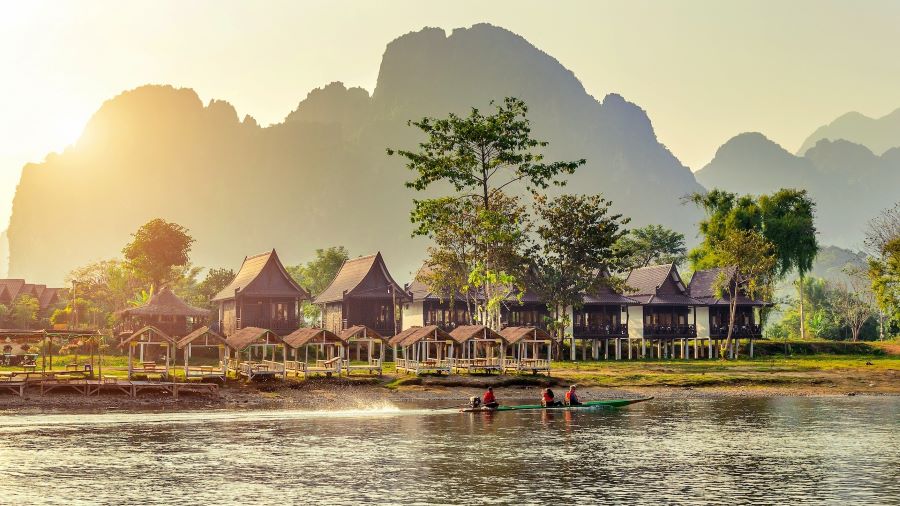
Travel services in Laos are simpler and slower. Overland travel by bus or minivan is common, and journeys between cities can take considerable time. While infrastructure continues to improve, transport options are fewer and less frequent, and taxis can feel relatively expensive compared to the general cost of living. This slower pace is part of the appeal for travelers who value a relaxed, rural atmosphere and are comfortable with flexible schedules.
Practical takeaway: Laos generally offers lower accommodation costs and a more laid-back, rustic travel experience. Vietnam provides broader choice, stronger mid-range and luxury options, and faster, more convenient transportation, making it better suited to travelers who prioritize comfort, variety, and efficient movement.
Budget and value for money
A more meaningful comparison than asking “Is Laos cheaper than Vietnam for travelers?” is understanding what you actually receive for the same travel budget. In practice, Vietnam and Laos differ less in headline prices than in how efficiently money is converted into comfort, time, and flexibility.
Vietnam: predictable costs and better cost control
Vietnam’s broad accommodation range and dense transport network allow travelers to fine-tune spending with minimal compromise. For a similar daily budget, it is often possible to choose between mid-range hotels, boutique stays, or selective luxury experiences while keeping travel time short and logistics smooth.
Transport costs are easier to manage due to frequent flights, competitive bus services, and widely available ride-hailing motorbike services with clear upfront pricing. This predictability reduces unexpected expenses and helps travelers maintain comfort without inflating the overall budget.
Laos: lower base prices, higher time and logistics costs
Laos can appear cheaper at first glance, particularly for accommodation, where guesthouses and small lodges are often inexpensive. However, fewer transport options and longer travel times can increase indirect costs. Limited schedules may require overnight stops, private transfers, or extended stays in transit towns, adding both time and expense.
For travelers who value slow movement and simplicity, these trade-offs can be acceptable or even desirable. For those on tighter schedules, however, the additional time and logistical friction can offset the savings from lower accommodation prices.
Practical takeaway: Vietnam generally delivers better value for travelers who prioritize comfort, efficiency, and cost predictability. Laos may cost less per night, but the true value depends on how much time flexibility and slower travel are part of the intended experience.
Laos or Vietnam: How to Choose the Right Destination for Your Travel Style
Vietnam is usually better if you:
- Are visiting Southeast Asia for the first time
- Travel with family or a mixed-age group
- Want beaches, cities, food, and heritage in one trip
- Have limited vacation time and prefer predictable logistics
Laos is usually better if you:
- Prefer slow travel and quieter destinations
- Enjoy river landscapes and rural immersion
- Want fewer tourist-heavy zones
- Are comfortable with longer transfers and simpler infrastructure
Final assessment
Laos is not a quieter version of Vietnam. It is a different destination built around slower movement, river and mountain landscapes, and a lower-volume tourism environment. Vietnam, by contrast, supports many travel styles in one country: heritage, food, cities, beaches, and nature—often with more predictable logistics.
If you want variety and flexibility within a limited timeframe, Vietnam is usually the clearer choice. If you want slower travel and a quieter atmosphere, Laos can be deeply rewarding—but it works best when you allow extra time for transfers and keep your plan flexible.
Frequently Asked Questions: Vietnam vs Laos Travel

Start planning your tailor-made Southeast Asia tour by contacting one of our specialists…