10 Must-See Attractions in Ho Chi Minh City for First-Time Visitors
The must-see attractions in Ho Chi Minh City reveal several versions of the same metropolis: wartime history at the War Remnants Museum and Independence Palace, French-era civic architecture around Cong Xa Paris, Chinese-Vietnamese heritage in Cho Lon, and contemporary street life on Nguyen Hue. Cu Chi Tunnels adds an important historical excursion beyond the central sightseeing area.
This Top 10 is designed for first-time international visitors who need more than a list of famous names. Each section explains current access, admission, time required, key features and the main limitation to consider. Most central attractions can be organized into compact walking routes, but Cu Chi needs a separate half or full day. Opening hours, event schedules and restoration access can change, so verify time-sensitive information shortly before visiting. The wider Ho Chi Minh City guide can help with weather, transport and neighborhood planning.
Ho Chi Minh City Attractions at a Glance
| Attraction | Best for | Area | Suggested time | Admission type |
|---|---|---|---|---|
| War Remnants Museum | Modern history and photojournalism | Xuan Hoa Ward | 1.5 to 2 hours | Ticketed |
| Independence Palace | History and modernist architecture | Ben Thanh Ward | 1.5 to 2 hours | Ticketed |
| Cu Chi Tunnels | Wartime history and an underground site | Northwestern Ho Chi Minh City | Half to full day | Ticketed |
| Notre-Dame Cathedral Basilica of Saigon | Religious and architectural heritage | Sai Gon Ward | 15 to 30 minutes | Exterior visit during restoration |
| Saigon Central Post Office | Historic architecture and maps | Sai Gon Ward | 20 to 40 minutes | Free public access |
| Ben Thanh Market | Food, shopping and market atmosphere | Ben Thanh Ward | 45 to 90 minutes | Free entry |
| Saigon Opera House | Architecture and live performance | Sai Gon Ward | 20 minutes or a full show | Exterior free, shows ticketed |
| Ho Chi Minh City Museum of Fine Arts | Vietnamese art and heritage interiors | Ben Thanh Ward | 1 to 1.5 hours | Ticketed |
| Thien Hau Pagoda | Chinese-Vietnamese culture | Cho Lon | 30 to 45 minutes | Free, donations optional |
| Nguyen Hue Walking Street | Evening city life and riverfront access | Sai Gon Ward | 45 to 90 minutes | Free |
1. War Remnants Museum
- Location: 28 Vo Van Tan Street, Xuan Hoa Ward, Ho Chi Minh City
- Best for: Travelers seeking historical context, photography and perspectives on the consequences of war
- Opening hours: 07:30 to 17:30 daily, with final admission at 17:00
- Admission: VND 40,000 for adults, with reduced or free admission for eligible younger visitors
- Main highlights: Nine permanent exhibition themes, war photography, anti-war material and outdoor military equipment
- Time needed: Approximately 1.5 to 2 hours
- Practical consideration: Several exhibitions contain graphic photographs and accounts that may distress children and sensitive visitors
The War Remnants Museum is the city’s most substantial introduction to the human consequences of twentieth-century warfare in Vietnam. Its collection contains more than 20,000 documents, artifacts, photographs and documentary films. The outdoor area displays aircraft, tanks and artillery, while the indoor galleries examine subjects including wartime photojournalism, international anti-war movements, prison conditions and the continuing effects of Agent Orange. The museum presents these subjects from a Vietnamese institutional perspective, which should be understood as part of the visit rather than treated as a reason to reduce the experience to military hardware.
Allow enough time for the photographic exhibitions, which often leave a stronger impression than the vehicles outside. The displays can be emotionally demanding, so families should decide in advance which rooms are suitable for younger children. English captions accompany much of the collection, although reading every panel can extend the visit beyond two hours. The museum is within a short ride or a manageable walk of Independence Palace, making the two sites a logical history-focused route. Visiting near opening time helps avoid both midday heat and larger tour groups. The dedicated War Remnants Museum guide provides additional background on the permanent exhibitions and nearby landmarks.

The War Remnants Museum combines outdoor military artifacts with detailed exhibitions on war and its human consequences.
2. Independence Palace
- Location: 135 Nam Ky Khoi Nghia Street, Ben Thanh Ward, Ho Chi Minh City
- Best for: Political history, modernist architecture and preserved state interiors
- Opening hours: 07:00 to 18:00 daily, except during separately announced official closures
- Admission: VND 40,000 for the palace or VND 80,000 for the combined palace and historical exhibition ticket for adults
- Main highlights: State rooms, presidential offices, rooftop, command bunker, communications rooms and landscaped grounds
- Time needed: Approximately 1.5 to 2 hours
- Practical consideration: The full route includes stairs and basement spaces, while respectful clothing is requested
Independence Palace, also widely called Reunification Palace, is the most important building for understanding the political geography of former South Vietnam. Vietnamese architect Ngo Viet Thu designed the present modernist structure after the earlier Norodom Palace was damaged in 1962. The new building was inaugurated in 1966. Its architecture incorporates geometric screens, ceremonial symmetry and symbolic forms while remaining closely adapted to the tropical climate through shade, ventilation and broad internal spaces.
The visit moves from formal reception rooms and presidential offices to communications facilities and the underground command bunker. These spaces help explain how political ceremony and military administration operated in the same complex. The palace is also associated with the final events of April 30, 1975, when tanks entered the grounds as the war ended in Saigon. Visitors interested in the building’s changing functions can add the exhibition “From Norodom Palace to Independence Palace 1868-1966” rather than purchasing only the palace ticket. An audio guide or a knowledgeable local guide makes the room functions and architectural symbolism easier to understand. Because the site covers 12 hectares, comfortable shoes and a slower pace are useful. A detailed Independence Palace visitor guide helps identify the most significant rooms instead of treating the building as a quick photo stop.

Independence Palace preserves both ceremonial state rooms and an underground command complex.
3. Cu Chi Tunnels
- Location: Ben Dinh and Ben Duoc visitor sites in northwestern Ho Chi Minh City
- Best for: Travelers interested in wartime engineering, rural history and a guided historical excursion
- Opening hours: Commonly 07:00 to 17:00 daily, but visitors should confirm the current schedule before departure
- Admission: Ticket structures differ by site, visitor category and optional activity
- Main highlights: Tunnel sections, concealed entrances, reconstructed facilities, documentary interpretation and wartime food
- Time needed: Two to three hours on site, normally a half or full day including transfers
- Practical consideration: Entering the narrow tunnels is optional and may not suit visitors with claustrophobia or limited mobility
Cu Chi Tunnels are the only attraction in this Top 10 that should be planned as a separate excursion from central Saigon. The underground system began developing during resistance against French colonial forces and expanded through later conflict. Visitor routes demonstrate how concealed entrances, ventilation, living areas, meeting spaces and defensive structures supported activity below and above ground. The sections open today have been prepared for visitors, but they remain narrow, dark, warm and physically demanding.
Choosing the correct site matters. Ben Dinh is closer to central Ho Chi Minh City and is used by many short group tours. Ben Duoc is farther away and is generally a better choice for travelers who prioritize historical depth and a broader memorial context. Allow roughly 1.5 to 2 hours of road travel each way, depending on traffic and pickup point. Wear closed shoes and clothes that can tolerate dust. Anyone uncomfortable underground can skip crawling and use the above-ground interpretation instead. Shooting activities are optional, separately charged and not necessary for understanding the site’s history. The Cu Chi Tunnels tour guide explains transport and site selection, while a Ho Chi Minh City and Cu Chi Tunnels full-day tour combines the excursion with central landmarks.

Visitors may enter prepared tunnel sections at Cu Chi, but going underground is optional.
4. Notre-Dame Cathedral Basilica of Saigon
- Location: 1 Cong Xa Paris, Sai Gon Ward, Ho Chi Minh City
- Best for: Religious heritage, historic architecture and an easy central walking route
- Current access: Closed to ordinary tourist visits inside during restoration, but open to worshippers attending scheduled Mass
- Admission: No charge for viewing the exterior or attending worship respectfully
- Main highlights: Red-brick facade, twin bell towers, Romanesque and Gothic Revival elements and the surrounding square
- Time needed: Approximately 15 to 30 minutes for an exterior visit
- Practical consideration: Scaffolding, barriers and changing sightlines are possible while the major restoration continues
Notre-Dame Cathedral Basilica of Saigon remains one of the city’s most recognizable religious buildings, but visitors need realistic expectations in 2026. Architect Jules Bourard designed the cathedral, which was constructed from 1877 to 1880 using materials associated with the French colonial building program. Its red-brick walls, rose windows, symmetrical facade and twin bell towers combine Romanesque massing with Gothic Revival details. The two restored gilded crosses were returned to the towers in March 2026, marking an important stage in the continuing conservation project.
The cathedral’s official notice currently states that ordinary tourists cannot enter for sightseeing during restoration. It remains an active place of worship and opens for scheduled Mass, including an English service listed for Sunday morning at the time of research. Travelers should not attend Mass simply to bypass visitor restrictions, and photography must not disturb worshippers. The most practical visit is therefore an exterior stop combined with the Central Post Office and nearby Book Street. Early morning offers softer light and less traffic around Cong Xa Paris, although construction equipment may affect photographs. The Saigon Notre-Dame Cathedral guide covers the building’s history, architectural features and worship context. Check the cathedral’s current notice shortly before visiting because access can change as restoration progresses.
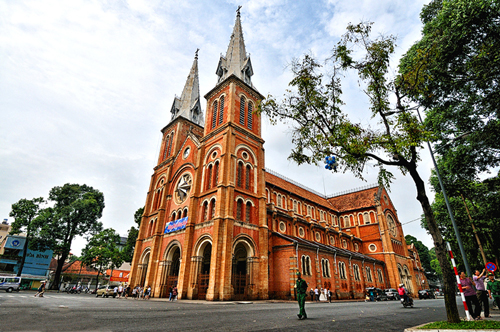
This earlier view shows the cathedral’s red-brick facade, while present-day sightlines may include restoration structures.
5. Saigon Central Post Office
- Location: 2 Cong Xa Paris, Sai Gon Ward, Ho Chi Minh City
- Best for: Historic civic architecture, interior photography and a short central stop
- Opening hours: Open daily as a working postal facility, with service hours subject to operational changes
- Admission: Free
- Main highlights: Vaulted hall, iron structure, tiled floor, historic maps, wooden counters and central clock
- Time needed: Approximately 20 to 40 minutes
- Practical consideration: Keep service counters clear because residents still use the building for postal business
Saigon Central Post Office is not only a preserved facade. It remains a functioning public building where postal services operate beneath one of the city’s most impressive historic interiors. The current structure was built from 1886 to 1891. Vietnam Post attributes the project to architects Villedieu and Foulhoux, while contemporary historical evidence gives a particularly strong role to Marie-Alfred Foulhoux. The widespread claim that Gustave Eiffel designed the present post office should therefore not be repeated as established fact.
Inside, the long vaulted hall draws attention toward the clock and portrait of Ho Chi Minh at the far end. Decorative ironwork, patterned floor tiles and rows of wooden counters preserve the character of a late nineteenth-century communications building. Two wall maps document Saigon and regional telegraph networks, providing more historical value than the souvenir stands that occupy parts of the hall. Because entry is free and the building stands directly opposite the cathedral, it can become crowded when large groups arrive. Visit early, take photographs without blocking customers, and allow people conducting postal business to reach the counters. Book Street is nearby, while Dong Khoi leads south toward the Opera House and riverfront. This makes the post office a useful transition between religious architecture, civic heritage and the modern center.

Saigon Central Post Office remains an active postal facility as well as a historic landmark.
6. Ben Thanh Market
- Location: Ben Thanh Ward, between Le Loi, Le Thanh Ton, Phan Boi Chau and Phan Chu Trinh streets
- Best for: First-time visitors seeking food, souvenirs and a central market experience
- Opening hours: 07:00 to 22:00 under current market rules, with some fresh-food and food businesses beginning from 04:00
- Admission: Free
- Main highlights: Food counters, coffee, dried goods, textiles, handicrafts, clothing and the clock-tower entrance
- Time needed: Approximately 45 to 90 minutes
- Practical consideration: Compare prices and agree on the cost before ordering or buying from non-fixed-price stalls
Ben Thanh Market is both a historic market building and one of central Saigon’s busiest visitor landmarks. Its four principal sides organize entrances around food, household goods, clothing, textiles, coffee, dried products and tourism-oriented souvenirs. Morning visits show more of the working food-market rhythm, while early evening brings a livelier dining and shopping atmosphere. The market’s current rules list operation from 07:00 to 22:00, with some food-related businesses starting earlier, although individual stalls do not all keep identical hours.
The opening of Ben Thanh Station on Metro Line 1 has made the area easier to reach without using a taxi. That convenience also makes the market a logical link between the Museum of Fine Arts, September 23 Park and the central boulevard network. Ben Thanh is heavily oriented toward visitors, so it should not be described as an untouched local market. Bargaining may be expected at stalls without fixed prices, but it should remain polite. Ask the price before food is prepared, check quantities and compare similar products before purchasing. Travelers looking for wholesale commerce and Chinese-Vietnamese neighborhood life should also explore Cho Lon. The dedicated Ben Thanh Market explains the entrances, product sections and evening format in more detail.

Ben Thanh Market combines food, shopping and direct access to Metro Line 1.
7. Saigon Opera House
- Location: 7 Lam Son Square, Sai Gon Ward, Ho Chi Minh City
- Best for: Architecture, evening performances and a Dong Khoi walking route
- Current access: Exterior viewing is unrestricted, while interior access normally requires a performance or event ticket
- Admission: Free for the exterior, with ticket prices varying by production and seat category
- Main highlights: Ornate facade, French Third Republic influence, historic auditorium, concerts, ballet and Vietnamese stage productions
- Time needed: About 15 to 20 minutes outside, or 1.5 to 2 hours with a performance
- Practical consideration: Confirm the official performance calendar because it is not a museum with guaranteed daytime interior tours
Saigon Opera House is most rewarding when travelers understand the difference between seeing a landmark and entering an active theater. The building opened in 1900 and displays the elaborate sculptural decoration and balanced facade associated with French civic architecture of the period. Its function has changed several times, including political use during the twentieth century, before returning to its role as a major performance venue. Today it hosts concerts, ballet, opera, contemporary productions, Vietnamese performing arts and official events.
There is no guaranteed walk-in museum route through the auditorium. Visitors who want to see the interior should consult the official schedule and purchase a ticket for an appropriate performance. Those without a show booking can examine the facade from Lam Son Square, ideally in the late afternoon when the light is softer. The Opera House sits beside an underground Metro Line 1 station and forms part of a compact walking route along Dong Khoi. Historic hotels, Nguyen Hue Walking Street and the Saigon River are all nearby. The Saigon Opera House history and architecture article adds context about the building’s changing roles. Avoid planning an interior visit based only on exterior opening assumptions, especially when private or civic events occupy the theater.
8. Ho Chi Minh City Museum of Fine Arts
- Location: 97A Pho Duc Chinh Street, Ben Thanh Ward, Ho Chi Minh City
- Best for: Vietnamese art, heritage interiors and an indoor midday visit
- Opening hours: 08:00 to 17:00 daily
- Admission: VND 30,000 for adults and VND 15,000 for eligible students and pupils
- Main highlights: Southern Vietnamese art, lacquer, sculpture, ceramics, stained glass, tiled floors and heritage architecture
- Time needed: Approximately 1 to 1.5 hours
- Practical consideration: Individual rooms may close temporarily for conservation or exhibition installation
The Ho Chi Minh City Museum of Fine Arts adds visual and cultural depth to an itinerary otherwise dominated by political history. Its principal building was once associated with the family of Hui Bon Hoa, a prominent businessman often known locally as Uncle Hoa. The architecture combines French planning with Chinese decorative influences, including patterned tile floors, stained glass, curved balconies and an early elevator structure. The building is therefore part of the experience rather than merely a container for the collection.
Galleries cover Vietnamese painting, sculpture, lacquer, ceramics and works connected with Ho Chi Minh City and southern Vietnam. Displays and temporary exhibitions can change, so visitors should focus on the relationship between the artworks, the mansion and the city’s cultural development rather than expecting one fixed masterpiece route. The museum works especially well during the hottest part of the day and sits within walking distance of Ben Thanh Market. Photography rules may vary by room, and some parts of the complex occasionally close for conservation or installation. The Ho Chi Minh City Museum of Fine Arts guide provides more detail on the building and collections. Allow at least an hour, because rushing through only the photogenic staircases misses the institution’s strongest value.

The Museum of Fine Arts combines Vietnamese collections with the architecture of a historic Saigon mansion.
9. Thien Hau Pagoda in Cho Lon
- Location: 710 Nguyen Trai Street in the Cho Lon area of Ho Chi Minh City
- Best for: Chinese-Vietnamese religious heritage, architecture and neighborhood culture
- Current access: An active temple generally visited during daytime worship hours
- Admission: Free, with respectful donations optional
- Main highlights: Courtyards, roof ceramics, incense coils, carved wood, ritual objects and altars dedicated to Thien Hau
- Time needed: About 30 to 45 minutes, or 2 to 3 hours with a wider Cho Lon route
- Practical consideration: Visitors must avoid blocking worshippers, using flash near altars or treating religious rituals as staged entertainment
Thien Hau Pagoda, formally associated with the Tue Thanh Assembly Hall, is one of the most meaningful places to understand Cho Lon’s Cantonese heritage. The temple is traditionally dated to 1760 and is dedicated to Thien Hau, also known as Mazu, a protective deity connected with seafarers. Its layout leads through a sequence of courtyards and halls filled with carved wood, hanging incense coils, historic ritual objects and richly modeled ceramic scenes along the roofline. These details express both religious belief and the community networks that shaped Chinese settlement in southern Vietnam.
This is a living place of worship, not a museum created around visitor photography. Wear clothing that covers shoulders and knees, keep voices low and ask permission before photographing individuals. The temple becomes especially active around the Lady Thien Hau festival on the 23rd day of the third lunar month, when worship and community events can also produce heavy crowds. A morning visit can be combined with Binh Tay Market, traditional medicine streets and a local meal. The Cho Lon Chinatown guide explains how the temple fits into the wider commercial and religious district. Travelers who visit only central Sai Gon Ward miss this important layer of the city’s identity, which reflects generations of Cantonese, Teochew, Hokkien and Hainanese settlement.
10. Nguyen Hue Walking Street
- Location: Sai Gon Ward, running from the City Hall area toward Ton Duc Thang Street and the Saigon River
- Best for: Evening walks, public street life, skyline views and first-night orientation
- Current access: Public space with vehicle and event arrangements that can change at specific times
- Admission: Free
- Main highlights: City Hall exterior, Ho Chi Minh statue, fountains, Cafe Apartment facade, public events and access to Bach Dang
- Time needed: Approximately 45 to 90 minutes
- Practical consideration: Major events and holidays can bring road closures, dense crowds and temporary barriers
Nguyen Hue Walking Street provides the clearest contrast to the museums and heritage buildings elsewhere in this list. The broad civic boulevard extends for approximately 670 meters from the City Hall area toward the river. Along the route, visitors encounter the Ho Chi Minh statue, fountains, contemporary towers, the well-known Cafe Apartment facade and changing displays or public performances. The boulevard becomes most animated after sunset, when families, young residents and visitors gather in the cooler evening air.
Begin near the City Hall exterior, which is an administrative building rather than an interior attraction, then walk south toward Bach Dang Waterfront Park. From the riverfront, travelers can continue with a dinner cruise or use the Saigon Waterbus. Waterbus tickets are one way, schedules are date-specific, and popular sunset departures may sell out, so check the official timetable before building an evening around the service. Nguyen Hue also connects easily with Dong Khoi, the Opera House and the surrounding dining area. Major celebrations, Tet displays and city events can make the boulevard spectacular but extremely crowded. The Ho Chi Minh City nightlife guide helps distinguish Nguyen Hue’s family-friendly public atmosphere from Bui Vien, rooftop bars and late-night clubs.
How to Plan Ho Chi Minh City Attractions by Time Available
| Time available | Recommended focus |
|---|---|
| Half day | Choose either War Remnants Museum plus Independence Palace, or Cathedral exterior plus Post Office, Opera House and Nguyen Hue. |
| One day | Combine the central history route with Cong Xa Paris, Dong Khoi, Ben Thanh and an evening walk on Nguyen Hue. |
| Two days | Add the Museum of Fine Arts and a separate Cho Lon route centered on Thien Hau Pagoda. |
| Three days | Add a half-day or full-day Cu Chi Tunnels excursion without compressing the central museums. |
A 2 or 3 days Ho Chi Minh City itinerary offers the best balance for first-time visitors. Group attractions geographically instead of traveling back and forth across the city. War Remnants Museum and Independence Palace form one cluster. The cathedral, post office, Dong Khoi, Opera House and Nguyen Hue form another. The Museum of Fine Arts and Ben Thanh Market can be combined before or after lunch, while Cho Lon deserves its own morning.
Practical Tips for Visiting Ho Chi Minh City Attractions
- Start outdoor routes early or continue them after 16:00 to reduce heat exposure.
- Carry water, sun protection and a light rain layer during the wet season.
- Use Metro Line 1 for Ben Thanh, Opera House and the eastern corridor when it fits the route.
- Use established ride-hailing services or licensed taxis and confirm the destination pin before departure.
- Cover shoulders and knees at active religious sites and maintain silence around worship.
- Keep valuables secure in dense markets, pedestrian events and crowded transport areas.
- Verify hours on the attraction’s official channel during public holidays or major city events.
- Do not schedule Cu Chi on the same half day as several central museums.
Plan Your Ho Chi Minh City Trip with Paradise Travel
Paradise Travel is a licensed international tour operator and destination management company. We are headquartered in Hanoi. The company has operated tours across Vietnam, Laos, Cambodia, Myanmar, and Thailand since the early 2000s. It proudly holds the TripAdvisor Travelers’ Choice Award for 2018, 2019, and 2024.
Planning Ho Chi Minh City tours requires careful timing to connect museums, heritage districts, markets and Cu Chi without spending most of the day in traffic. Let our local experts arrange knowledgeable guides, comfortable transportation and an itinerary matched to your interests. Get in touch with our team today!

Address: 81 Alley 12 Dao Tan Street, Giang Vo Ward, Hanoi, Vietnam
Hotline: 0989391076
Email: sales@vietnamparadisetravel.com
Frequently Asked Questions

Start planning your tailor-made Southeast Asia tour by contacting one of our specialists…