Where to Visit in Vietnam: 15 Must-See Places for Your Trip
Vietnam rewards travelers with an unusually wide range of places to experience, from limestone bays and mountain valleys to imperial palaces, ancient trading ports, underground tunnels and tropical islands. For a first trip, the challenge is rarely finding enough places to visit. It is deciding which ones deserve limited time in an itinerary.
This guide focuses on specific places rather than broad provinces. Instead of simply recommending Ninh Binh, Ha Giang or Sapa, it highlights Trang An Landscape Complex, Ma Pi Leng Pass and Muong Hoa Valley. Each destination is selected for a clear reason to visit and includes practical guidance on who it suits, how much time to allow and what not to miss.
Best Places to Visit in Vietnam at a Glance
| Place | Best for | Time needed | Region | Don’t miss |
|---|---|---|---|---|
| Ha Long Bay | Iconic scenery and cruises | 2 days / 1 night | North | Karst islands, caves, kayaking, sunset |
| Hoi An Ancient Town | Heritage, food and atmosphere | 1-2 days | Central | Japanese Covered Bridge, old houses, lantern-lit streets |
| Trang An Landscape Complex | Karst scenery and boat journeys | Half to full day | North | Boat route, caves, temples, limestone valleys |
| Ban Gioc Waterfall | Waterfalls and photography | 1-2 days | North | Quay Son River, bamboo raft, Nguom Ngao Cave |
| Muong Hoa Valley | Rice terraces and trekking | Half to full day | North | Lao Chai, Ta Van, terraces, ancient stone field |
| Ma Pi Leng Pass | Mountain-road scenery | Half to full day | North | Nho Que River, Tu San Canyon, viewpoints |
| Hue Imperial City | Royal history and architecture | Half to full day | Central | Ngo Mon Gate, palaces, temples, Forbidden Purple City |
| Phong Nha-Ke Bang National Park | Caves and adventure | 2-3 days | Central | Phong Nha Cave, Paradise Cave, jungle and rivers |
| My Son Sanctuary | Cham history and archaeology | Half day | Central | Cham tower-temples, museum, valley setting |
| Hanoi Old Quarter | Street life, food and culture | Half to full day | North | 36 guild streets, Ma May House, O Quan Chuong |
| Cu Chi Tunnels | Modern history | Half to full day | South | Underground passages, bunkers, Ben Dinh or Ben Duoc |
| Phu Quoc Island | Beaches and island holidays | 3-5 days | South | Sao Beach, An Thoi Islands, national park, seafood |
| Lan Ha Bay | Kayaking and quieter bay scenery | Full day or overnight | North | Hidden coves, karsts, kayaking, Cat Ba |
| Cai Rang Floating Market | Mekong river culture and food | 2-3 hours | South | Sunrise boat trip, fruit boats, breakfast on the river |
| Marble Mountains | Caves, temples and viewpoints | 2-3 hours | Central | Huyen Khong Cave, pagodas, Water Mountain |
1. Ha Long Bay – Best for Vietnam’s Iconic Seascape
- Where: Gulf of Tonkin in northeastern Vietnam, with most cruises departing from Ha Long or Tuan Chau.
- Best for: First-time visitors, couples, families and photographers.
- Time needed: Ideally 2 days and 1 night.
- Don’t miss: Limestone towers, an overnight cruise, caves, kayaking and sunrise or sunset on the bay.
Ha Long Bay is one of the places most closely associated with travel in Vietnam. Thousands of limestone formations rise from calm green water, creating a marine karst landscape of towers, caves, sheltered channels and forested islands. The wider UNESCO property is now recognized as Ha Long Bay – Cat Ba Archipelago, covering 65,650 hectares and including 1,133 islands and islets. For visitors, however, the experience remains simple: move slowly through the landscape by boat and allow the scale of the formations to reveal itself over several hours rather than viewing the bay only from shore.
An overnight cruise is generally more rewarding than a rushed day trip because it allows time for sunset, an early-morning view of the bay and activities such as kayaking or visiting a cave. Cruise routes vary, so compare the itinerary rather than choosing only by cabin quality. Some focus on famous sights, while others spend more time in quieter areas.

Ha Long Bay’s limestone islands, one of Vietnam’s most iconic sights
2. Hoi An Ancient Town – Best for Heritage and Atmosphere
- Where: Hoi An, Central Vietnam, beside the Thu Bon and Hoai rivers.
- Best for: Culture lovers, food travelers, couples and first-time visitors.
- Time needed: 1-2 days for the Ancient Town and nearby countryside.
- Don’t miss: Japanese Covered Bridge, Tan Ky Old House, Fujian Assembly Hall and the riverside after dark.
Hoi An Ancient Town is an exceptionally well-preserved former trading port where Vietnamese, Chinese, Japanese and European influences became embedded in the street plan and architecture. UNESCO identifies the town as an outstanding example of a Southeast Asian commercial port operating between the 15th and 19th centuries. Yellow merchant houses, assembly halls, ancestral homes, temples and narrow streets remain concentrated within a small historic core, making Hoi An one of the easiest major heritage sites in Vietnam to explore on foot.
Visit once in daylight and again after sunset because the atmosphere changes considerably. Morning is best for architecture, markets and quieter photographs, while evening brings lanterns, riverside restaurants and considerably larger crowds. Do not spend the entire stay inside the heritage core. Tra Que, Cam Kim, Cam Thanh and An Bang Beach are close enough to show how quickly Hoi An changes from historic town to farms, villages and coast.

Hoi An Ancient Town
3. Trang An Landscape Complex – Best for Karst Scenery and a Boat Journey
- Where: Ninh Binh, around 90-100 km south of central Hanoi.
- Best for: First-time visitors, families, nature lovers and photographers.
- Time needed: Half day for Trang An itself, full day when combined with nearby sites.
- Don’t miss: Rowboat journey, limestone caves, forested karsts, waterside temples and nearby Hoa Lu.
Trang An is much more than a scenic boat stop. The UNESCO-listed landscape covers 6,226 hectares of limestone massifs, enclosed valleys, subterranean waterways, forest and archaeological sites. Evidence found in local caves records human occupation stretching back more than 30,000 years, while nearby Hoa Lu later became the Vietnamese capital during the 10th and 11th centuries. This combination of geology, archaeology and cultural history is why Trang An is recognized as a mixed natural and cultural World Heritage property rather than simply a beautiful wetland.
The signature experience is a small rowboat journey through narrow waterways and cave passages beneath steep limestone cliffs. Allow enough time to enjoy the route rather than treating it as transport between temples. If you have a full day, combine Trang An with Hoa Lu or Hang Mua; trying to add Trang An, Tam Coc, Bai Dinh and Hang Mua into one short day usually creates more time in vehicles than in the landscape. Distances and suggested visit times for the surrounding sites are summarized in this Ninh Binh travel guide.

A rowboat journey through Trang An Landscape Complex
4. Ban Gioc Waterfall – Best for Dramatic Natural Scenery
- Where: Northeastern Vietnam on the Quay Son River at the Vietnam-China border.
- Best for: Nature travelers, photographers and visitors exploring remote northern Vietnam.
- Time needed: 1-2 days when combined with surrounding landscapes.
- Don’t miss: Main waterfall, bamboo raft, Quay Son River and nearby Nguom Ngao Cave.
Ban Gioc Waterfall spreads across a broad limestone valley where the Quay Son River breaks into multiple cascades along the international border. The main waterfall descends in three tiers over limestone cliffs, surrounded by forested karsts, cultivated fields and clear river water. The wider landscape forms part of Non Nuoc Cao Bang UNESCO Global Geopark, so the visual appeal of Ban Gioc is not isolated to the waterfall itself. Limestone caves, traditional villages and geological formations continue across the surrounding area.
A bamboo raft takes visitors close enough to feel the spray and see the scale of the main cascades from river level. Water volume is strongest during the wetter part of the year, while the drier months often produce clearer turquoise water and easier road conditions. Nguom Ngao Cave is close enough to combine with the waterfall and adds a very different underground limestone environment. Ban Gioc is remote from Hanoi, so avoid planning it as an exhausting out-and-back day trip. Staying in the region creates time for the waterfall, cave and local Tay and Nung communities without spending most of the visit on the road.
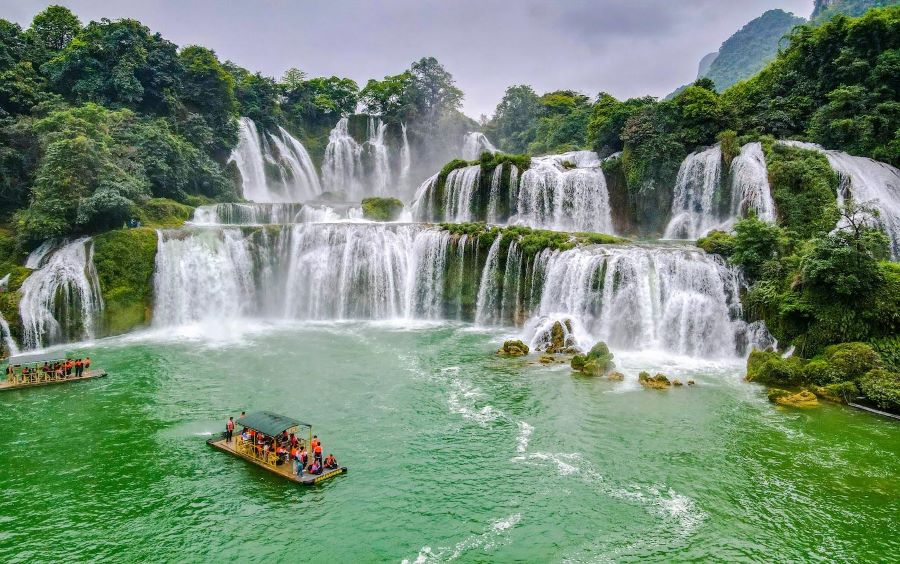
Ban Gioc Waterfall, one of Vietnam’s most dramatic natural sights
5. Muong Hoa Valley – Best for Rice Terraces and Mountain Culture
- Where: Southeast of Sapa town in the Hoang Lien mountains.
- Best for: Trekkers, photographers and travelers interested in highland communities.
- Time needed: Half day to full day.
- Don’t miss: Lao Chai, Ta Van, terraced fields, Muong Hoa stream and the ancient stone field.
Muong Hoa Valley is one of the strongest reasons to travel beyond Sapa town. Terraced rice fields descend across steep hillsides around villages such as Lao Chai and Ta Van, while the Muong Hoa stream follows the floor of the valley beneath the Hoang Lien mountains. The landscape is also cultural rather than purely scenic. Hmong, Giay and other highland communities have shaped the terraces through generations of farming, and village paths provide a closer look at homes, agriculture and daily routines than viewpoints beside the main road.
Walking is the best way to experience the valley because distances that look short on a map often involve steep paths and changing elevation. A common route descends from the Sapa side toward Lao Chai and Ta Van, with transportation arranged for the return if travelers do not want to climb back. Rice-field colors change dramatically through the agricultural cycle, so the same valley can look very different between planting and harvest. More detail on villages, trekking, the ancient stone field and seasonal scenery is available in this Muong Hoa Valley guide.

Rice terraces across Muong Hoa Valley
6. Ma Pi Leng Pass – Best for Mountain-Road Scenery
- Where: Between Dong Van and Meo Vac in Vietnam’s far northern highlands.
- Best for: Adventure travelers, road-trip enthusiasts and landscape photographers.
- Time needed: Half to full day as part of a wider highland itinerary.
- Don’t miss: Nho Que River, Tu San Canyon, mountain viewpoints and the road toward Meo Vac.
Ma Pi Leng Pass is one of the most dramatic sections of mountain road in Vietnam. The route between Dong Van and Meo Vac climbs high above the Nho Que River as limestone peaks and canyon walls fall steeply toward the valley below. Vietnam Tourism describes the Dong Van to Ma Pi Leng stretch as one of the country’s most striking roads, and the relatively short distance can take much longer than expected because the scenery encourages repeated stops.
The famous roadside viewpoints are only part of the experience. A side route toward the Nho Que River provides a lower perspective on Tu San Canyon, while Dong Van and Meo Vac add markets, old streets and highland communities to the journey. Travelers without strong motorbike experience should not feel pressured to ride independently simply because the Ha Giang Loop is commonly associated with motorcycles. A private car with an experienced local driver can offer the same scenery with less risk and more time for stops. Broader route planning around Dong Van, Meo Vac and the karst plateau is covered in this Ha Giang travel guide.

The winding road along Ma Pi Leng Pass
7. Hue Imperial City – Best for Vietnam’s Royal History
- Where: On the north bank of the Perfume River in Hue.
- Best for: History lovers, architecture travelers and first-time visitors to Central Vietnam.
- Time needed: Half day for the Imperial City, full day with nearby royal monuments.
- Don’t miss: Ngo Mon Gate, royal courtyards, temples, palaces and the Forbidden Purple City area.
Hue became the capital of unified Vietnam in 1802 and remained the political, cultural and religious center of the Nguyen Dynasty until 1945. The Imperial City sits within the larger Hue Citadel and forms the heart of the UNESCO-listed Complex of Hue Monuments. Its layout was conceived according to Vietnamese royal planning, natural geography and cosmological principles, with the Perfume River and Ngu Binh Mountain contributing to the symbolic landscape.
Give the complex enough time for more than a quick walk from Ngo Mon Gate to the main courtyard. Temples, gates, gardens and restored palace structures reveal how the royal precinct was organized and how ceremonial, administrative and residential spaces differed. The Imperial City is only one component of Hue’s royal landscape. Minh Mang, Tu Duc and Khai Dinh tombs, Thien Mu Pagoda and the Perfume River extend the historical narrative outside the citadel walls. Travelers deciding how much time to allocate can use this article on why Hue is worth visiting to connect the Imperial City with the wider royal landscape.

Hue Imperial Citadel.
8. Phong Nha-Ke Bang National Park – Best for Caves and Adventure
- Where: North-central Vietnam in the Truong Son limestone region.
- Best for: Adventure travelers, hikers, caving enthusiasts and nature lovers.
- Time needed: At least 2-3 days for a useful first visit.
- Don’t miss: Phong Nha Cave, Paradise Cave, jungle trails, Chay River and Dark Cave.
Phong Nha-Ke Bang protects one of the world’s most important limestone karst landscapes. The geological system began developing roughly 400 million years ago, and the wider UNESCO property now extends across the Vietnam-Laos border with Hin Nam No National Park. More than 220 kilometers of documented caves and underground waterways occur across the transboundary property, while the Vietnamese side contains enormous cave chambers, subterranean rivers, tropical forest and exceptional biodiversity.
Son Doong receives most international attention, but it should not define an ordinary visit because access requires a specialist multi-day expedition booked well in advance. Most travelers can experience the region through Phong Nha Cave, Paradise Cave, Dark Cave, kayaking, cycling and hiking. Staying two or three nights also creates time for Bong Lai Valley and the rivers around Phong Nha town. The dry-season months are generally better for cave and outdoor activities because heavy rain can affect access. A practical first-trip structure is outlined in this 2-day Phong Nha itinerary.

Phong Nha-Ke Bang National Park
9. My Son Sanctuary – Best for Cham Heritage
- Where: In a mountain valley around 40 km from Hoi An.
- Best for: Archaeology, architecture and ancient-history travelers.
- Time needed: Around half a day.
- Don’t miss: Cham tower-temples, stone carvings, museum displays and the valley setting.
My Son Sanctuary preserves the remains of a religious and political center of the Champa Kingdom whose development stretched from the 4th to the 13th centuries. Hindu religious ideas from India were adapted into a distinct Cham architectural tradition, visible in the surviving brick tower-temples, stone pillars and sandstone carvings. UNESCO recognizes the complex as an exceptional expression of Champa civilization, set within a secluded valley surrounded by mountains.
The structures are most meaningful with historical context, so visit the interpretation area or use a knowledgeable guide before moving through the temple groups. Look closely at the brick construction, sculptural details and different architectural styles rather than treating the site as a collection of ruins for photographs. Starting early improves both comfort and atmosphere because much of the site is exposed to the sun. Hoi An is the most practical base, making My Son easy to combine with a longer Central Vietnam stay. Historical background, architecture and visiting advice are covered in this detailed My Son Sanctuary guide.

Cham tower-temples at My Son Sanctuary
10. Hanoi Old Quarter – Best for Street Life and Local Food
- Where: North of Hoan Kiem Lake in central Hanoi.
- Best for: Food travelers, first-time visitors, photographers and urban culture.
- Time needed: Half to full day, plus an evening if possible.
- Don’t miss: Historic guild streets, Ma May House, O Quan Chuong, street food and traditional coffee.
Hanoi Old Quarter is not a single monument but a living historic district shaped by trade, craft guilds and dense urban life. Its famous 36 streets were historically associated with particular trades, and traces remain in names such as Hang Bac, Hang Ma and Hang Gai. Tube houses, temples, old shopfronts, markets and food stalls create a street environment that is visually chaotic but culturally layered. O Quan Chuong preserves the memory of Hanoi’s former city gates, while Ma May House offers a closer look at traditional merchant architecture.
Walking is more rewarding than trying to complete a checklist of landmarks. Start around Hoan Kiem Lake or the quieter edges of the quarter, then move through individual streets while stopping for food and coffee. Early morning shows markets and local routines, while evening brings street dining, bars and weekend pedestrian activity. Traffic can be overwhelming at first, so a cyclo or guided walking tour is useful for orientation. The history of the guild streets, architecture and practical walking areas is explained in this Hanoi Old Quarter guide.

A small coffee shop in the Old Quarter
11. Cu Chi Tunnels – Best for Modern Vietnamese History
- Where: Northwest of central Ho Chi Minh City.
- Best for: History travelers and first-time visitors interested in the wartime period.
- Time needed: Half day, or full day when combined with Ho Chi Minh City sightseeing.
- Don’t miss: Tunnel passages, underground rooms, concealed entrances and historical interpretation.
The Cu Chi Tunnels form a vast underground network developed and expanded over decades of conflict. Vietnam Tourism describes a system of approximately 250 kilometers containing communication routes, bunkers, kitchens, sleeping areas, medical facilities, wells, storage spaces and defensive positions. The site illustrates how underground infrastructure supported military operations and daily survival during an extended period of warfare.
Visitors usually choose between Ben Dinh and Ben Duoc. Ben Dinh is commonly used by shorter tours, while Ben Duoc provides another perspective on the tunnel complex and surrounding historical landscape. Some tunnel sections have been adapted so visitors can enter them, but crawling underground is optional and can feel restrictive for anyone uncomfortable in confined spaces. The site is much more meaningful when interpreted historically rather than treated as an adventure attraction. Travelers can prepare for the visit by reading this Cu Chi Tunnels guide, which covers the history, transportation and main visitor areas.

Cu Chi Tunnels
12. Phu Quoc Island – Best for Beaches and Island Time
- Where: Southwestern Vietnam in the Gulf of Thailand.
- Best for: Beach holidays, couples, families, diving and resort stays.
- Time needed: 3-5 days.
- Don’t miss: Sao Beach, An Thoi Archipelago, Phu Quoc National Park, fishing villages and seafood.
Phu Quoc is large enough that it should be treated as an island destination rather than a single beach stop. Its roughly 150-kilometer coastline includes long resort beaches, smaller northern coves and access to the An Thoi islands in the south. More than half of the island is associated with protected forest within the wider UNESCO Biosphere Reserve landscape, creating a contrast between developed coastal areas and greener inland and northern sections. Pepper farms, fish sauce production and fishing communities also remain part of the island’s identity.
Three to five days gives enough time to combine beach time with at least one island-hopping or snorkeling day and some exploration away from the resort. Long Beach is convenient for sunsets, Sao Beach is known for pale sand and clear water, and the An Thoi area provides access to smaller offshore islands. The drier months generally produce calmer beach conditions. Because the island is larger than many first-time visitors expect, group activities by area rather than repeatedly driving from one end to the other.

Hon Thom Island, part of the Phu Quoc archipelago
13. Lan Ha Bay – Best for Kayaking and Quieter Bay Scenery
- Where: East and southeast of Cat Ba Island in northern Vietnam.
- Best for: Active travelers, kayakers and visitors combining the bay with Cat Ba.
- Time needed: Full day or an overnight cruise.
- Don’t miss: Limestone karsts, secluded coves, kayaking, swimming and Cat Ba Island.
Lan Ha Bay shares the same wider limestone seascape that makes the Gulf of Tonkin famous but offers a slightly different travel experience from the classic Ha Long cruise routes. Hundreds of karsts rise from sheltered water around Cat Ba Island, creating narrow channels, small beaches, lagoons and coves that are particularly well suited to kayaks and smaller boats. The scenery is intimate enough that active exploration often becomes more important than simply watching the landscape from a cruise deck.
Lan Ha works especially well for travelers already staying on Cat Ba because day boats can combine kayaking, swimming and coastal scenery without requiring another long transfer. Overnight cruises are also available, but check the actual route because some products marketed as Ha Long cruises spend much of their time in Lan Ha and vice versa. Travelers who value internationally iconic scenery and a traditional cruise may still prefer Ha Long Bay, while Lan Ha is attractive for kayaking and Cat Ba access. This comparison of Ha Long, Bai Tu Long and Lan Ha bays explains the main differences.
14. Cai Rang Floating Market – Best for Mekong River Culture
- Where: On the river near Can Tho in the Mekong Delta.
- Best for: Food travelers, photographers and visitors interested in river commerce.
- Time needed: Around 2-3 hours in the early morning.
- Don’t miss: Sunrise boat ride, wholesale fruit boats, produce displayed on poles and breakfast on the river.
Cai Rang Floating Market is one of the clearest places to experience the historical relationship between commerce and waterways in the Mekong Delta. Large wooden boats arrive carrying agricultural products and fruit, while smaller vessels move between them selling breakfast, coffee and daily necessities. Vendors traditionally display samples of their goods from tall poles so buyers can identify what each boat is carrying from a distance. The result is less like a conventional market with stalls and more like a moving network of wholesale trade on the water.
Timing determines the experience. Leave Ninh Kieu Wharf around 5:00 am so you reach the river as daylight develops and commercial activity is still strong. Arriving late in the morning misses much of the atmosphere. A private small boat provides more flexibility to stop for breakfast and continue into smaller canals after the market. Cai Rang has changed as road transport and supermarkets have expanded, so visit it as a living economic tradition rather than expecting a staged attraction. Practical boat times and visitor advice are covered in this Can Tho floating market guide.

Cai Rang Floating Market at sunrise
15. Marble Mountains – Best for Caves, Temples and Viewpoints
- Where: Around 7 km south of central Da Nang on the road toward Hoi An.
- Best for: Culture, spirituality, photography and short sightseeing stops.
- Time needed: Around 2-3 hours.
- Don’t miss: Thuy Son, Huyen Khong Cave, Tam Thai Pagoda, Linh Ung Pagoda and panoramic viewpoints.
Marble Mountains, known locally as Ngu Hanh Son, consists of five limestone and marble peaks named for the five elements: metal, water, wood, fire and earth. The mountains have been associated with spiritual practice for centuries, with caves, shrines, Buddhist pagodas and viewpoints occupying different levels of the karst landscape. Thuy Son, or Water Mountain, contains the concentration most visitors explore, including Tam Thai Pagoda, Linh Ung Pagoda and several atmospheric caverns.
Huyen Khong Cave is the strongest individual highlight. Openings in the collapsed ceiling allow shafts of sunlight to enter the large chamber, illuminating Buddhist shrines and rock walls. Expect many stone steps and uneven surfaces even if you use the elevator for part of the ascent. Early morning is the best time to avoid both strong heat and large tour groups, and modest clothing is appropriate around active religious sites. Marble Mountains is easy to combine with Da Nang or a road transfer toward Hoi An. Other nearby cultural and natural stops are included in this overview of places to visit in Central Vietnam.
Practical Tips for Visiting Vietnam’s Must-See Places
- Do not plan the trip by distance alone. Mountain roads around Ma Pi Leng and Ban Gioc take considerably longer than an equivalent distance on an expressway.
- Give major natural sites enough time. Ha Long Bay works better overnight, Phong Nha deserves at least two days, and Phu Quoc is better treated as a multi-night destination.
- Start early at crowded heritage sites. Hoi An, My Son, Marble Mountains and Trang An are usually more pleasant before the largest tour groups arrive.
- Match the season to the experience. Rice terraces, waterfalls, beaches and caves can change dramatically with rainfall, harvest cycles and sea conditions.
- Use local guides where interpretation matters. Hue, My Son, Cu Chi and highland ethnic areas become much more meaningful when historical and cultural context is explained accurately.
- Group nearby places together. Hoi An, My Son and Marble Mountains fit naturally into one Central Vietnam itinerary, while Trang An can be combined with Hoa Lu and Hang Mua.
- Avoid trying to see the entire country too quickly. Travelers with one week are usually better focusing on one or two regions rather than spending every day transferring between major sights.
Plan Your Vietnam Trip with Paradise Travel
Paradise Travel is a licensed international tour operator and destination management company headquartered in Hanoi. The company was established in 2005 and operates under International Tour Operator License No. 01-2161/2023/TCDL-GP LHQT. Its local consultants arrange accommodation, private transportation, guides and tailor-made itineraries throughout Vietnam and neighboring Southeast Asian destinations.
Travelers who want to connect several of these places without building every transfer independently can explore Vietnam discovery tours covering combinations of Hanoi, Ha Long Bay, Ninh Binh, Sapa, Hoi An, Hue, Ho Chi Minh City and the Mekong Delta. Routes can be adjusted according to available time, travel style and the regions you want to prioritize.
Get in touch with our team for personalized itinerary planning based on your travel dates, interests and budget.

Address: 81 Alley 12 Dao Tan Street, Giang Vo Ward, Hanoi, Vietnam
Hotline: 0989391076
Email: sales@vietnamparadisetravel.com
Frequently Asked Questions

Start planning your tailor-made Southeast Asia tour by contacting one of our specialists…