

15 Most Beautiful Cultural Towns, Villages and Quarters in Vietnam
Vietnam’s most memorable small destinations are not always the places with the biggest monuments or beaches. Some are old trading towns, mountain settlements, farming villages or historic quarters where architecture, food, religion and community traditions still shape daily life. These places give foreign travelers a closer look at how different parts of Vietnam developed their own cultural identities.
This list uses “town” in a traveler-facing sense rather than as a strict administrative category. It includes historic towns, villages and compact cultural quarters that reward slow exploration on foot, by bicycle or through a homestay. The destinations are arranged roughly from north to south.
A second research pass also considered places such as Phong Nha, Cat Ba, Tam Dao, Mui Ne and Con Dao. They remain worthwhile destinations, but their strongest travel appeal comes primarily from caves, islands, beaches or larger natural attractions. The 15 places below were prioritized because the settlement itself and its living culture are central to the experience.
Which cultural towns and villages in Vietnam are worth exploring?
| Destination | Distinct cultural identity | Best for |
|---|---|---|
| Dong Van | Karst highland trading town | Architecture, mountain markets, road trips |
| Lo Lo Chai | Lo Lo earthen-house village | Homestays, ethnic culture, embroidery |
| Bac Ha | Multi-ethnic Sunday market town | Markets, food, traditional horse racing |
| Sa Pa | Mountain hub surrounded by ethnic villages | Trekking, textiles, community culture |
| Quynh Son | Tay stilt-house village | Then singing, homestays, rural heritage |
| Mai Chau | White Thai valley communities | Stilt houses, cycling, weaving |
| Duong Lam | Traditional Red River Delta village | Laterite architecture, ancient houses |
| Tam Coc | Karst river village and rice landscape | Cycling, temples, rural life |
| Hoi An | Historic international trading port | Architecture, food, crafts |
| Tra Que | Herb-growing village | Farming, cooking, sustainable tourism |
| Da Lat | Creative highland town | Music, coffee, flowers, architecture |
| Cholon | Chinese-Vietnamese commercial quarter | Temples, markets, food |
| Sa Dec | Mekong flower and literary town | Flowers, old houses, Chinese heritage |
| Chau Doc | Multi-faith Mekong border town | Cham, Khmer, Hoa and Kinh culture |
| Ha Tien | Historic southern frontier town | Literary heritage, temples, border culture |
1. Dong Van Ancient Town
Dong Van Ancient Town is one of Vietnam’s most atmospheric mountain settlements for travelers interested in both architecture and ethnic culture. The compact old quarter lies within the Dong Van Karst Plateau UNESCO Global Geopark, surrounded by limestone mountains that make the settlement feel dramatically enclosed.
The historic core contains around 40 old houses, many dating from the late 19th and early 20th centuries. Thick walls, yin-yang roof tiles and deep-fronted shop houses reflect adaptations to the cold highland climate as well as Chinese and local architectural influences. The central market square remains the natural gathering point of the town.
Dong Van becomes more interesting when travelers look beyond the buildings. H’Mong, Tay, Dao, Lo Lo and other communities from surrounding valleys bring produce, textiles and livestock into regional markets. Corn-based dishes, smoked meat and local spirits reflect an agricultural landscape where rice cultivation is not always possible.
Stay overnight rather than passing through at midday. Early morning and evening reveal a quieter side of the old quarter, when cafes, kitchens and market lanes return to a local rhythm. Dong Van also fits naturally into the Ha Giang Loop, together with Ma Pi Leng Pass, Lung Cu and the Nho Que River.

Dong Van Old Quarter
2. Lo Lo Chai Village
Lo Lo Chai is one of the strongest new additions to this list. Located below Lung Cu Flag Tower near Vietnam’s northern frontier, the village was named a Best Tourism Village by UN Tourism in 2025 for its cultural preservation and community-led tourism.
The settlement is home to the Lo Lo ethnic community and preserves distinctive trinh tuong houses built from compacted earth. UN Tourism notes that some traditional homes are more than 200 years old. Their thick clay walls regulate temperature during the cold mountain winter and create the ochre-colored streets that give the village much of its visual identity.
Culture remains visible beyond architecture. Local families maintain embroidered clothing, ancestral rituals, harvest traditions and their own language. Visitors can learn basic embroidery, eat family meals and stay overnight in community-run homestays.
On Friday and Saturday evenings, the community cultural house hosts performances from roughly 8:00 PM to 10:00 PM. Folk songs, dances and bamboo games turn the evening into a shared activity rather than a staged daytime photo opportunity.
Lo Lo Chai is particularly rewarding for travelers already exploring Dong Van. Spend a night rather than making a quick stop after Lung Cu, and ask permission before photographing residents or entering private homes.

Lo Lo Chai Village
3. Bac Ha
Bac Ha is most rewarding for travelers who want a functioning highland market town rather than a polished mountain resort. Its Sunday market draws H’Mong, Dao, Tay, Nung, Phu La and other communities from the surrounding uplands.
The market is not simply a handicraft bazaar. Separate areas sell livestock, vegetables, agricultural tools, textiles and household goods, while food stalls serve dishes such as thang co, men men, noodles and corn liquor. The social purpose of the market remains as important as shopping, with families and traders using Sunday as a weekly meeting point.
Bac Ha also changes dramatically with the agricultural calendar. Tam Hoa plum trees cover the surrounding hills with white flowers early in the year, followed by the fruit harvest around May and June. This seasonal landscape explains the long-standing nickname “White Plateau”.
The town’s most distinctive festival is traditional horse racing. The practice entered Vietnam’s National Intangible Cultural Heritage list in 2021. Local riders traditionally compete without conventional saddles on horses otherwise used for farming and transport. In 2026, Bac Ha staged the 19th edition of the race as part of its summer cultural program.

Bac Ha combines a working Sunday market with plum-growing landscapes and highland cultural traditions.
4. Sa Pa and its surrounding cultural villages
Sa Pa remains one of Vietnam’s most visited mountain towns, but its strongest cultural experiences lie beyond the commercial center. The town overlooks the Hoang Lien Son range and Muong Hoa Valley, where terraced fields connect settlements inhabited by H’Mong, Red Dao, Giay, Tay and other communities.
Each village has a different cultural identity. Lao Chai is closely associated with H’Mong communities and indigo-dyed textiles. Ta Van has a strong Giay presence, while Ta Phin village is particularly known for Red Dao embroidery and herbal bathing traditions.
Fansipan rises to 3,147.3 meters above sea level, but reaching the summit should not replace village trekking if culture is your main interest. Walk with a knowledgeable local guide, learn how terraces are farmed and spend time with textile producers instead of moving only between viewpoints.
A village homestay can also change the experience. Staying outside central Sa Pa places visitors closer to fields, kitchens and evening family life. Travelers interested in clothing and textile symbolism can connect these visits with the site’s coverage of Sa Pa ethnic customs and clothing.
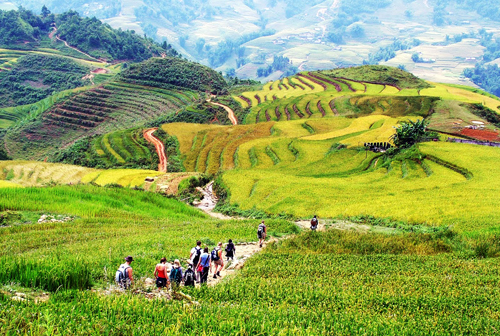
Sa Pa is best used as a gateway to H’Mong, Red Dao, Giay and Tay communities in the surrounding valleys.
5. Quynh Son Community Tourism Village
Quynh Son is an excellent choice for travelers looking beyond Vietnam’s established mountain circuit. UN Tourism recognized the Tay community as a Best Tourism Village in 2025, highlighting its architecture, cultural conservation and community tourism.
The village sits within the limestone landscape of Bac Son and contains more than 400 traditional wooden stilt houses. Many use yin-yang roof tiles and face in the same general direction, creating an unusually harmonious settlement pattern when viewed from the surrounding hills.
The population is predominantly Tay, and one unusual community detail recorded by UN Tourism is the prevalence of the family name Duong. Cultural life includes Then singing and the tinh lute, traditions tied to the spiritual and social life of Tay and Nung communities. The practice of Then was inscribed by UNESCO on the Representative List of the Intangible Cultural Heritage of Humanity in 2019.
Visitors can stay in stilt-house homestays, join village meals and listen to Then performances rather than limiting the trip to a viewpoint. The Long Tong agricultural festival adds another layer of seasonal culture.
Quynh Son remains much quieter than Sa Pa. This makes it particularly attractive to repeat visitors to Vietnam who want a community-based experience without the density of a major mountain tourism center.
6. Mai Chau
Mai Chau is one of the easiest places in northern Vietnam to combine beautiful scenery with an overnight stay in a living ethnic community. The valley is surrounded by limestone mountains and rice fields, while White Thai villages such as Lac and Pom Coong preserve a recognizable stilt-house landscape.
Traditional houses stand above the ground on wooden columns, historically providing ventilation and space for animals, tools and agricultural work below. Many families now use part of these houses for homestays while maintaining the architectural form.
Weaving is one of the most visible local crafts. Visitors can watch women work on wooden looms and compare traditional textile patterns rather than buying anonymous souvenirs in a city market. Meals commonly feature sticky rice cooked in bamboo tubes, grilled meat, local vegetables and other valley produce.
Another cultural attribute is Keng Loong, a Thai performance tradition using rhythmic wooden pestles and troughs. The practice entered Vietnam’s National Intangible Cultural Heritage list in 2023.
Mai Chau works especially well by bicycle because the valley floor is relatively flat. A slow route between Lac, Pom Coong and neighboring settlements gives travelers time to observe fields, weaving workshops and everyday village architecture. Longer Mai Chau trips can continue toward Pu Luong rather than returning directly to Hanoi.
7. Duong Lam Ancient Village
Duong Lam is one of the strongest cultural day trips from Hanoi for travelers who want to understand the traditional settlement pattern of the Red River Delta. Its historic lanes preserve laterite walls, wooden houses, communal spaces, temples, village gates and wells within a community that is still inhabited.
Laterite gives Duong Lam its distinctive visual character. The porous reddish-brown stone appears in boundary walls, gates and house foundations, producing a completely different streetscape from the timber shop houses of Hoi An or earthen architecture of Ha Giang.
Mong Phu forms the best-preserved core. Its old gate, banyan tree and communal house illustrate the traditional relationship between sacred space, social gathering and the agricultural village. Several family houses are centuries old and can be visited when residents are receiving guests.
Duong Lam is also associated with Phung Hung and Ngo Quyen, two major figures in early Vietnamese history. Temples and memorial sites dedicated to them add national history to the everyday vernacular architecture.
Walk rather than drive through the old lanes. Small-scale experiences such as tasting fermented soybean sauce, sesame sweets or tea inside a family house make more sense here than rushing through multiple monuments.
8. Tam Coc
Tam Coc has become one of northern Vietnam’s favorite bases for international travelers because a compact village sits directly inside a working rice and karst landscape. It forms part of the wider Trang An Landscape Complex, Vietnam’s first UNESCO mixed cultural and natural World Heritage property.
The defining experience begins at the Ngo Dong River. Small boats pass between rice fields and travel through three limestone caves, Hang Ca, Hang Hai and Hang Ba. Some local boat rowers are famous for propelling their oars with their feet, a technique that has become closely associated with the Tam Coc journey.
The village itself is increasingly tourism-oriented, but cycling a few minutes outside the central streets changes the atmosphere. Country lanes connect farms, lotus ponds, temples and smaller settlements framed by limestone cliffs.
Bich Dong Pagoda adds a cultural layer that many day trips rush. The complex climbs through three levels, Ha, Trung and Thuong pagodas, with part of the architecture built into the limestone mountain. Thai Vi Temple adds connections to the Tran Dynasty and the region’s medieval history.
Stay overnight if possible. Once day buses leave, Tam Coc becomes a much better base for cycling, local restaurants and slower exploration of the Ninh Binh countryside.
9. Hoi An Ancient Town
Hoi An remains Vietnam’s most complete historic trading-town experience. UNESCO inscribed Hoi An Ancient Town as a World Heritage Site in 1999 for preserving a Southeast Asian port that connected Vietnamese, Chinese, Japanese and European merchants between the 15th and 19th centuries.
The World Heritage property covers about 30 hectares and contains more than 1,100 timber-frame buildings. Merchant houses, Chinese assembly halls, family chapels, temples and markets sit within a street network shaped by centuries of commerce along the Thu Bon River.
The Japanese Covered Bridge remains the town’s most recognizable monument. Its major conservation project lasted more than 19 months and was completed in 2024, reopening the historic structure after extensive work on its timber and foundation system.
Hoi An gained another international distinction in 2023 when UNESCO admitted it to the Creative Cities Network for Crafts and Folk Art. Lantern making, woodworking, pottery and Bài Chòi performance help explain why the town remains a living cultural center rather than only an architectural relic.
Spend at least one early morning in the old streets before tour groups arrive, then return after dark when lanterns transform the riverfront.

Hoi An preserves a dense trading-port landscape of merchant houses, temples, assembly halls and family shrines.
10. Tra Que Vegetable Village
Tra Que deserves its own place rather than being treated as a minor Hoi An excursion. Located only about 3 km from the ancient town, the farming community was recognized by UN Tourism as a Best Tourism Village in 2024.
The village’s identity comes from herb and vegetable cultivation rather than monuments. Around 202 households cultivate approximately 18 hectares of farmland, supplying aromatic greens used in Hoi An cooking. Farmers traditionally enrich the soil with organic material collected from local waterways rather than relying solely on intensive chemical inputs.
Vietnam recognized Tra Que’s vegetable-growing knowledge and craft as National Intangible Cultural Heritage in 2022. For visitors, that makes the agricultural method itself the attraction.
The strongest experiences are practical. Join farmers preparing soil, planting or watering crops, then use freshly harvested herbs in a cooking session. Dishes such as tam huu, banh xeo and local salads demonstrate how a farming village directly influences Hoi An’s culinary identity.
A Tra Que village experience works particularly well by bicycle from Hoi An. Early morning and late afternoon are the most active farming periods and also avoid the strongest midday heat.

Tra Que Vegetable Village
11. Da Lat
Da Lat is larger than the other settlements on this list, but its highland character still makes it feel distinct from Vietnam’s major metropolitan cities. Pine-covered hills, flower farms, old villas, coffee estates and cool weather shaped the town as a mountain retreat rather than an industrial center.
French-era architecture remains visible across the central area. Da Lat Railway Station was designed in the early 1930s by French architects Moncet and Reveron, with three pointed roof sections commonly associated with the nearby Lang Biang mountains. Short heritage train services continue toward Trai Mat.
Da Lat’s identity is no longer defined only by colonial architecture. UNESCO admitted the city to its Creative Cities Network for Music in 2023. Contemporary music programs increasingly connect with gong traditions and the cultures of indigenous Central Highlands communities.
Coffee is another essential attribute. The surrounding highlands produce Arabica, and farm-roastery visits can take travelers through cultivation, processing and roasting rather than reducing Da Lat coffee culture to photogenic cafes.
Flowers remain equally important. The Da Lat Flower Festival continues to expand with installations, exhibitions and performances across the highland destination.

Da Lat combines highland architecture with coffee, flowers and its newer identity as a UNESCO Creative City of Music.
12. Cholon, Ho Chi Minh City’s historic Chinese quarter
Cholon is essential for travelers who want to understand the Chinese-Vietnamese communities that helped shape commerce, religion and food in southern Vietnam. The name means “Big Market”, and trade remains central to the character of the district.
Cantonese, Teochew, Hokkien, Hainanese and other Chinese communities established guild halls, temples, businesses and food traditions here over generations. Their influence is still visible in street names, religious associations and family-run shops.
Binh Tay Market is the commercial anchor, with more than 2,000 stalls and shops trading dried seafood, spices, mushrooms, fabrics, household goods and wholesale products. Early morning reveals its working-market character more clearly than a midday sightseeing visit.
Nearby Thien Hau Temple is dedicated to Mazu, the sea goddess strongly associated with southern Chinese migration. Nghia An Assembly Hall preserves Teochew religious traditions centered on Guan Yu. Large incense coils, carved altars and ceramic roof decorations make both spaces visually distinctive.
For everyday urban heritage, walk through Hao Sy Phuong and Hai Thuong Lan Ong Street, where old townhouses, herbal medicine shops and small eateries survive among newer development. Dim sum, wonton noodles, roast meats and herbal desserts make Cholon one of Vietnam’s richest neighborhoods for food-based cultural exploration.
13. Sa Dec
Sa Dec is one of the Mekong Delta’s most underrated cultural towns for international travelers. Its identity combines flower cultivation, Chinese-Vietnamese architecture, river trade and literary history within a compact urban area.
The best-known cultural site is Huynh Thuy Le Ancient House. The residence was built in 1895 and substantially renovated in 1917, combining a French-style exterior with Chinese decorative elements inside. Huynh Thuy Le later became associated with French writer Marguerite Duras and the autobiographical story behind her novel The Lover.
Sa Dec is also the Mekong Delta’s major flower-growing center. Nurseries line canals and roads around the town, creating a horticultural landscape that becomes especially vivid before Tet. During the 2025 Sa Dec Flower and Ornamental Plant Festival, the local flower-growing craft received recognition as National Intangible Cultural Heritage.
Kien An Cung Pagoda adds another layer of Chinese-Vietnamese history, while local food reflects the trading culture of the delta. Sa Dec hu tieu is one of the town’s defining dishes, built around rice noodles traditionally produced in the surrounding area.
One overnight stay allows enough time for the old house, flower village, market and a slow evening beside the Sa Dec River.
14. Chau Doc
Chau Doc is one of southern Vietnam’s richest cultural crossroads. Located near the Cambodian border and the Hau River, the town brings Kinh, Cham, Khmer and Hoa communities into a relatively compact landscape of markets, mosques, Buddhist temples and pilgrimage sites.
Across the river, Cham settlements around Chau Phong preserve Islamic religious life, stilt-house architecture and textile traditions. Mosques such as Mubarak are active places of worship, so visitors should dress modestly and treat them as community spaces rather than attractions designed for photography.
The second major cultural landscape lies around Sam Mountain. Shrines, temples and pagodas cluster on and around the mountain, with Ba Chua Xu Temple serving as the most important pilgrimage destination.
In 2024, UNESCO inscribed the Festival of Ba Chua Xu Goddess at Sam Mountain on the Representative List of the Intangible Cultural Heritage of Humanity. The festival takes place from the 22nd to the 27th day of the fourth lunar month and involves processions, offerings, ritual bathing of the goddess statue, music and community participation.
Chau Doc Market adds another cultural layer through fermented fish, freshwater fish, palm sugar and Mekong ingredients. Travelers can explore the area through a locally focused Chau Doc itinerary rather than using the town only as a transit point to Cambodia.
15. Ha Tien
Ha Tien is a fitting final stop because few Vietnamese towns combine border history, Chinese migration, Vietnamese political expansion, Khmer influence and literary culture so clearly. The settlement lies close to Cambodia in present-day An Giang Province and grew around maritime trade rather than a large modern urban economy.
The town’s historical development is closely associated with Mac Cuu, a merchant and political figure originally from Guangdong. He arrived in the region in the late 17th century and developed Ha Tien as a trading center. In 1708, the territory entered the political orbit of the Nguyen lords.
Binh San Mountain contains the Mac family temple and tomb complex. Exploring the hillside provides context for the family that shaped Ha Tien’s early political and commercial identity.
Ha Tien’s most unusual cultural attribute is literary. In 1736, Mac Thien Tich established Chieu Anh Cac, a circle of scholars whose poetry celebrated the landscapes of the region. Works associated with the group helped establish Ha Tien as an early literary center of southern Vietnam.
That heritage remains part of local cultural programming today. Visitors can combine the Mac family sites with Dong Ho Lagoon, local temples and food influenced by Vietnamese, Chinese and Khmer traditions. Ha Tien remains less polished than Hoi An or Da Lat, but its border-town character is precisely why repeat visitors find it rewarding.
How should you choose between these places?
Choose based on the cultural experience rather than scenery alone. Dong Van, Lo Lo Chai, Bac Ha and Sa Pa are strongest for northern highland cultures. Quynh Son and Mai Chau provide quieter community-based stays, while Duong Lam and Tam Coc reveal the traditional landscapes of the Red River Delta.
Hoi An and Tra Que work especially well together because one preserves a historic trading port while the other explains the agricultural heritage behind its cuisine. Da Lat offers a more contemporary highland creative culture. In the south, Cholon is strongest for Chinese-Vietnamese heritage, Sa Dec for literary and flower culture, Chau Doc for religious diversity, and Ha Tien for frontier and literary history.
Plan Your Vietnam Trip with Paradise Travel
Paradise Travel is a licensed international tour operator and destination management company. We are headquartered in Hanoi. The company has operated tours across Vietnam, Laos, Cambodia, Myanmar, and Thailand since the early 2000s. It proudly holds the TripAdvisor Travelers’ Choice Award for 2018, 2019, and 2024.
Exploring Vietnam’s cultural towns and villages requires more than connecting famous landmarks. Highland markets operate on specific days, ethnic communities are spread across remote valleys, and places such as Cholon, Sa Dec, Chau Doc and Ha Tien become much more meaningful with local historical context. A Vietnam tour can combine heritage towns, community villages, markets and private transportation according to your interests and schedule. Let our experts optimize the route with knowledgeable guides and comfortable transportation! Get in touch with our team today!

Address: 81 Alley 12 Dao Tan Street, Giang Vo Ward, Hanoi, Vietnam
Hotline: 0989391076
Email: sales@vietnamparadisetravel.com
Frequently Asked Questions

Start planning your tailor-made Southeast Asia tour by contacting one of our specialists…


Nice article Tommy. As a history lover, I love traveling to Vietnam and visit Hue. Hue became the capital city of reunified Vietnam and was the cultural and political heart of the country. As the former Imperial capital, Hue is home to the Imperial Citadel, a sprawling complex of buildings and temples where the royal family resided.
Thank you for your comment. It’s our pride to know that you love traveling to our country and enthusiastic about researching into poetic Imperial Citadel Hue.
If you have an interest in a spiritual trip to Vietnam, to know more about historical, cultural and architectural sites and to set your foot on marvelous destinations in our country, please do not hesitate to contact us.
Hope to see you in our country in the shortest time!